Found Dead on Northern San Diego Beach
Speculation of Earthquake and Tsunami Warning... No Scientific Evidence
A large deep-sea fish nicknamed the "Doomsday fish" has been spotted again off the coast of California, USA. On the 20th (local time), CNN and USA Today reported that a large deep-sea fish, often considered a bad omen, was sighted off the coast of California.
According to the Scripps Institution of Oceanography at the University of California (UC) San Diego, the carcass of a large oarfish measuring 9 to 10 feet (2.7 to 3 meters) was found on Grandview Beach, north of San Diego, on the 6th. This large oarfish can grow up to 9 meters in length and is characterized by a red head fin resembling a crown.
The oarfish usually inhabits deep waters about 900 meters below the surface, making it rarely seen by humans. However, this recent sighting marks the third time in the past three months. Previously, in August, a 3.6-meter-long oarfish was found at La Jolla Cove Beach in San Diego, and in September, another oarfish was found dead and washed ashore in Huntington Beach, Orange County, north of San Diego, and sent to a laboratory for study.
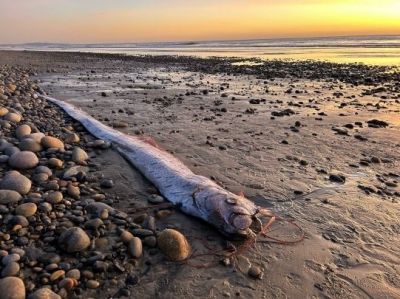
This deep-sea fish tends to leave its natural habitat when in distress, so it is extremely rare to find one alive. For this reason, it is also nicknamed the "Doomsday fish." In Japan, there is a myth that the appearance of this oarfish in shallow waters is a precursor to earthquakes and tsunamis.
According to the U.S. nonprofit environmental organization Ocean Conservancy, at least 12 large oarfish were reported off the coast of Japan in 2010, the year before the Great East Japan Earthquake in March 2011. This led to a hypothesis that seismic activity just before the earthquake caused deep-sea fish to be pushed toward the shore. However, in 2019, a study was published concluding that there is no correlation between the appearance of oarfish on beaches and earthquakes in Japan.
Regarding the recent frequent sightings of oarfish on California beaches, the Scripps Institution of Oceanography analyzed that it may be related to changes in the marine environment or an increase in the oarfish population. The researchers explained, "The recent red tide coincided with the Santa Ana winds (localized strong winds in the western U.S.) last week, and there may have been many other variables influencing this."
© The Asia Business Daily(www.asiae.co.kr). All rights reserved.
![Clutching a Stolen Dior Bag, Saying "I Hate Being Poor but Real"... The Grotesque Con of a "Human Knockoff" [Slate]](https://cwcontent.asiae.co.kr/asiaresize/183/2026021902243444107_1771435474.jpg)















