Seoul's Upward Trend Continues
Gyeonggi Stable, Incheon Declines
"Loan Regulations Reduce Momentum"
The nationwide apartment sale prices turned downward after 27 weeks. Seoul continued its upward trend, but the momentum slowed in the metropolitan area.
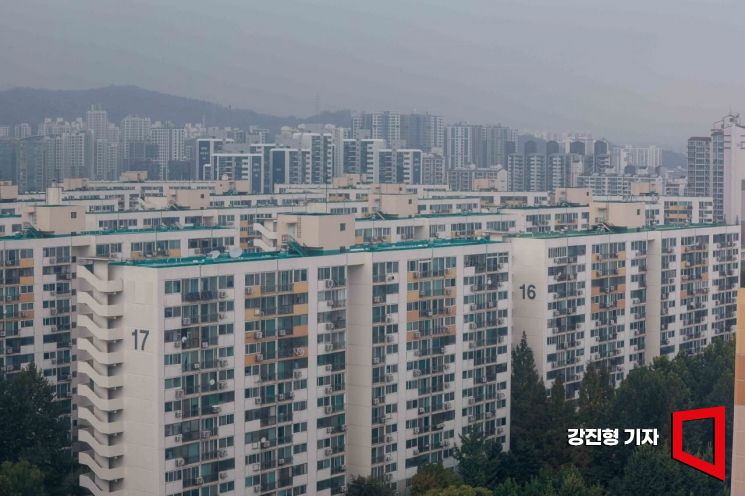
According to the Korea Real Estate Board on the 22nd, as of the third week of November (based on the 18th), nationwide apartment prices fell by 0.01% compared to the previous week. This is the first decline in nationwide apartment prices since the second week of May.
The metropolitan area rose by 0.01%. The rate of increase narrowed compared to the previous week (0.03%). Gyeonggi Province showed a flat trend (0.00%), halting the upward momentum recorded until the previous week. Incheon fell by 0.04% due to declines in old downtown areas. However, apartment prices in Seoul rose by 0.06%, continuing an upward trend for 35 consecutive weeks.
An official from the Real Estate Board explained, "It seems that tightening loans has weakened the buying power," adding, "As the decline in sale prices in local areas deepened and the rate of increase in the metropolitan area gradually shrank, nationwide apartment sale prices turned downward."
In Seoul, Gangnam-gu (0.15%), Seocho-gu (0.11%), Yongsan-gu (0.11%), and Jongno-gu (0.10%) recorded higher-than-average growth rates. Gangbuk-gu (0.01%), Dongjak-gu (0.01%), Gwangjin-gu (0.02%), Dongdaemun-gu (0.02%), and Geumcheon-gu (0.02%) showed relatively low increases. The Real Estate Board explained that popular complexes such as those undergoing reconstruction or near subway stations still have active buying inquiries, but other complexes are experiencing inventory backlogs due to a cautious stance caused by loan regulations.
In Gyeonggi Province, Gwangju (-0.19%) and Icheon (-0.17%) saw larger declines. In Gwangju, prices of older apartments in Taejeon and Yangbeol-dong fell, and in Icheon, the impact of unsold units continued.
Local areas continued their adjustment phase with a 0.04% decline compared to the previous week. The five major metropolitan cities recorded -0.05%, and the eight provinces recorded -0.03%.
Unlike sale prices, jeonse (long-term lease) prices rose by 0.03%. However, the rate of increase narrowed compared to the previous week (0.04%). The increase slowed in the metropolitan area, including Seoul (0.05% → 0.04%) and the metropolitan area overall (0.07% → 0.05%). Local areas remained flat (0.00%).
Jeonse prices in Gangnam-gu, Seoul, rose by 0.11%, and the shortage of listings continues mainly in preferred residential complexes. However, the Real Estate Board reported that in some areas, the rise was limited due to increased loan interest rates and an increase in new housing supply.
© The Asia Business Daily(www.asiae.co.kr). All rights reserved.
![Clutching a Stolen Dior Bag, Saying "I Hate Being Poor but Real"... The Grotesque Con of a "Human Knockoff" [Slate]](https://cwcontent.asiae.co.kr/asiaresize/183/2026021902243444107_1771435474.jpg)















