Seminar Hosted by Hankyung Association and Korean Broadcasting Society
Held on the 20th at FKI Tower Conference Center
Criticism of Unfairness and Issues in Fair Trade Act's Large Corporation Regulations
There has been a claim that various regulatory policies imposed on large corporations based on the current Fair Trade Act provisions are lowering the value of companies and hindering efficient management, making improvement absolutely necessary.
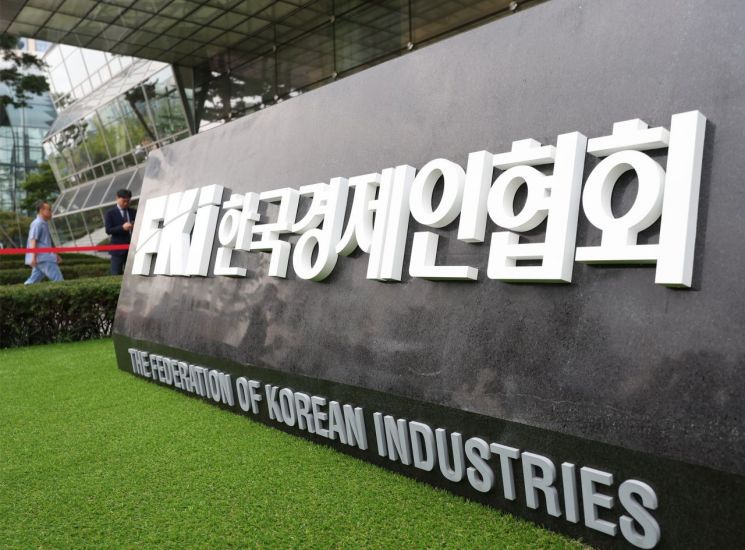
On the morning of the 20th, Professor Ji In-yeop of the Department of Economics at Dongguk University made this claim during the seminar titled "The Unfairness of Large Corporation Regulations under the Fair Trade Act and the Problems of Applying Other Laws Based on the Fair Trade Act," held at the FKI Tower Conference Center. He presented an analysis showing that regulations on large corporations are having a negative impact on our economy.
Professor Ji stated, "Since the introduction of corporate group regulations through the 1986 amendment of the Fair Trade Act, policies regarding large-scale corporate groups have become increasingly complex and diverse," adding, "Pre-regulation of the investment structure of corporate groups restricts the diversity of corporate group governance, which can undermine corporate value and management efficiency."
He continued, "From a long-term perspective, it is necessary to review the policy of designating corporate groups by comparing the benefits of increased transparency and improved governance with the costs caused by restrictions on business activities." As evidence, Professor Ji presented results from an analysis of the relationship between the 'regulation index,' which indicates the intensity of large corporate group regulations, and 'economic growth' and 'corporate value.' According to this, the stronger the regulation, the lower the growth rate of a company's market capitalization. Professor Ji emphasized, "It is necessary to be cautious about directly applying the regulatory standards set forth in the Fair Trade Act to other laws such as the Broadcasting Act," and added, "Economic realities must be scientifically reflected in large corporation policies."
At this event jointly hosted by the Korea Economic Association and the Korean Society for Broadcasting Studies, academia pointed out the reality that companies belonging to large corporate groups designated by the Fair Trade Act are facing managerial limitations and raised the need for legal amendments. The issue of the Broadcasting Act was particularly emphasized. Article 4 of the Enforcement Decree of the Broadcasting Act restricts ownership of broadcasting companies by firms belonging to large corporate groups under the Fair Trade Act. Here, the criterion for large corporations is total assets of 10 trillion won or more. Kim Chang-beom, Executive Vice Chairman of the Korea Economic Association, stated in his opening remarks, "In a situation where global competition in the media sector is accelerating, the current system for designating corporate groups under the law may become a burden for our companies," and pointed out, "It is time to consider a comprehensive overhaul of legislation so that the abundant investment resources held by large corporations can serve as a cornerstone for fostering future growth industries such as media and content."
Professor Lee Sung-yeop of the Graduate School of Technology Management at Korea University noted, "The regulation was created as an entry barrier to prevent media monopolies by large corporations in an era when media was limited to terrestrial broadcasters and newspapers," and added, "Since then, due to technological advancements and changes in the broadcasting and media market environment, including the emergence of OTT and SNS, the influence of terrestrial broadcasting on public opinion has significantly decreased." He further stated, "The possibility of large corporations monopolizing public opinion through terrestrial broadcasting has become markedly low, rendering the regulation ineffective," and argued that regulations should change in accordance with the times. He also added that, in the mid to long term, ownership restrictions on large corporations should be completely abolished at least for private broadcasters to actively support their growth into global content companies. Seon Jeong-ho, a lawyer at the law firm Kwangjang, agreed, saying, "Broadcasting policies need to consider the high level of social responsibility and social value assurance required of media companies," and noted, "It is necessary to review whether ownership regulations on broadcasters must necessarily take the form of prior entry restrictions."
© The Asia Business Daily(www.asiae.co.kr). All rights reserved.
![Clutching a Stolen Dior Bag, Saying "I Hate Being Poor but Real"... The Grotesque Con of a "Human Knockoff" [Slate]](https://cwcontent.asiae.co.kr/asiaresize/183/2026021902243444107_1771435474.jpg)















