Securing 36,500 Farms by 2029
Industry's First On-Device AI Tractor Unveiled
Daedong will actively promote the precision agriculture dissemination project next year to contribute to increasing agricultural production. Precision agriculture is a smart farming technology that provides solutions tailored to the growth status of each crop based on agricultural data, aiming to maximize the harvest of high-quality agricultural products with minimal resources.
Daedong announced on the 17th that it plans to secure 36,500 precision agriculture farms by 2029 to build a precision agriculture service ecosystem. This corresponds to about 4.0% of the estimated total domestic farms in 2029. This plan was unveiled at the ‘2024 Daedong Future Agriculture Day’ held on the 13th in the Gimje area of Jeonbuk.
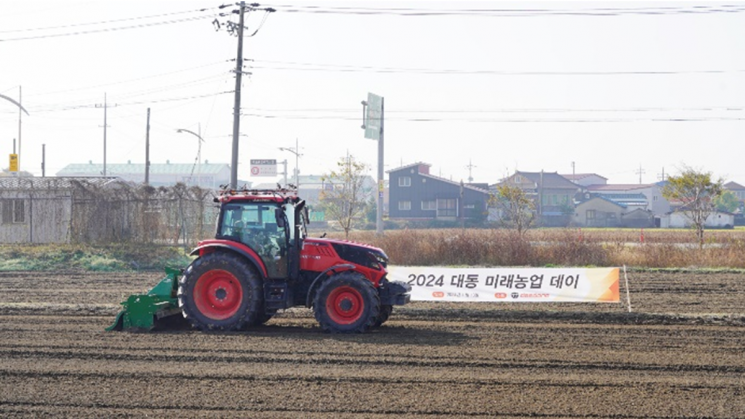 At the '2024 Daedong Future Agriculture Day' held in the Jeonbuk Gimje area on the 13th, an unmanned agricultural work tractor that does not require a person to board or operate was demonstrated. Photo by Daedong
Daedong supports efficient farming planning and improved work productivity through four products: drone-based ‘Plot Information Digitization,’ farm data analysis-based ‘Customized Farm Management Services,’ ‘Precision Agriculture Solutions’ tailored to crop growth, and a smart farm work agency platform. In this regard, in 2025, Daedong plans to provide beta precision agriculture services to domestic local governments to prove the value of the technology, and from 2026 to 2027, expand the scope to large-scale agricultural corporations such as farming cooperatives and agricultural cooperatives.
In January this year, Daedong signed an MOU with the Korea Field Management Central Federation and provided precision agriculture solutions to 12 farms cultivating rice or paddy soybeans in Gimje, Jeonbuk; Jangseong, Jeonnam; Sangju, Gyeongbuk; and Icheon, Gyeonggi, covering about 60 hectares (180,000 pyeong) of farmland. Among them, the largest-scale specialized rice farm in Gimje, Jeonbuk, was provided with precision agriculture solutions on 10 hectares (30,000 pyeong). As a result, compared to specialized farms of the same area in the same region without the solution, fertilizer usage was about 4,650 kg, 7% less, and rice harvest was about 6,100 kg, 6.9% higher. Considering that the total rice harvest in Gimje decreased by 5% compared to the previous year due to abnormal weather and pests this year, the harvest of farms using precision agriculture solutions increased by more than 16% compared to all farms in Gimje. In monetary terms, farms applying the solution saved 620,000 KRW in fertilizer purchase costs by using 7% less fertilizer, and generated 6,960,000 KRW in revenue from a 6.9% increase in rice harvest, creating an economic income of about 7.58 million KRW.
Na Young-jung, head of Daedong’s P&Biz division, said, “Based on four years of demonstration results, it is analyzed that the dissemination of precision agriculture to all domestic rice farms could create an economic effect of about 1 trillion KRW.”
At the Daedong Future Agriculture Day, the on-device AI tractor that performs autonomous farm work, scheduled for release in 2026, was also unveiled. This model corresponds to autonomous driving level 4.5 according to the agricultural machinery automation standards announced by the National Institute of Technology and Standards. By applying vision sensors and AI video technology, the camera sensors attached to the agricultural machinery autonomously recognize external environments such as farm roads, field boundaries, and obstacles, compared to existing lidar-based autonomous agricultural machinery. Additionally, technology that automatically recognizes the implement is applied to save implement setting time and autonomously generate farm work plans.
To develop the on-device AI tractor, Daedong deployed tractors for autonomous work data collection across the country and collected over 3 million agricultural environment images through more than 2,500 hours of farmland driving over two years. Daedong expects that the on-device AI tractor will reduce work time by more than 20% with high work efficiency and increase production by 5-10% through precise work.
Won Yoo-hyun, CEO of Daedong, said, “Daedong’s agricultural AI technology can be a solution to major issues threatening the sustainability of domestic agriculture, such as aging farmers, decreasing farmland, and rapid climate change,” adding, “AI in agriculture is already a global trend, and since Korea possesses a certain level of AI capability and is making national-level AI investments, Daedong will continue to strengthen its investment in agricultural AI to open the era of future agriculture.”
© The Asia Business Daily(www.asiae.co.kr). All rights reserved.
![Clutching a Stolen Dior Bag, Saying "I Hate Being Poor but Real"... The Grotesque Con of a "Human Knockoff" [Slate]](https://cwcontent.asiae.co.kr/asiaresize/183/2026021902243444107_1771435474.jpg)















