'Noise' Repeated Over 40 Times in a Single Passage
Broadcast Scripts and Online Conversation Passages Included
Also Asked About Latest AI and Deepfake Issues
This year’s College Scholastic Ability Test (CSAT) once again featured questions that bewildered test-takers. In particular, the Korean language section included a passage in which the word "noise" appeared an astonishing 45 times. On the 14th, Yonhap News reported that in the common Korean language subject reading section, the passage titled "Artificial Intelligence Diffusion Model for Video Generation," which appeared in questions 10 to 13, repeated the word "noise" more than 40 times.
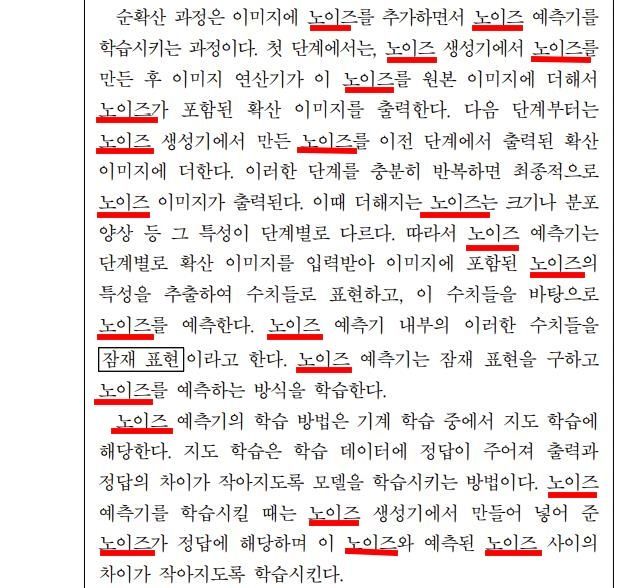 Some parts of the passages for questions 10 to 13 in the Korean language section of the 2025 College Scholastic Ability Test contained the noise expression repeated 45 times. Korean Institute for Curriculum and Evaluation website
For example, the passage contained a sentence where "noise" appeared five times: "When training the noise predictor, the noise generated and inserted by the noise generator corresponds to the correct answer, and the training aims to minimize the difference between this noise and the predicted noise." This led to posts on various online communities recalling the phrase "Rose Apartment," which repeatedly chants "apartment." There were also concerns expressed such as, "The repeated use of the word 'noise' might cause readers to lose track while reading."
The elective subject "Language and Media" featured passages 44 and 45, which included a pamphlet created by a high school student council for planning a year-end event and related online chat screens. Notably, question 45 was based on a homepage bulletin board screen constructed from the student council members’ online conversations, drawing attention. The social studies elective "Life and Ethics" also included AI as a topic, asking about the argument that "Artificial intelligence technology should be regulated by law because it reduces human jobs." The "Politics and Law" subject featured the socially problematic issue of "deepfake." It presented a series of processes showing how a country enacts laws to punish the production and distribution of false videos, followed by related questions.
Another elective subject, "Society and Culture," included a unique question featuring a passage seemingly inspired by popular ordinary-person dating programs. It introduced a script from the entertainment program "Making Connections," depicting scenes where older and younger participants introduce themselves. The cast included a programmer, a graduate student, and a broadcast producer. In "Korean Geography," a passage was taken from a broadcast script prepared by a broadcasting company before filming a documentary.
In mathematics, questions 26 to 30 in the elective subject "Calculus" were considered challenging. In particular, question 30, which tested the ability to solve problems using the differentiation of composite functions and the shape of graphs, was pointed out as difficult. Nam Yungon, head of the MegaStudy Admissions Strategy Research Institute, said, "These were problems that required one more round of thinking, so the solutions were probably not straightforward." Lee Manki of the Uway Education Evaluation Research Institute explained, "Because a trigonometric function was nested inside another trigonometric function, it was a new type of problem. Trigonometric functions themselves are tricky, and having to apply them again makes it even more difficult."
© The Asia Business Daily(www.asiae.co.kr). All rights reserved.
![Clutching a Stolen Dior Bag, Saying "I Hate Being Poor but Real"... The Grotesque Con of a "Human Knockoff" [Slate]](https://cwcontent.asiae.co.kr/asiaresize/183/2026021902243444107_1771435474.jpg)
















