Decline in Domestic Demand Leads to Decrease in Wholesale, Retail, and Construction Employment
Wholesale and Retail Sector Sees Largest Drop Since July 2021
Youth Employment Negative for 24 Consecutive Months
Number of People Taking Breaks Rises to Over 200,000 for Four Consecutive Months
The number of employed people last month increased by only 83,000 compared to the same month last year. After rising to over 100,000 since July, it fell below 100,000 again after four months. This is the result of a decrease in employment in retail and wholesale trade and construction industries due to sluggish domestic demand. The population categorized as 'resting' reached 207,000, marking the highest ever for October.
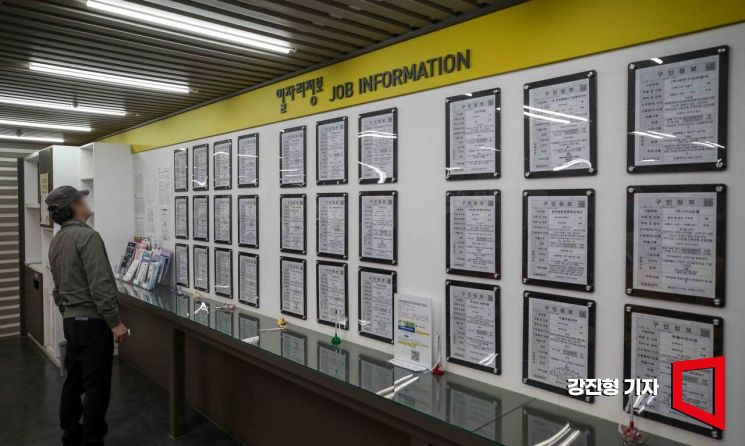 On October 13, a job seeker visiting an employment center in Seoul looked at the job postings as the number of employed people increased by 83,000 compared to the same month last year, falling below 100,000 for the first time in four months.
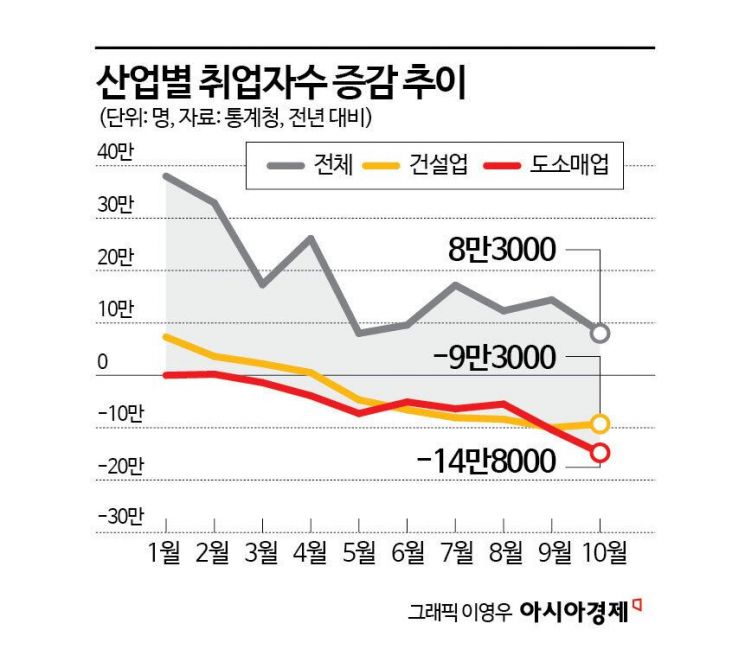
According to the 'October Employment Trends' released by Statistics Korea on the 13th, the number of employed people aged 15 and over last month was 28,847,000, an increase of 83,000 compared to the same month last year. This year, the increase was below 100,000 in May (80,000) and June (96,000), then maintained over 100,000 for three consecutive months since July (172,000), but decreased again last month. The upward trend in employment numbers has continued for 44 months since March 2021.
Last month, employment increased in health and social welfare services (97,000), education services (84,000), and professional, scientific, and technical services (77,000), but decreased in wholesale and retail trade (-148,000), construction (-93,000), and agriculture, forestry, and fisheries (-67,000). This reflects a continued negative trend in industries closely related to domestic demand.
In particular, wholesale and retail trade decreased for eight consecutive months, marking the largest decline since July 2021 (-186,000). Construction experienced its largest decline since the 2013 10th industrial classification last September (-100,000), and although the decline narrowed last month, it could not avoid a six-month consecutive decrease. Agriculture and forestry also saw employment decrease for six consecutive months, with last month's decline being the largest since September 2016 (-72,000).
Seo Un-ju, Director of the Social Statistics Bureau at Statistics Korea, explained regarding wholesale and retail trade, "The decline in retail has tended to extend to wholesale," adding, "Both wage workers and self-employed individuals have generally decreased." Regarding construction employment, she diagnosed, "General construction is directly affected by the construction market conditions, and specialized construction has been declining since May."
By age group, employment increased among those aged 60 and over (257,000), those in their 30s (67,000), and those in their 50s (12,000), but decreased among those in their 20s (-175,000) and 40s (-72,000). Employment among youth (ages 15?29) decreased by 182,000, marking 24 consecutive months of decline. The youth employment rate also fell by 0.8 percentage points to 45.6% compared to the same month last year. In contrast, the employment rate for those aged 15?64, according to the OECD standard, rose by 0.1 percentage points to 69.8% compared to the same month last year.
The number of unemployed people was 678,000, an increase of 51,000 compared to the same month last year. This was due to increases in unemployment among those in their 50s, 40s, and 20s. The unemployment rate rose by 0.2 percentage points to 2.3%. Among them, the youth unemployment rate increased by 0.4 percentage points to 5.5%.
The economically inactive population was 16,082,000, an increase of 21,000. Although it decreased in areas such as childcare (-112,000), it increased in categories such as 'resting' (207,000) and household work (50,000). In particular, the 'resting' population has been increasing by over 200,000 since July and reached a record high for October last month. The youth population among those 'resting' increased by 52,000.
The government evaluated that the difficulties of vulnerable employment groups such as construction, self-employed, and youth continue amid the adjustment process of the employment growth rate, which had significantly exceeded the long-term trend in 2022 and last year. However, considering the gradual improvement in private consumption conditions and the base effect, the government expects the employment increase to be larger this month and in December compared to last month.
Kim Beom-seok, First Vice Minister of Strategy and Finance, said at the joint meeting of the government ministries' job task force (TF) on the same day, "We will prepare the third investment activation plan within the year, including support for the operation of on-site waiting projects to create quality jobs in the private sector." He added, "To provide customized support for the struggling construction industry and self-employed, we will steadily prepare additional support measures for small business owners, such as realistic public construction costs, financial support, and revitalization of Onnuri gift certificates."
© The Asia Business Daily(www.asiae.co.kr). All rights reserved.
![Clutching a Stolen Dior Bag, Saying "I Hate Being Poor but Real"... The Grotesque Con of a "Human Knockoff" [Slate]](https://cwcontent.asiae.co.kr/asiaresize/183/2026021902243444107_1771435474.jpg)
















