Demolition of Existing Mapo Incinerator and Plan for New Facility
Seoul City: "Environmental Impact Assessment Meets Standards"
Mapo District: "Health Risks from Incineration Pollutants... Call for Cancellation"
The Seoul Metropolitan Government held a residents' briefing session regarding the new metropolitan resource recovery facility (incinerator) to be established in Sangam-dong, Mapo-gu. The city stated its position to build the new incinerator based on the environmental impact assessment concluding it is 'safe,' and to dismantle the existing facility by 2035; however, residents attending the briefing strongly opposed this, saying, "We cannot trust the Seoul Metropolitan Government."
On the 12th at 10 a.m., Seoul held a residents' briefing session on the draft environmental and climate impact assessment of the new incinerator to be established in Sangam-dong, Mapo-gu, at the reception hall of Sangam World Cup Stadium. Although the session was originally intended for 400 citizens, many seats were sparsely empty.
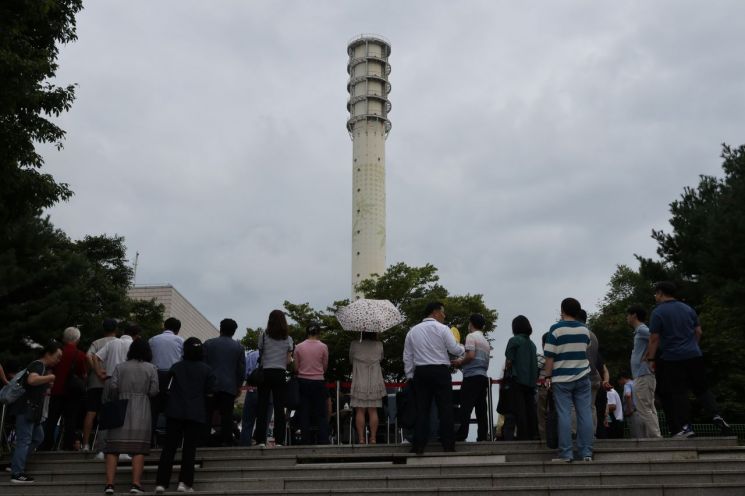
Previously, in August 2022, the city selected two plots, including 481-6 Sangam-dong adjacent to the current incinerator site, as the new location. The facility will be built on a total area of 21,000㎡, and the current incinerator is planned to be closed by 2035. A project official explained at the briefing, "The Waste Management Act, which bans direct landfill of municipal waste starting in 2026, has been amended, making it urgent to prepare countermeasures for the landfill ban," adding, "As of 2022, Seoul requires about 1,000 tons of landfill disposal, and expanding incineration facilities is essential to secure alternatives."
The city announced that the impact assessment results showed that the new incinerator would not have a significant effect on air quality or odor. It also explained that when the new facility operates, particulate matter, nitrogen dioxide, dioxins, and other pollutants all meet environmental standards. For unavoidable environmental impacts such as dust, noise, and vibration during construction, and air pollutants, wastewater, and waste generated during operation, the city has prepared mitigation measures for each item.
Seoul stated that the existing incinerator will be dismantled, leaving only the new incinerator, reflecting a concept of 'modernization.' However, citizens attending the briefing expressed strong distrust. A resident of Mapo-gu, Mr. Lee, who participated in the Q&A session, pointed out, "It is inconsistent with Seoul's policy to install an additional incinerator in a 1+1 form when there is already an existing facility."
In response, Go Seok-young, head of the Resource Recovery Facility Division of Seoul, replied, "Practically, it is not '1+1' but '1+1-1.' We build the (new) facility and close the existing one." Seoul Mayor Oh Se-hoon also stated during a city council question session in August, "The Mapo-gu incinerator was scheduled to be completed in 2026 and coexist with the existing incinerator until 2035, but construction was delayed. We have shortened the demolition period of the existing incinerator, reducing the coexistence period of the two incinerators by 5 to 6 years," adding, "From a different perspective, it will be replaced by a modernized, clean, and splendid facility that other three facilities cannot enjoy."
Mr. Lee criticized again, saying, "Who would believe that? Can you guarantee it, Director? Among the four incinerators currently in the city, the Mapo incinerator is actually the newest facility, so dismantling it in 2035 is inconsistent."
At the briefing, one citizen raised their voice after the Seoul city officials finished their explanation, saying, "The residents are outside; who are you explaining to? How is this a residents' briefing session?"
Mapo-gu: "Incineration is harmful... Existing facilities should be used if necessary"
Mapo-gu opposes the construction of the new incinerator based on the risks of incineration. On the 5th, Mapo-gu emphasized the dangers of harmful substances such as dioxins generated from incinerators at an international forum co-hosted with the Global Alliance for Incinerator Alternatives (GAIA). Professor Paul Connett, who delivered the keynote speech at the forum, cited an example where dioxin levels detected in eggs produced near the incinerator exceeded safety standards, stating, "Long-term measurements reveal much higher dioxin levels than currently detected." On the 8th, Mapo-gu also conducted a second soil contamination survey at the planned new incinerator site.
Another reason for opposition is that there is no need to build a new incinerator if the operation rates of the four incinerators in Seoul (Mapo, Gangnam, Yangcheon, Nowon) are increased to 100%. Currently, the operation rate of the four incinerators is about 80%, and if improved to 100% through facility upgrades, additional incinerators would be unnecessary. Park Kang-soo, head of Mapo District Office, said, "We will take the lead in protecting residents' health and environmental rights without compromise," adding, "If Seoul pushes forward with building an additional incinerator, it will face strong opposition from Mapo residents and cause the city's wrongful administration to attract international attention."
© The Asia Business Daily(www.asiae.co.kr). All rights reserved.
![Clutching a Stolen Dior Bag, Saying "I Hate Being Poor but Real"... The Grotesque Con of a "Human Knockoff" [Slate]](https://cwcontent.asiae.co.kr/asiaresize/183/2026021902243444107_1771435474.jpg)















