Japanese Woman in Late 40s Spends Over 50 Million Won on 3 Years of Elementary School Tuition for Daughter
6th Grade Daughter Attends Academy Classes on Weekdays, Weekends, and Holidays
New Book Highlights Reality of Public Elementary Schools Saying "School Is Not Fun"
Edu Mom Trapped in Payment Hell: "Don't Become Like Me, a Career-Interrupted Woman"
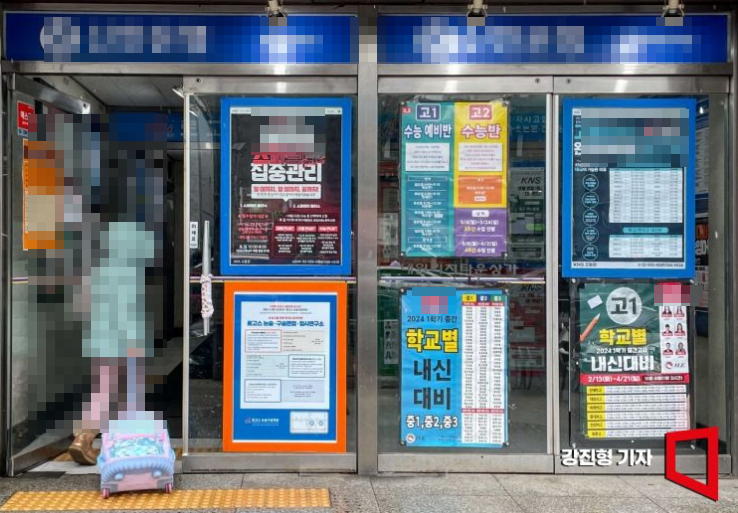 A stock photo of a child pulling a carrier while going to an academy, unrelated to the article content
Yoko Tanaka (pseudonym), a Japanese woman in her late 40s with a sixth-grade elementary school daughter, is an edumom (a mother deeply interested in her child's education). She spends over 20 million yen annually on her child to get her into a good junior high school. Her daughter attends several academies each month, paying 6,600 yen (60,000 won) per session. During summer vacation, she receives nearly 20 individual tutoring sessions each in Korean and math, enduring a total expense of 500,000 yen (5.4 million won). Tanaka says that as her daughter’s grades improve with more academy attendance, she herself has fallen into a "charging hell." For mock exams, each costs about 6,000 yen (55,000 won), and purchasing past exam questions from the schools she wants to apply to via secondhand apps costs 23 times the original price. During the third, fourth, and fifth grades of elementary school, the annual cost was 3 million yen (27.4 million won), and in the final sixth grade, it was 2.5 million yen (23 million won). In total, more than 5.5 million yen (50 million won) was spent on academy fees.
Her daughter also follows a tight daily schedule. On weekdays, she studies at the academy twice from 4:30 p.m. to 9 p.m., and after returning home from school at 3:30 p.m., she eats a rice ball in 15 minutes and rushes to the academy. She returns home around 10 p.m., has dinner, takes a bath, reviews academy lessons, and falls asleep at midnight. She wakes up at 6 a.m., solves academy workbooks, and goes to school. On days off, she completes academy homework and receives individual tutoring, attending the academy until 7 p.m. on Saturday afternoons as well. On Sundays, she studies for 10 hours a day while doing academy homework. At the academy, classes and seating are determined monthly based on academic rankings, causing significant pressure every month about which class and seat she will occupy. She has no time to do school homework because she is overwhelmed with the vast amount of academy homework.
Tanaka sometimes does school homework on behalf of her daughter. She says, "I manage her schedule like a manager. Honestly, I have to consider cost-effectiveness. I worry about what will happen if I spend 5 million yen and she only gets into a low-level school. If it can be solved with money, I want to pay as much as possible to ensure she passes. Entrance exams are ultimately a matter of technique. As long as she can solve the problems, that’s enough."
On the 11th, the Japanese media outlet "Gendai Business" introduced a recent book gaining attention in Japan titled "Report: School is Boring." This book reveals the reality of educational disparity reproduction occurring in public elementary schools nationwide and questions the true essence of education. The media focused on the inside story of edumoms trapped in charging hell. Previously, Tanaka worked full-time after graduating from university but had to quit due to overwork at a black company (a company notorious for labor exploitation). Afterwards, she worked as a non-regular employee and could not find a good job. The media reported, "The parent generation who experienced the employment ice age has directly witnessed such disparities and the increase in non-regular employment, so Tanaka decided on junior high school entrance exams hoping her daughter would have a job that allows economic independence." Tanaka said, "I think junior high school entrance exams offer opportunities if you try hard, even if you are not particularly smart," adding, "I advise my daughter that science is better than humanities and we are visiting universities. I hope she becomes a stable public servant in the future." The media noted that the entrance exam industry is booming, understanding the hearts of parents who want their children to attend good schools and work at good companies.
According to the media, the employment rate for university graduates, which was 80% in the 1980s, sharply declined after the bubble burst in 1991. In 2000, it fell below 60% to 55.8%, reaching a low of 55.1% in 2003. Economic crises such as the bubble collapse, financial instability, IT bubble burst, Lehman shock, and the 2020 COVID shock have changed the employment market. From the late 1990s, the proportion of non-regular employees increased, rising from 20.2% in 1990 to 37% in 2023. The rate of non-regular employment among women is higher than men, reaching about 50% in 2023. As of 2023, the average annual salary is 4.6 million yen (42 million won) overall, with regular employees averaging 5.3 million yen (48 million won) and non-regular employees averaging 2.02 million yen (18 million won). Male regular employees earn 5.94 million yen (54 million won), non-regular males earn 2.69 million yen (25 million won), female regular employees earn 4.13 million yen (38 million won), and non-regular females earn 1.69 million yen (15 million won).
© The Asia Business Daily(www.asiae.co.kr). All rights reserved.
![Clutching a Stolen Dior Bag, Saying "I Hate Being Poor but Real"... The Grotesque Con of a "Human Knockoff" [Slate]](https://cwcontent.asiae.co.kr/asiaresize/183/2026021902243444107_1771435474.jpg)
















