Establishing Legal Basis for Direct Subsidies
Key to Bill Implementation and Substantial Change
The People Power Party's 'Special Semiconductor Act,' proposed on the 11th, received a generally positive response from the related industry. Considering that global competitors such as the United States and Taiwan are providing astronomical subsidies, a carrot policy is necessary for us to secure competitiveness as well. This bill includes provisions to exempt semiconductor research and development (R&D) personnel from the 52-hour workweek limit and to enable direct government subsidies to semiconductor companies. However, since similar bills in the past were only discussed and never implemented, there is also considerable caution that the bill's progress must be closely monitored until the end.
The industry first praised the establishment of a legal basis for direct subsidies to semiconductor companies. An industry official said, "Currently, support is limited to indirect measures such as loans or tax credits," adding, "If the bill passes, it will help reduce the financial burden on domestic semiconductor companies competing globally." Another official said, "The domestic semiconductor industry is moving in a direction that helps it gain an advantage in global competition," and "We hope that the bill's proposal will lead to more discussions and revisions, resulting in substantial changes."
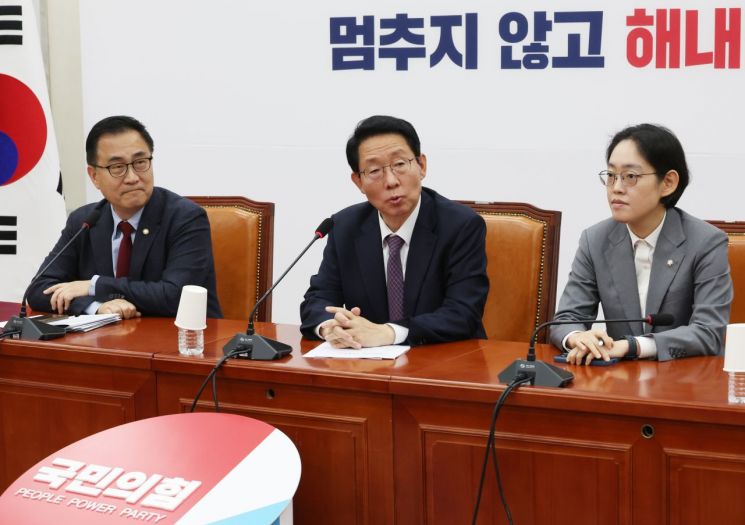 Kim Sang-hoon, Chairman of the Policy Committee of the People Power Party (center), is speaking at a press briefing held at the National Assembly on the 10th. Chairman Kim stated, "We will submit the coordinated content with government ministries tomorrow (the 11th)" and added, "We aim to pass it in the plenary session by the 28th through bipartisan agreement." Photo by Yonhap News.
However, there was disappointment regarding the exclusion of the 'increase in tax credit rates for semiconductor R&D facility and equipment investments' from the bill. R&D facilities and equipment investments are major investment areas in the semiconductor industry, with most expenses concentrated in this sector.
An industry official said, "R&D facilities and equipment investments are areas where companies actually spend significant costs," adding, "Given the nature of large-scale equipment investments continuing even after factory construction, increasing the tax credit rate in this area would provide practical help to the industry." However, they added, "Since the tax benefits are not yet significantly different from those of other countries, further detailed discussions will be necessary."
Another official said, "It is common for amendments and supplements to be made after the bill is proposed," adding, "What is important is that this bill is actually implemented and brings substantial changes to support the semiconductor industry."
The ruling party included the exemption of semiconductor R&D personnel from the 52-hour workweek limit, which the semiconductor industry had hoped for, in the bill. However, since the opposition party, the Democratic Party of Korea, holds a conservative stance, difficulties are expected in passing the bill.
An industry official said, "The direction of this special bill to practically strengthen support for the semiconductor industry is clearly positive," but also pointed out, "Similar bills have been proposed in the past but were often used only as political tools and faded away." They added, "It is necessary to observe whether it will be practically implemented."
© The Asia Business Daily(www.asiae.co.kr). All rights reserved.
![Clutching a Stolen Dior Bag, Saying "I Hate Being Poor but Real"... The Grotesque Con of a "Human Knockoff" [Slate]](https://cwcontent.asiae.co.kr/asiaresize/183/2026021902243444107_1771435474.jpg)















