Seoul City Passes Redevelopment Plans for 3 Sites at Dogyewi
Increases Housing Units by 507 Compared to Existing Through Floor Area Ratio Increase
A total of 8,000 households will be supplied in the areas of Nowon, Geumcheon, and Guro districts in Seoul. This is the first case where the profitability correction coefficient was applied, increasing the floor area ratio and adding more than 500 households compared to the original plan. It is estimated that the members' contribution will decrease by up to 100 million KRW.
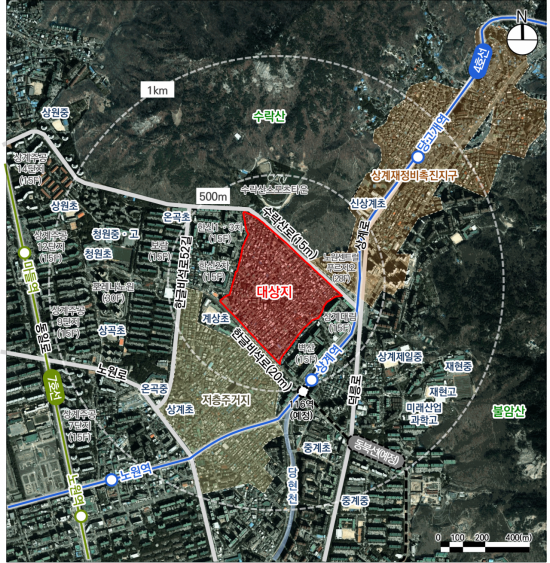
On the 6th, Seoul City held the 15th Urban Planning Committee meeting and announced on the 7th that it had approved with modifications three cases including the redevelopment of 154-3 Sanggye-dong, Nowon-gu, the redevelopment of 871 Siheung 1-dong, Geumcheon-gu, and the reconstruction maintenance plan for Daehung, Seongwon, and Dongjin Villa in Guro-gu, along with landscape review.
The sites were the first to apply the profitability improvement measures newly included in the city's '2030 Urban and Residential Environment Maintenance Basic Plan (Residential Environment Maintenance Section),' such as the profitability correction coefficient and recognition of the current floor area ratio. The profitability correction coefficient is a multiplier applied to the allowable incentive amount and is used as a means to enhance the profitability of maintenance project sites with low profitability. The lower the land price, the higher the correction coefficient, thus benefiting from profitability advantages. Previously, the correction coefficient was applied only up to 1.0 (maximum incentive of 20 percentage points), but the city expanded this coefficient up to 2.0 (maximum incentive of 40 percentage points).
The three sites that passed this review also had significantly lower official land prices compared to the Seoul city average, so they received the maximum profitability correction coefficient of 2.0. As a result, they were granted a higher floor area ratio than before applying the correction coefficient, increasing the number of households by 507 compared to the original plan.
The 154-3 Sanggye-dong area in Nowon-gu is expected to be transformed into a large apartment complex with 26 buildings under 39 floors, totaling 4,591 households through redevelopment. The city upgraded the zoning from Type 2 (up to 7 floors) to Type 3 General Residential Area. The profitability correction coefficient was calculated at 1.96, increasing the allowable floor area ratio incentive to 39.2%. The number of saleable households increased by 332 (from 1,216 to 1,548) compared to the public inspection plan. In this case, the estimated contribution per member is expected to decrease by about 72 million KRW on average.
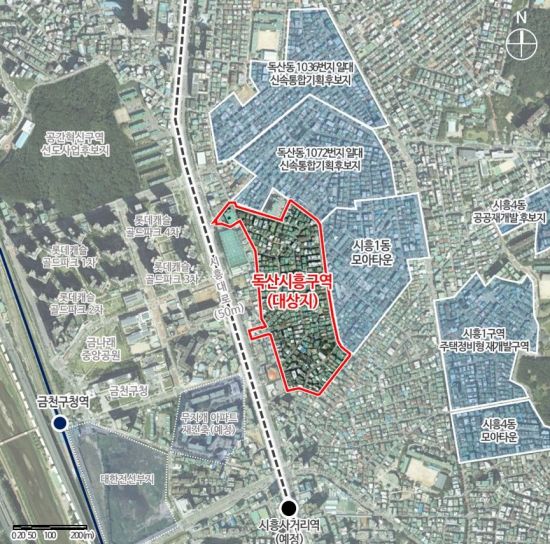
The 871 Siheung 1-dong area in Geumcheon-gu, a rapid integrated planning redevelopment candidate site as of December 2022, will have 16 buildings under 45 floors, totaling 2,072 households after this review. The Type 1 and Type 2 (up to 7 floors) General Residential Areas were upgraded to Type 2 (up to 7 floors) and Type 3 General Residential Areas, respectively. The profitability correction coefficient was also calculated at 1.88, significantly increasing the allowable floor area ratio incentive from 20% to 37.6%. As a result, the number of saleable households increased by 57 (from 773 to 830) compared to the residents' public inspection plan. Applying this, the estimated contribution per member is expected to decrease by about 45 million KRW on average.
Daehung, Seongwon, and Dongjin Villa in 45-32 Onsu-dong, Guro-gu, will be rebuilt into an apartment complex with 15 buildings under 45 floors, totaling 1,455 households. The zoning was upgraded from Type 2 General Residential Area to Type 3 General Residential Area, and the profitability correction coefficient was calculated at 2.0, raising the allowable floor area ratio incentive to 40%. The social welfare facility within the site, a sheltered workshop for the disabled, was recognized as a strategic fostering use facility, and the maximum floor area ratio incentive building coefficient of 1.0 was also applied, further increasing the floor area ratio. Through this, the number of saleable households increased by 118 (from 1,255 to 1,373) compared to the public inspection plan. The estimated contribution per member is expected to decrease by about 100 million KRW on average.
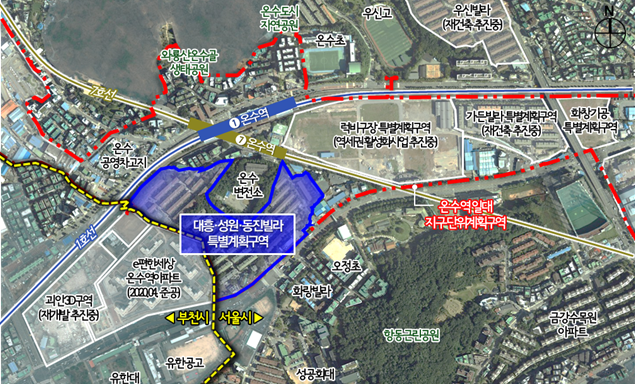
This area was designated as a maintenance zone in 2014, but due to low profitability and rising construction costs, residents' burdens increased, and the project made no progress for over 10 years. Although it is adjacent to Bucheon City in Gyeonggi Province and serves as a gateway to the western side of Seoul, development was delayed, leaving it relatively underdeveloped. However, with the significant improvement in profitability this time, reconstruction is expected to accelerate. Previously, Seoul Mayor Oh Se-hoon and Minister of Land, Infrastructure and Transport Park Sang-woo visited the site and promised to expedite the maintenance project.
Han Byung-yong, Director of the Housing Office, said, "To expand stable housing supply, the city has carefully prepared the profitability improvement measures system and will promptly apply it to all ongoing sites so that residents can fully benefit. We will actively support this." He added, "We expect that existing areas or new regions that had difficulty securing profitability will gain momentum in promoting maintenance projects."
© The Asia Business Daily(www.asiae.co.kr). All rights reserved.
![Clutching a Stolen Dior Bag, Saying "I Hate Being Poor but Real"... The Grotesque Con of a "Human Knockoff" [Slate]](https://cwcontent.asiae.co.kr/asiaresize/183/2026021902243444107_1771435474.jpg)

















