Anna Burns, 2018 Booker Prize Winner, Visits Korea for the First Time
Receives the 8th Lee Ho-cheol Unification Road Literary Award
"We Share the Pain of Korea and Northern Ireland"
"When coming to Korea, I brought books by Han Kang. I have read two of her books and am currently reading a third. If I have the opportunity, I would like to meet Han Kang in person."
Anna Burns, author of the 2018 Booker Prize-winning novel "Milkman," has visited Korea. Burns said she has read Han Kang's novels "Human Acts" and "The Vegetarian," and is currently reading "The White Book." She commented, "I think she is an outstanding writer," adding, "Her works are brutal and chilling at times, but emotions such as hatred are depicted in a very realistic and skillful way."
Burns visited Korea to attend the 8th Lee Ho-cheol Unification Road Literary Award ceremony. This year, she is the recipient of the main award.
At a press conference held on November 6 at the Korea Press Center in Jung-gu, Seoul, Burns said it was her first visit to Asia. Regarding her first impression of Seoul, she remarked, "The most striking thing is how incredibly kind people are and how courteous the drivers are. In Northern Ireland or London, you constantly hear car horns blaring."
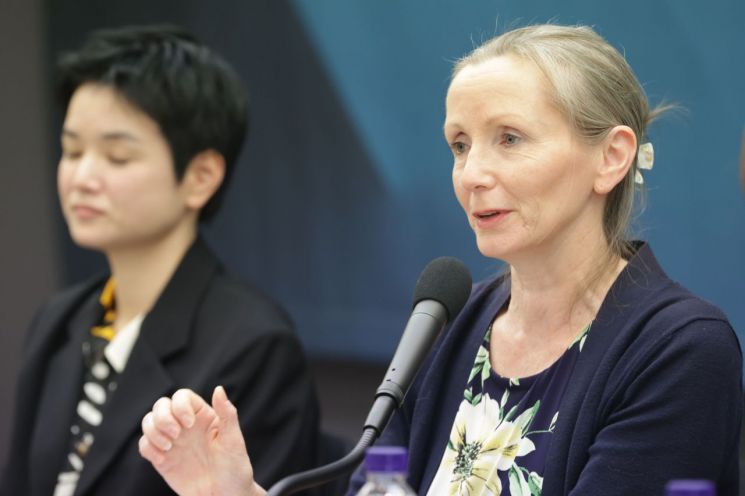 Anna Burns (right) and writer Kim Mella are expressing their acceptance speeches for the main award at the '8th Lee Ho-cheol Unification Road Literary Award Main and Special Award Winners Press Conference' held on the morning of the 6th at the Press Center in Jung-gu, Seoul.
 Photo by Yonhap News
Burns was born in 1962 in Belfast, the capital of Northern Ireland. Northern Ireland is a region that separated from predominantly Catholic Ireland in 1921, centering around pro-British Protestants. From the late 1960s until the signing of the Good Friday Agreement (Belfast Agreement) in 1998, the region suffered through what is known as "the Troubles," during which over 3,500 people lost their lives as pro-British (Protestant) and pro-Irish (Catholic) factions clashed violently for about 30 years.
Burns stated, "I believe Northern Ireland and Korea share a history of pain," adding, "That is why receiving the Lee Ho-cheol Unification Road Literary Award is so deeply moving for me."
Drawing from her childhood experiences, Burns wrote novels such as "No Bones" and "Milkman," and in 2018, she won the Booker Prize for "Milkman."
"Milkman is the story of a girl who loves reading and running. However, the 1970s, when the girl lived, was a time when the Troubles continued, and even in her neighborhood, enemies stood in extreme opposition on either side of a single street. The girl, out of fear from being watched and stalked, tries to hide and gradually loses her sense of identity."
Burns said that the circumstances faced by the girl in her novel closely resemble her own upbringing. She explained, "During my childhood, violence and threats were a constant part of life. Because I grew up in such a violent environment, I never truly experienced what peace was."
"Northern Ireland is a small region, but there were countless checkpoints, barriers, and armed groups. The situation was so brutal that it could be called madness. People would even cross through water to avoid those checkpoints, and such circumstances were truly horrific. I have never lived in Korea, so I do not know the situation here in detail. However, I believe that division itself is a terrible and tragic thing for both Korea and Northern Ireland."
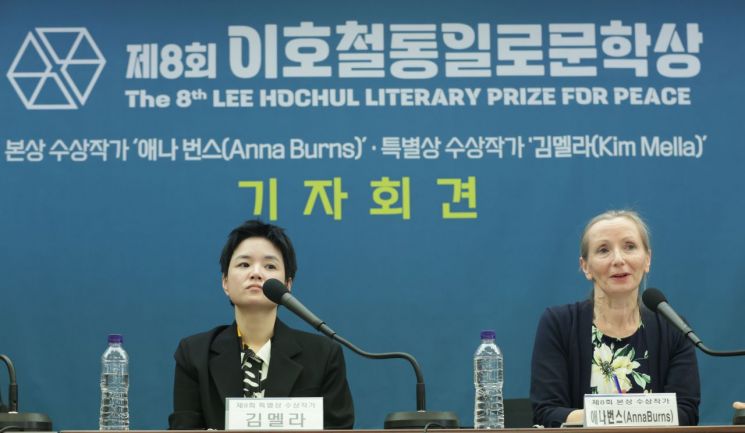 Anna Burns (right) and writer Kim Mella are expressing their acceptance speeches for the main award at the '8th Lee Ho-cheol Unification Road Literary Award Main and Special Award Winners Press Conference' held on the morning of the 6th at the Press Center in Jung-gu, Seoul.
 Photo by Yonhap News
The Lee Ho-cheol Unification Road Literary Award was established in 2017 by Eunpyeong District to carry on the literary spirit of Lee Ho-cheol (1932-2016), a master of division literature, and to envision together the future era of unification and peace that he hoped for. Lee Ho-cheol had a special connection to Eunpyeong District, having written there for over 50 years. The award is divided into a main prize and a special prize. The main prize is given to a living writer, regardless of language or nationality, who has demonstrated efforts to overcome conflicts, disputes, and violence on a global scale. The special prize is awarded to a domestic writer. Winners of the main and special prizes receive a plaque and prize money of 50 million won and 20 million won, respectively. This year's special prize went to Kim Mella for her debut full-length novel, "The High Sense of the Nonexistent Floor," published last year.
"The High Sense of the Nonexistent Floor" tells the story of a grandmother, Sagwija, and her granddaughter, Acerola, who live together in Namsan Village. Sagwija lives in hiding due to her experience of being falsely accused as a spy during the era of military dictatorship.
Writer Kim Mella explained that she did not directly depict the state violence that historically occurred in Namsan.
"When I think of Namsan, the Namsan Tower or Namsan Library first come to mind. However, historically, there was a national intelligence agency below Namsan, and I learned from books and materials that much state violence took place there. While writing the novel, researching, and interviewing victims of state violence, I thought a lot about these issues, but I could not write about them in detail. Not only did I lack direct experience, but I also felt I could not bear to describe or narrate torture and violence. I portrayed Sagwija as a character whose life was changed simply by the terror of even wandering near those places, just as I would be."
She said, "Reading the novels of Lee Ho-cheol and Anna Burns was a deeply meaningful experience. It made me reflect sincerely on what it means to write as an author and what it means to embrace history and transform it into narrative. That experience of reading is what gives this award its great significance."
© The Asia Business Daily(www.asiae.co.kr). All rights reserved.
![Clutching a Stolen Dior Bag, Saying "I Hate Being Poor but Real"... The Grotesque Con of a "Human Knockoff" [Slate]](https://cwcontent.asiae.co.kr/asiaresize/183/2026021902243444107_1771435474.jpg)
















