Measurement Results Show Blood Alcohol Concentration at License Revocation Level
Police Investigating Accident Consider Applying Special Act
An internet personal broadcaster (BJ) who caused a drunk driving accident and even streamed it live on social networking services (SNS) was caught by the police. On the 5th, the Bupyeong Police Station in Incheon announced that a woman in her 20s, A, was booked without detention on charges of drunk driving under the Road Traffic Act. BJ A is accused of driving a car in a heavily intoxicated state and crashing into a passenger car ahead on a road in Bupyeong-gu, Incheon, around 12:40 a.m. on the 1st. Immediately after the accident, she conducted a live broadcast on SNS, saying, "I drove drunk," "(The victim) tried to extort money. I won't settle and will go to prison," and incoherently stated, "I pay the country money (fines), but I won't pay money to those trash (victim) couples."
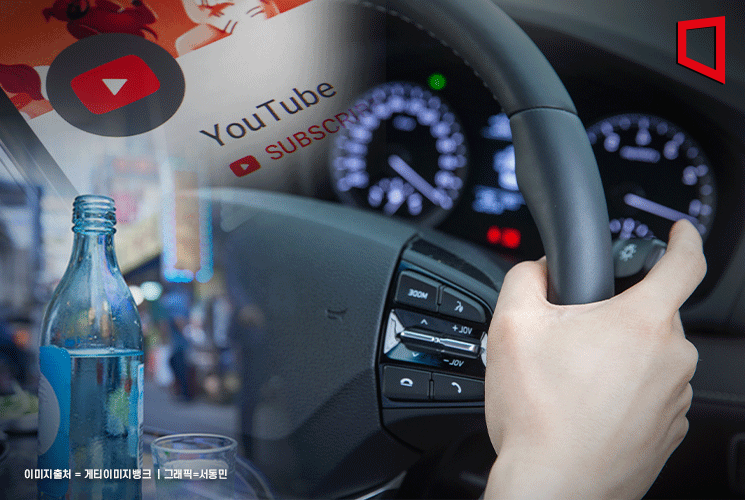 An internet personal broadcaster (BJ) who caused a drunk driving accident and even streamed it live on social media (SNS) was caught by the police. On the 5th, the Bupyeong Police Station in Incheon announced that a woman in her 20s, Ms. A, was booked without detention on charges of drunk driving under the Road Traffic Act.
 [Photo by Asia Economy]
The broadcast also live-streamed the police arriving at the scene after receiving a 112 report from the victim and conducting a breathalyzer test on A. At that time, A's blood alcohol concentration was 0.233%, a level that cancels her license. After being sent home by the police, A continued to make secondary victimizing remarks toward the victim during her subsequent live broadcasts. She said to the victim, "You look like you don't even have money," and "I already hit you; I should have just killed you. Just kidding."
In response to some viewers criticizing her behavior, A retorted, "People are alive, aren't they? No one got hurt," "Am I the only one who drives drunk? Everyone does it," and "Why are you acting so nice?" The police are investigating the specific circumstances of the incident based on on-site closed-circuit television (CCTV) and vehicle black box footage. A police official stated, "We will check the extent of the victim's injuries to determine whether to apply charges of dangerous driving causing injury under the Act on the Aggravated Punishment of Specific Crimes."
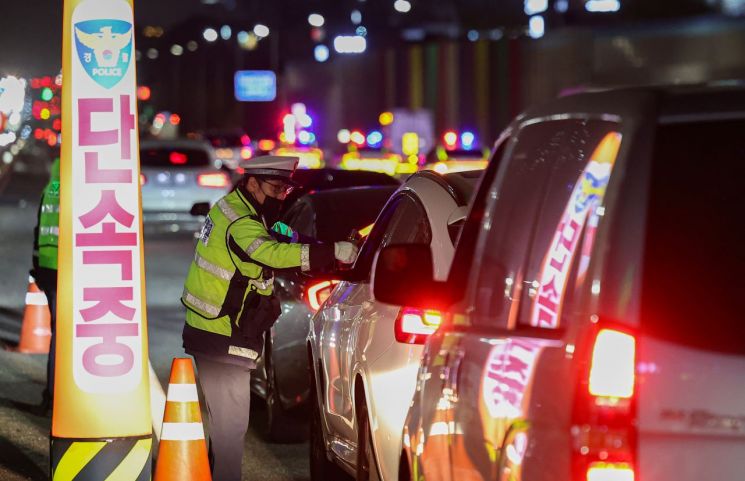 Meanwhile, the National Police Agency, in cooperation with the autonomous police committees of each city and province, will conduct a "Year-end and New Year Special Crackdown on Drunk and Drugged Driving" targeting automobiles and personal mobility devices for three months from the 1st of this month to January 31 of next year. Earlier, on the 31st of last month, the police announced that to raise awareness about drunk driving, the usual year-end and New Year drunk driving crackdown, which typically took place over two months starting in December, will be expanded this year to three months starting from November.
 [Photo by Yonhap News]
Meanwhile, the National Police Agency, in cooperation with local autonomous police committees, is conducting a "Year-end and New Year Special Crackdown on Drunk and Drugged Driving" targeting automobiles and personal mobility devices for three months from the 1st of this month to January 31 of next year. Previously, on the 31st of last month, the police announced that to raise awareness about drunk driving, the usual two-month year-end and New Year drunk driving crackdown starting in December would be expanded to three months starting in November this year. Under the National Police Agency's supervision, nationwide crackdowns are conducted at least twice a week by each provincial police agency, with simultaneous regular and occasional crackdowns by region. To enhance the effectiveness of the crackdown, mobile checkpoints that move locations unpredictably will also be operated. Notably, this year, drugged driving crackdowns will be conducted for the first time.
Even when there is suspicion of drinking but no alcohol is detected, or when crackdowns occur near clubs or entertainment bars, the purpose is to check for possible drug use. Abnormal driving behaviors such as speeding, reckless driving, or zigzag driving, the degree of eye redness, and movements when exiting the vehicle will be closely observed. If drugged driving is suspected, saliva-based rapid drug tests will be actively conducted with the driver's consent. Even without the driver's consent, if there is clear evidence of drugged driving, a warrant will be obtained to conduct a detailed examination. According to statistics from the National Police Agency, last year, the number of drunk driving arrests was 39,255 at the license suspension level and 90,895 at the license cancellation level, totaling 130,150 cases, a 12% increase compared to two years ago. Last year, there were 13,042 drunk driving traffic accidents, resulting in 159 deaths and 20,628 injuries.
© The Asia Business Daily(www.asiae.co.kr). All rights reserved.
![Clutching a Stolen Dior Bag, Saying "I Hate Being Poor but Real"... The Grotesque Con of a "Human Knockoff" [Slate]](https://cwcontent.asiae.co.kr/asiaresize/183/2026021902243444107_1771435474.jpg)
















