[US Election 2024]
Electoral College: Harris 270 vs Trump 268
The prediction for the outcome of the U.S. presidential election remained tied until election day.
According to the U.S. presidential election result prediction model by the British current affairs weekly The Economist on the 5th (local time), the final predicted winning probabilities (as of the 4th) for Republican former President Donald Trump and Democratic Vice President Kamala Harris were tied at 50-50.
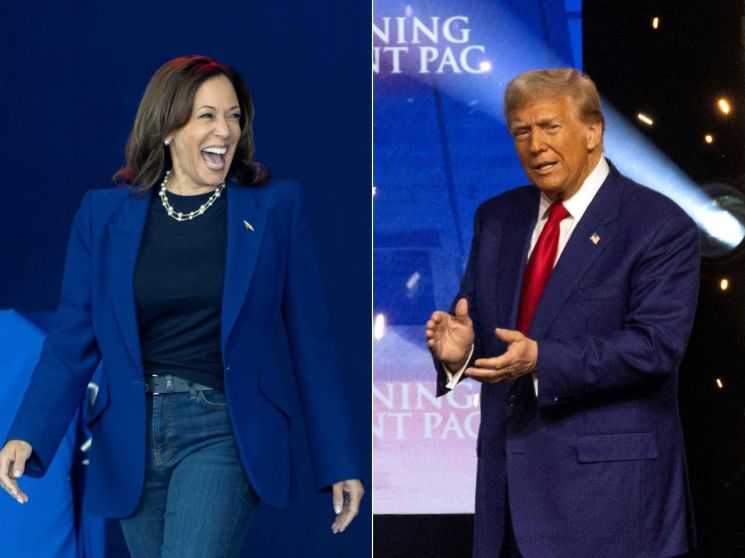 Vice President Kamala Harris (left), a candidate in the U.S. presidential election, and former President Donald Trump [Image source=AFP Yonhap News]
This prediction model means that if the election were held 100 times, former President Trump and Vice President Harris would each win 50 times.
However, looking at the final trend, Vice President Harris showed a short-term upward momentum. Harris's winning probability increased by 1 percentage point compared to the previous day, while former President Trump's decreased by 1 percentage point.
Compared to the winning probabilities a week ago, Vice President Harris rose by 5 percentage points, while former President Trump fell by 5 percentage points.
In The Economist's prediction model, Vice President Harris and former President Trump were tied at 50-50 on the 10th and 11th of last month. Harris then took the lead until the 19th, when former President Trump reversed the lead with 51% to Harris's 49%. Trump maintained the lead for about ten days before the prediction returned to a 50-50 tie on the 30th of last month. Since then, the race has been neck and neck with back-and-forth shifts.
Although the final predicted winning probabilities are tied, the median expected number of electoral votes is slightly in favor of Vice President Harris (270) over former President Trump (268).
In the U.S. presidential election, a candidate must secure a majority of at least 270 out of the total 538 electoral votes to win.
The Economist's election prediction model was developed in collaboration with Columbia University and simulates results by incorporating state-level polls along with external factors such as local economic statistics, past election results, and demographic characteristics.
© The Asia Business Daily(www.asiae.co.kr). All rights reserved.
![Clutching a Stolen Dior Bag, Saying "I Hate Being Poor but Real"... The Grotesque Con of a "Human Knockoff" [Slate]](https://cwcontent.asiae.co.kr/asiaresize/183/2026021902243444107_1771435474.jpg)















