Urgent Need to Renew Licenses for Aging Nuclear Plants
10 Nuclear Reactors to Reach End of Life by 2030
Passage of High-Level Radioactive Waste Special Act Also Urgent
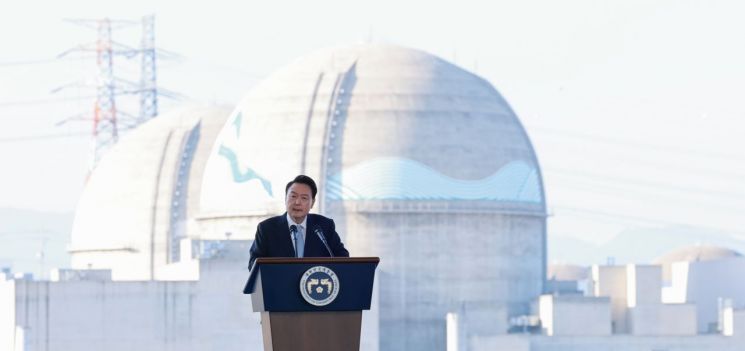 President Yoon Suk-yeol delivers a congratulatory speech at the 'Comprehensive Completion Ceremony of Shin Hanul Nuclear Power Plant Units 1 and 2 and Groundbreaking Ceremony of Units 3 and 4' held at the Korea Hydro & Nuclear Power Hanul Nuclear Power Headquarters in Uljin-gun, Gyeongbuk on October 30, 2024. Photo by Yonhap News.
"The scale of the construction itself is enormous, requiring as much rebar as that used in building 40 Lotte World Towers."
On the 30th, at the Shin Hanul Units 1 and 2 comprehensive completion and Shin Hanul Units 3 and 4 groundbreaking ceremony held at the Korea Hydro & Nuclear Power Hanul Nuclear Power Headquarters in Uljin, Gyeongbuk, Minister of Trade, Industry and Energy An Deok-geun responded this way when President Yoon Suk-yeol said, "Nuclear power plants support an entire city." The comprehensive completion and groundbreaking ceremony held that day is significant as it marks the normalization of the nuclear power ecosystem, which had been halted under the previous Moon Jae-in administration's nuclear phase-out policy.
Shin Hanul Unit 1 began commercial operation in January 2022, and Unit 2 started in April this year, completing the construction project of the two nuclear power plants built as a pair. These are the 27th and 28th nuclear power plants to begin commercial operation in South Korea and the seventh nuclear power plant to apply the next-generation Korean-designed reactor (APR1400), which is also an export-type nuclear power plant.
Shin Hanul Units 3 and 4 had already received power generation business permits but were halted for five years from 2017 due to the previous administration's nuclear phase-out policy, becoming a symbol of the nuclear phase-out. The domestic nuclear power industry faced a near-collapse as work dried up over the past five years, but with the resumption of nuclear power plant construction, it is gradually regaining momentum.
President Yoon decided to resume construction of Shin Hanul Units 3 and 4 in July 2022 as part of the new government's energy policy direction to normalize the shrinking nuclear power industry. Subsequently, 11 related ministries including the Ministry of Trade, Industry and Energy, and local governments such as Gyeongsangbuk-do and Uljin County approved the implementation plan within 11 months. Normally, nuclear power plant construction permits take more than 30 months, but this was completed in just 11 months. The Nuclear Safety and Security Commission also pushed for intensive consultations and reviews on the suspended construction permit review and approved the construction permit on September 12, allowing the resumption of construction for Shin Hanul Units 3 and 4.
The government explained that it has supplied a total of 8.7 trillion won worth of work orders since the new administration, including 2.4 trillion won in 2022, 3 trillion won in 2023, and 3.3 trillion won this year, to restore the nuclear power ecosystem. Nuclear power industry sales have also steadily increased, from 21.6 trillion won in 2021 to 25.4 trillion won in 2022, and 32.1 trillion won in 2023. Investment by nuclear power companies (excluding KHNP) was only 143.8 billion won in 2021 but rose significantly to 488 billion won in 2023.
However, there are still many challenges to restoring the nuclear power ecosystem. First, the continued operation of nuclear power plants whose design life has expired is a formidable challenge. Currently, when a nuclear power plant reaches the end of its 30 or 40-year design life, it must undergo a re-evaluation by the Nuclear Safety and Security Commission to decide whether to continue operation. Kori Unit 1 and Wolsong Unit 1 were permanently shut down after completing 40 years of operation in 2017 and 2019, respectively.
At the event on the 30th, President Yoon said, "Currently, Kori Units 2 and 3 are halted, and by the year after next, a total of five nuclear power plants will be stopped," emphasizing, "We need to revise the system to allow continued operation of nuclear power plants confirmed to be safe by referring to advanced overseas cases."
By 2030, a total of 10 nuclear power plants will reach the expiration of their initial operating licenses. These include Kori Units 2 to 4, Wolsong Units 2 to 4, Hanul Units 1 and 2, and Hanbit Units 1 and 2. The five nuclear power plants President Yoon mentioned refer to Kori Units 2, 3, and 4, and Hanbit Units 1 and 2.
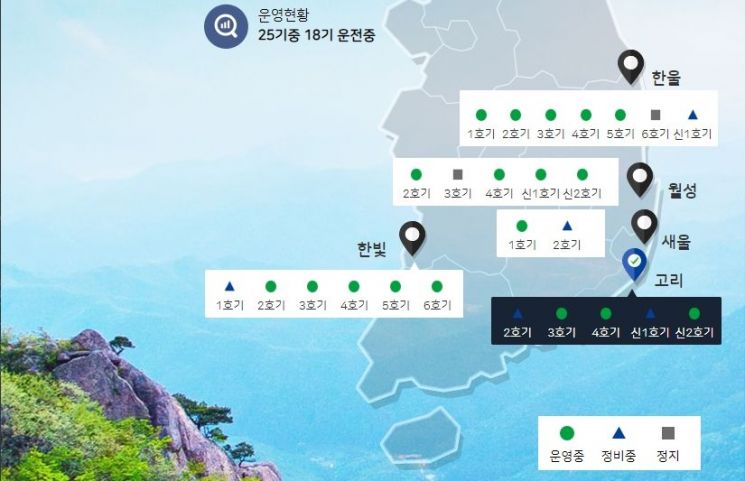
The procedures for continued operation of nuclear power plants are already underway. KHNP has applied for operation change permits for Kori Units 2, 3, and 4, and submitted safety evaluation reports for Hanbit Units 1 and 2 and Hanul Units 1 and 2. Safety evaluation reports were also submitted in April for Wolsong Units 2, 3, and 4.
Safety reviews and facility improvements for continued operation typically take 3 to 4 years. Under current regulations, even if a continued operation permit is granted, re-evaluation must be conducted every 10 years. Accordingly, the nuclear power industry is demanding an extension of the period to allow continued operation for more than 20 years when obtaining operation change permits. President Yoon's statement about "referring to advanced overseas cases" is interpreted as considering these industry demands. The United States allows continued operation in 20-year increments.
Regarding continued operation of nuclear power plants, opposition from environmental groups and residents must also be overcome, separate from the Nuclear Safety and Security Commission's review. At a recent public hearing on the lifespan extension of Hanbit Units 1 and 2, residents protested and collectively resigned.
The government plans to promote a special law on nuclear power industry support to ensure continuous support for nuclear power plants even when administrations change, and to establish and announce a 2050 mid-to-long-term nuclear power industry roadmap within this year. Lee Cheol-gyu, chairman of the National Assembly Industry, Trade, Energy, Small and Medium Enterprises Committee, recently introduced the "Special Act on Support for the Nuclear Power Industry." This bill provides the basis for establishing and implementing basic plans for nuclear power industry support and includes provisions to establish a nuclear power industry development fund to secure stable financial resources.
To operate nuclear power plants stably, enacting the High-Level Radioactive Waste Management Special Act is essential. Although the High-Level Radioactive Waste Special Act was proposed in the previous National Assembly, it was automatically discarded due to unresolved differences between ruling and opposition parties. In the 22nd National Assembly, Lee In-seon and Kim Seok-ki of the People Power Party and Kim Seong-hwan of the Democratic Party have proposed the High-Level Radioactive Waste Special Act.
© The Asia Business Daily(www.asiae.co.kr). All rights reserved.
![Clutching a Stolen Dior Bag, Saying "I Hate Being Poor but Real"... The Grotesque Con of a "Human Knockoff" [Slate]](https://cwcontent.asiae.co.kr/asiaresize/183/2026021902243444107_1771435474.jpg)
















