Training Giant African Pouched Rats to Detect Landmines
Plan to Deploy in Crackdown on Illegal Wildlife Trafficking
CNN reported on the 30th (local time) that rats have stepped up to crack down on wildlife trafficking, one of the world's major illegal trade industries.
According to the report, the global nonprofit organization APOPO recently announced that African giant pouched rats (hereafter referred to as pouched rats) trained at the port of Dar es Salaam, Tanzania's largest city, achieved excellent results by detecting over 83% of targets, and they are preparing to expand the rats' range of activity to warehouses and terminals.
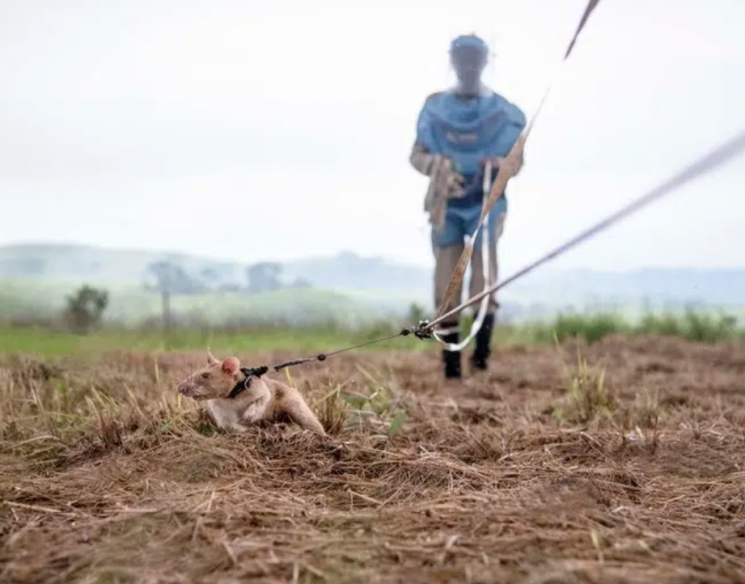
APOPO is an organization that trains pouched rats to detect landmines and explosives. The trained rats are called "HeroRATs." These rats are large enough to rival cats in size, but they are light enough not to detonate landmines when stepping on them and are highly intelligent, completing landmine detection work that takes humans four days in just 30 minutes.
Experts expect them to play a significant role in cracking down on illegal wildlife trafficking in Africa. CNN reported, "The scale of illegal wildlife trade is estimated to be up to $23 billion annually (approximately 32 trillion KRW), making it the fourth largest illegal trade industry in the world after counterfeit goods, drugs, and human trafficking."
Scientists involved in the training emphasized that the strengths of the pouched rats lie in their relatively short training time, flexible work with various trainers, and cost efficiency. They were trained to detect wildlife illegally trafficked even when hidden within other substances. The training cost per pouched rat is $7,000 to $8,000 (approximately 9.5 to 11 million KRW), which is much cheaper compared to electronic inspection equipment such as X-rays or CT scans, according to the organization.
Crawford Allan, Vice President of the Wildlife Crime Division at the U.S. branch of the World Wildlife Fund (WWF), pointed to Africa as a hotbed of illegal wildlife trafficking, stating, "When the risk of crackdown on wildlife smugglers increases and is reflected in black market prices, trafficking demand decreases," and evaluated, "The wildlife detection technique using rats is hoped to be a practical solution for regulatory authorities facing budget difficulties."
© The Asia Business Daily(www.asiae.co.kr). All rights reserved.
![Clutching a Stolen Dior Bag, Saying "I Hate Being Poor but Real"... The Grotesque Con of a "Human Knockoff" [Slate]](https://cwcontent.asiae.co.kr/asiaresize/183/2026021902243444107_1771435474.jpg)















