The Times "North Korea's Equipment Is Poor but Master of Asymmetric Tactics"
North Korea's Past Military Cooperation with Vietnam, Egypt, and Iran
As news emerged that North Korea has deployed its troops to Russia, which is at war with Ukraine, a British media outlet highlighted the reality and dangers of the North Korean military.
On the 25th (local time), the British daily The Times reported, "The North Korean military has 1.3 million active personnel and 7.6 million reservists, making it the fourth largest in the world by number," adding, "All men must serve for up to 10 years, and women for 5 years." The outlet also pointed out, "However, internally, there is a shortage of fuel, spare parts, and supplies needed to operate vehicles and other equipment."
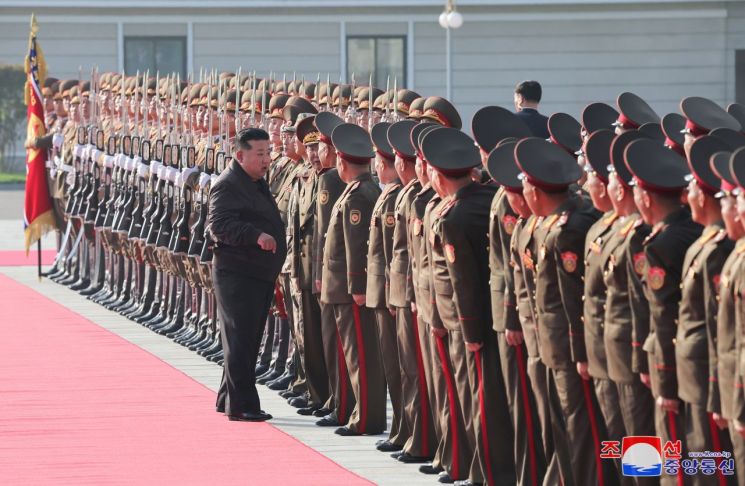 North Korean State Affairs Commission Chairman Kim Jong-un visited the command of the 2nd Corps of the Korean People's Army on the 17th, according to a report by the Korean Central News Agency on the 18th.
 [Photo by Pyongyang Korean Central News Agency, Yonhap News]
The media also revealed that the nutritional status of North Korean soldiers is very poor. Due to malnutrition, they are significantly shorter on average than South Korean soldiers, and in 2017, it was discovered that a defector soldier’s stomach was full of parasites, the outlet reported.
The North Korean military possesses relatively modern tanks called 'Pokpung-ho,' which resemble the Russian T-72, as well as aging Soviet-made fighter squadrons, fleets of warships, and submarines. However, The Times stated, "Most of these conventional weapons are relics from the Cold War era without spare parts," and "none of these are of much help to Russian President Vladimir Putin in waging the war in Ukraine."
Nevertheless, the outlet emphasized that the North Korean military should not be underestimated. It explained, "North Korea is a master of so-called 'asymmetric warfare,' which involves carefully identifying the enemy’s weaknesses and then deploying a small number of highly trained special forces to attack." It added, "The most useful asset for Russia would be North Korean special forces," noting, "They could parachute behind the front lines where U.S. and South Korean troops are stationed or infiltrate by submarine to attack ports, airports, nuclear power plants, and spread fear among civilians." The size of North Korea’s special forces was also reported to be around 200,000.
In addition to special forces, 'information warriors' who carry out cyberattacks are also a threatening presence. The Times explained that about 3,000 'information warriors' under North Korea’s Reconnaissance General Bureau can paralyze power facilities and weapons systems through cyberattacks or disrupt Global Positioning Systems (GPS).
Besides the current deployment to Russia, North Korea has previously sent troops or engaged in military cooperation with allied countries around the world. Major foreign media reported that during the Vietnam War from 1966 to 1972, North Korea deployed about 1,000 troops, including hundreds of MiG fighter pilots, to North Vietnam. During the Fourth Middle East War (1973), it sent a military advisory group of about 1,500 personnel to Egypt. North Korea has also been suspected of cooperating with Iran on nuclear weapons and ballistic missile development, and it is known that the plutonium-producing nuclear power plant in Syria, destroyed by an Israeli airstrike in 2007, was under construction with North Korean assistance.
Meanwhile, as speculation grows that North Korean troops dispatched to Russia and currently training are about to be deployed in combat, the U.S. daily The New York Times (NYT) reported on the 25th that North Korean forces have gathered in Kursk, a major battlefield on Russian soil. Kursk, located in southwestern Russia, is a border area where Ukrainian forces entered on August 6, occupying some territory and engaging Russian troops.
NYT cited one anonymous Ukrainian government official and two U.S. officials, reporting that thousands of North Korean troops began arriving in Kursk on the 23rd and are expected to participate in counterattacks to drive out Ukrainian forces. The North Korean troops have traveled about 6,400 km to gather in Kursk, and a senior Ukrainian official familiar with the troop movements expects up to 5,000 North Korean soldiers to assemble by the 28th. This force is part of North Korea’s elite units, which travel from Vladivostok by Russian military transport plane Ilyushin Il-62M to a military airfield in western Russia, then proceed by vehicle to the combat zone, the official said.
© The Asia Business Daily(www.asiae.co.kr). All rights reserved.
![Clutching a Stolen Dior Bag, Saying "I Hate Being Poor but Real"... The Grotesque Con of a "Human Knockoff" [Slate]](https://cwcontent.asiae.co.kr/asiaresize/183/2026021902243444107_1771435474.jpg)















