Major Chicken Franchise Headquarters' Distribution Margin 13%
Up to 109.8 Million KRW Charged Per Franchise
"Distribution Margin Passed Directly to Consumers"
"Measures Needed to Reduce Franchisee Burden by Headquarters"
It has been revealed that chicken franchise headquarters, led by the Franchise Association, have increased their sales and profits by securing high distribution margins from franchisees. Criticism is being raised against the franchise industry, which has recently raised consumer prices one after another citing the burden of 'delivery fees.' The distribution industry points out the need for comprehensive measures to alleviate the cost burden on self-employed workers along with the reduction of delivery app fees.
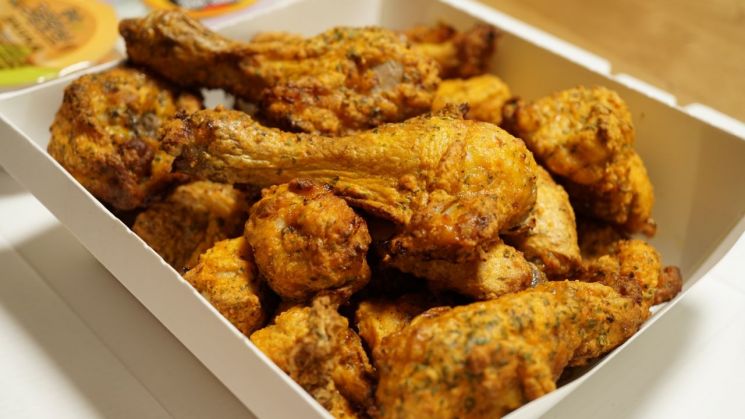
Distribution Margin Alone at 13%... Chicken Headquarters Fattened Their Profits
According to an analysis of data received from the Fair Trade Commission by the office of Kim Nam-geun, a member of the National Assembly's Political Affairs Committee from the Democratic Party of Korea, the distribution margin of the top six franchise headquarters over the past three years (2020-2022) was 12.9% per franchise store (65.29 million KRW per store).
The distribution margin is the profit margin (difference franchise fee) earned by supplying raw and subsidiary materials to franchisees, which is a kind of commission for franchisees when dealing with the headquarters. For example, if raw materials such as raw chicken, cooking oil, and vegetables were purchased on the market for 100,000 KRW, the franchisee was supplied at 113,000 KRW. One franchise took a margin exceeding 17%, collecting up to 100.98 million KRW per franchise store.
Currently, the burden of food ingredients accounts for nearly half of the operating costs of franchise and other dining businesses. According to the Ministry of Agriculture, Food and Rural Affairs' 'Dining Business Type Report,' the cost of food ingredients in the annual operating expenses of dining businesses increased from 41.1% in 2020 to 42.4% (86.3 million KRW) in 2022. This is the largest burden compared to labor costs (33.2%), rent (9.6%), and other expenses (14.8%).
Due to the high distribution margin, the sales and profits of chicken franchises surged compared to franchise stores. The average sales per chicken franchise store decreased by 1.6%, from 350 million KRW in 2020 to 329.69 million KRW last year, while the headquarters' sales increased by 32.9%. The operating profit of 128 franchise headquarters, including chicken franchises, surged by 77.8% during the same period.
Last year, the operating profit of eight chicken franchise headquarters, including BHC, Genesis BBQ, and Kyochon F&B, recorded 268.1 billion KRW (operating profit margin 10%). None of them posted losses. BHC had the highest operating profit at 120.3 billion KRW (operating profit margin 22%), followed by Genesis BBQ (65.3 billion KRW, 14%) and Kyochon F&B (24.8 billion KRW, 5.6%).
 Kim Dong-jeon, CEO of Mom's Touch & Company, is responding to a lawmaker's question during the National Assembly's audit of the Fair Trade Commission held by the Political Affairs Committee on the 21st. Photo by Kim Hyun-min
"Delivery App Fees Aside, Burden on Franchise Owners Must Be Reduced"
The problem is that major franchises are raising consumer prices one after another, taking advantage of the noise surrounding delivery app fees. This year, BBQ raised the price of chicken (23,000 KRW) by 3,000 KRW, and Goobne Chicken and Puradak also raised prices of major products by 1,000 to 1,900 KRW. Mom's Touch raised prices of 62 types of burgers and chicken by 300 to 500 KRW starting from the 24th.
Among self-employed workers, there is a growing call for urgent measures to reduce the burden on franchise owners separately from delivery app fees. While the Korea Franchise Association is increasing activities to urge fee reductions, it is criticized for neglecting policies that actually reduce the burden on franchise headquarters and franchisees. At the National Assembly Political Affairs Committee's audit on the 21st, when Democratic Party member Lee Kang-il asked, "Is there no plan to lower raw material costs?" Kim Dong-jeon, CEO of Mom's Touch & Company, replied, "As a franchise competing with global companies, we need to maintain an operating profit margin of 13-15%."
The delivery proportion in the dining market is about 25%, with in-store sales accounting for 75%. Franchisees have many additional costs to bear, including not only raw material procurement costs but also initial investment costs and royalties to the headquarters. The claim that franchises raise prices due to delivery cost burdens is considered 'illogical.' An industry insider said, "Even if delivery fees are reduced, franchises are unlikely to lower prices," adding, "The government should establish not only a delivery coexistence council but also a franchise coexistence council."
© The Asia Business Daily(www.asiae.co.kr). All rights reserved.
![Clutching a Stolen Dior Bag, Saying "I Hate Being Poor but Real"... The Grotesque Con of a "Human Knockoff" [Slate]](https://cwcontent.asiae.co.kr/asiaresize/183/2026021902243444107_1771435474.jpg)

















