Increase in Overseas Stock Commission Income Benefits
'Seohak Gaemi' Holds $137.9 Billion
IB Deal Recovery Base Effect... Mirae Asset Hits 'Record High'
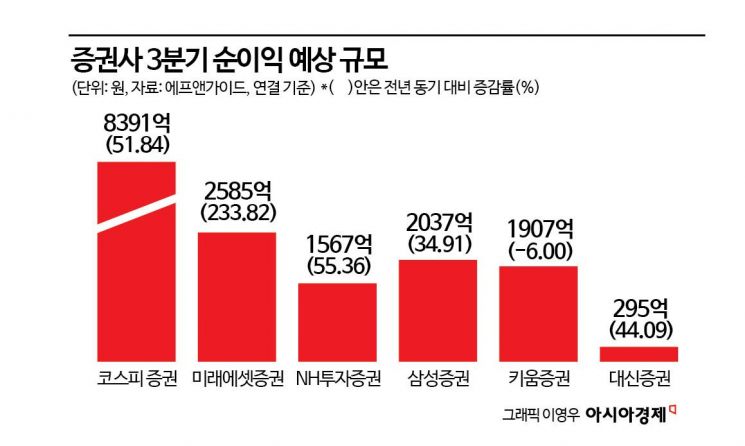
The securities industry is expected to record strong performance in the third quarter. This is due to the base effect from last year's sluggish investment banking (IB) sector and the increase in 'Seohak Gaemi'?Korean investors directly investing in U.S. stocks?leading to higher overseas stock commission income. Mirae Asset Securities, regarded as the 'big brother' of the financial investment industry and a representative value-up (corporate value enhancement) theme stock, hit a 52-week intraday high on the 25th.
On the 28th, financial information provider FnGuide estimated the third-quarter net profit consensus for five securities firms (Mirae Asset, NH Investment & Securities, Samsung, Kiwoom, and Daishin Securities) at 839.1 billion KRW, representing a 51.84% increase compared to the previous year. All except Kiwoom Securities are expected to see an increase in net profit.
The firm expected to see the largest net profit growth rate is Mirae Asset Securities, with an anticipated net profit of 258.5 billion KRW, up 233.8% year-on-year. Trading profits increased in a favorable operating environment due to declining market interest rates. One-time foreign exchange gains of 120 billion KRW related to the capital reduction of the Hong Kong branch, along with some recognition of valuation losses on overseas real estate such as the France Majunga Tower, are also expected.
Kiwoom Securities is expected to record 190.7 billion KRW, a 6% decrease from the previous year, which aligns with consensus estimates. This decline is presumed to be due to poor performance in proprietary investment (PI) stock trading. However, the increase in overseas stock trading benefits, along with IB deal profits such as the Seoul Mokdong project financing (PF) order, offset the losses.
The overall strong performance in the securities industry is analyzed to be driven by brokerage commission income from the favorable overseas stock market conditions. According to the Korea Securities Depository, as of the third quarter this year, the amount of foreign currency securities held by domestic investors was 137.94 billion USD, an 8.3% increase from the previous quarter. The settlement amount rose by 37.5% to 174.67 billion USD. Jung Min-ki, a researcher at Samsung Securities, noted, "The recent remarkable growth of overseas stock brokerage is noteworthy," adding, "In the second quarter, the proportion of overseas stock brokerage revenue accounted for 25% of total stock brokerage revenue, up 7 percentage points from the previous year."
The popularity of overseas stocks was led by the United States. In fact, the U.S. accounted for 74.4% of the foreign currency securities held by domestic investors in the third quarter, with the top five markets comprising 98.3%. Particularly, U.S. stocks made up 90% of the foreign currency stock holdings, clearly showing the dominant trend of U.S. stocks. Tesla overtook Nvidia to become the top holding in terms of custody amount after three months. Nvidia, Apple, Microsoft, and the ProShares UltraPro QQQ ETF followed. The U.S. stock market's continued upward trend this year is believed to have increased the number of investors making direct investments.
This popularity of overseas stocks has offset the sluggish domestic stock trading. In fact, domestic stock trading volume seemed to increase thanks to the government's value-up policy but then declined again. The average daily trading volume started at 19.4 trillion KRW in January, peaked at 22.7 trillion KRW in March, and then steadily decreased to the 19 trillion KRW range in July, 18 trillion KRW in August, and 16 trillion KRW in September. The KOSPI index closed at 2,583.27 on the 25th, down 3.24% from the beginning of the year. On the 24th, the U.S. S&P 500 index, centered on large-cap stocks, closed up 22.5% year-to-date, and the tech-heavy Nasdaq index rose 24.72%.
Additionally, the base effect is considered to have been reflected as the IB sector was sluggish last year due to the real estate project financing (PF) shock. Park Hye-jin, a researcher at Daishin Securities, pointed out, "We expected the IB business environment to improve this year, and many securities firms have actually seen increased profits in PF projects." The credit extension for real estate PF is also on the rise again. The securities firms' real estate PF credit extension, which had decreased to the 16 trillion KRW range in August, recently recovered to the 17 trillion KRW range. Although this is below last year's 19 trillion KRW level, it is interpreted as a sign that business is resuming.
Stock prices in the securities sector are also on the rise. Mirae Asset Securities hit a 52-week intraday high of 9,220 KRW on the 25th. Institutional investors have been buying shares for 49 consecutive days, pushing the stock price up. Mirae Asset Securities plans to achieve a return on equity (ROE) of over 10% by 2026 through its value-up policy and increase shareholder returns, including dividends, to 30%. Furthermore, it plans to retire 100 million treasury shares by 2030. Other securities firms are also approaching their own record highs set this year.
However, there is also an assessment that the securities sector may be relatively excluded from the value-up theme compared to other financial stocks. Park Shin-hye, a researcher at Daishin Securities, cited the limited stock price increase compared to banks and insurance companies as due to "the lack of impactful shareholder return policies like those in banks or insurance" and "the high profit volatility that makes proactive capital policies difficult."
© The Asia Business Daily(www.asiae.co.kr). All rights reserved.
![Clutching a Stolen Dior Bag, Saying "I Hate Being Poor but Real"... The Grotesque Con of a "Human Knockoff" [Slate]](https://cwcontent.asiae.co.kr/asiaresize/183/2026021902243444107_1771435474.jpg)















