International Finance Association Conference Dialogue
"Export Slump, Focus on External Factors"
Lee Chang-yong, Governor of the Bank of Korea, said that the preliminary estimate of real Gross Domestic Product (GDP) for the third quarter grew by 0.1% quarter-on-quarter, falling short of expectations, and that "the growth rate will need to be reviewed again in November."
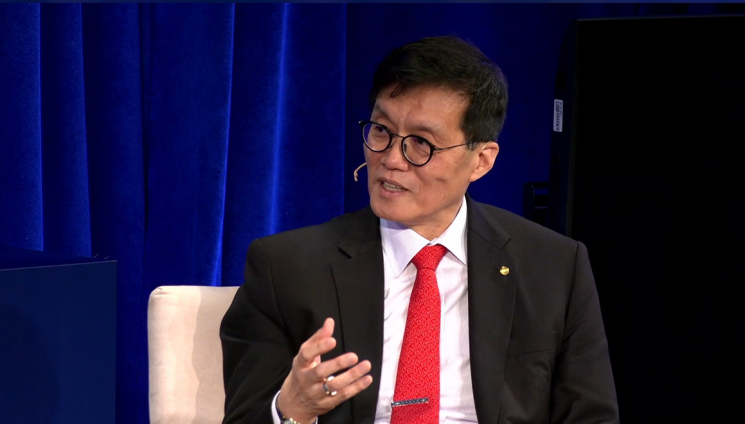 Lee Chang-yong, Governor of the Bank of Korea, speaking as a panelist at the Institute of International Finance (IIF) conference in Washington D.C., USA, on the 24th (local time). Screenshot from the IIF live streaming.
According to the Bank of Korea on the 25th, Governor Lee made these remarks on the 24th (local time) while participating as a panelist at the Institute of International Finance (IIF) conference held in Washington D.C., USA, discussing "Korea's Economic Outlook and Challenges."
He said, "We had been expecting a growth rate of 2.4% for this year and 2.1% for next year," adding, "The third-quarter GDP figures were released yesterday, and since exports were somewhat weaker than expected, we will need to review the growth rate again in November."
Governor Lee explained, "This may be an issue that requires attention to external factors. China's economic slowdown is certainly one problem, and global political and geopolitical tensions could be another. We also need to reassess whether our view on the IT cycle is correct."
Regarding the impact of the U.S. interest rate path on the Korean economy, he said, "Recently, the U.S. economy has shown stronger data than expected, and due to fiscal policy concerns related to the U.S. presidential election, the dollar has strengthened again over the past two weeks," adding, "The most practical concern now is whether the Federal Reserve (Fed) cutting rates by 25 basis points (1bp = 0.01 percentage point) will stop the dollar's strength or if it will continue."
On China's economic slowdown, he said, "China produces a lot, but competition is very fierce, so it is not gaining as much profit. Many Chinese companies are heading outside China to find demand, which means the global value chain is changing."
He continued, "Trade with China began to decline between 2013 and 2014, long before the trade conflict started," emphasizing, "This means China's competitiveness had already started to increase, and since China is rapidly catching up with us, we must not respond too complacently."
Meanwhile, the discussion also covered central bank digital currency (CBDC) and artificial intelligence (AI). When asked about the introduction of retail CBDC, Governor Lee explained, "Over the past two years, we have conducted pilot tests for retail CBDC, and since Korea already has a well-established fast payment system and credit cards are widely used, it was very difficult to find a reason for its necessity. We plan to develop wholesale CBDC along with tokenized deposits."
Regarding Korea's use of AI, he said, "Korea is one of the few countries with the technological capability to produce AI chips, giving it a competitive advantage as a producer," adding, "Also, since Korea is aging very rapidly, we expect AI to help solve labor shortages and aging problems."
© The Asia Business Daily(www.asiae.co.kr). All rights reserved.
![Clutching a Stolen Dior Bag, Saying "I Hate Being Poor but Real"... The Grotesque Con of a "Human Knockoff" [Slate]](https://cwcontent.asiae.co.kr/asiaresize/183/2026021902243444107_1771435474.jpg)















