‘Faith,’ ‘Pain,’ ‘Crime,’ ‘Lies’ Repeated... Reflected Hopes for Judicial Retribution
Elderly Victims Scammed Multiple Times... Top Targets for Coin Recruiters
New Village Movement Community Ties Become Shackles for Victims
"Law Is Just"... Hopes for Judicial Retribution Also Reflected
The Ado International coin scam, known as the "440 billion won Ponzi scheme," is considered a prime example of multi-level marketing crime in South Korea. A total of 36,000 people fell victim to this scam, with a significant number being elderly. In July, the main perpetrator, Mr. Lee, received an encouraging verdict-15 years in prison, the maximum sentence for fraud under the law. In this context, our publication conducted a morpheme analysis of 126 handwritten petitions for severe punishment submitted by Ado International fraud victims to the Seoul Central District Court. We aim to examine in depth the concrete pain that so-called "illegal fundraising and multi-level marketing scams," often featured in newspaper headlines, bring to the lives of individual victims. We will also address the issues of recovering and confiscating criminal proceeds from illegal fundraising scams throughout this series.
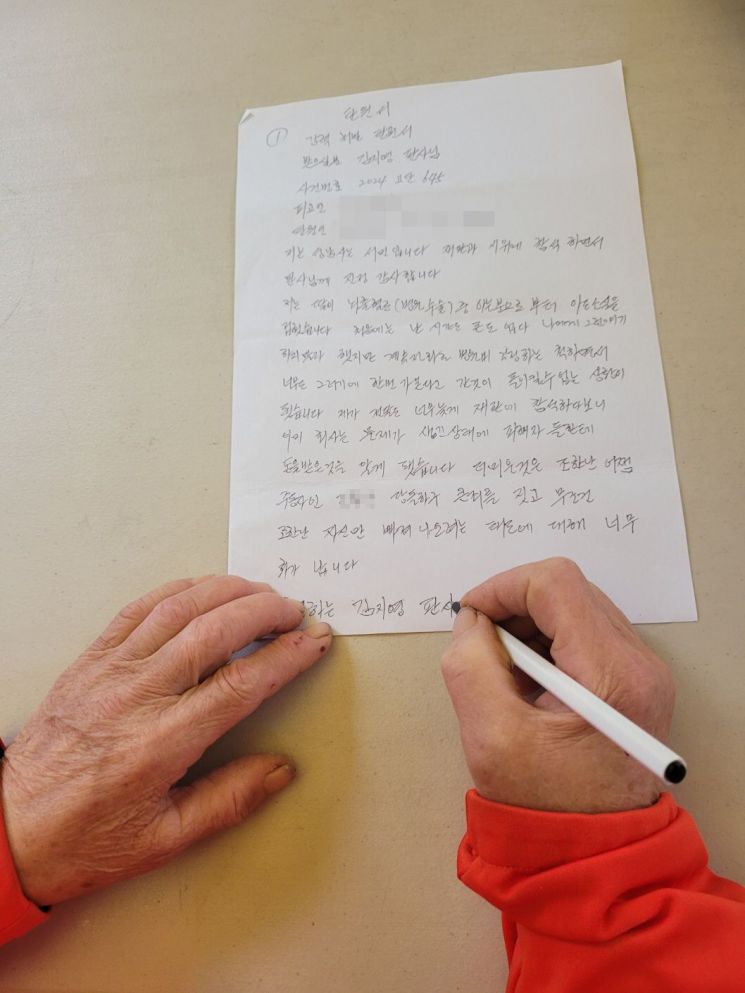
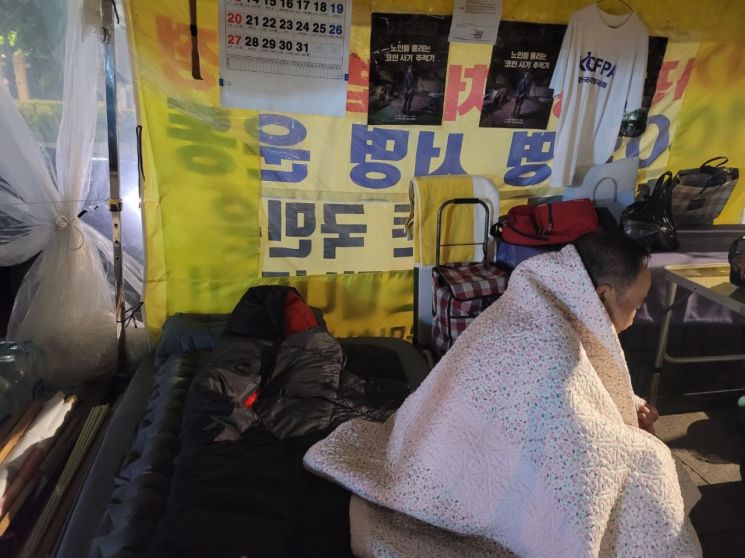 Mr. Lee (75 years old), who lost a total of 130.3 million won in the Ado International coin scam, is waiting in a tent.
At a protest tent of about 4 square meters labeled "Ado International Coin Fraud Victims," located in front of Jeonggok Building, 6 Beopwon-ro 1-gil, Seocho-gu, Seoul, we met an elderly man. This was Mr. Lee (75), who lost his entire savings of 130.3 million won in the Ado International coin scam. Crouched in front of a desk with a folding suitcase, sleeping bag, hot packs, and hand warmers, he was writing a petition under a blanket. Lee said, "My hands tremble and move slowly, so I have to throw away and rewrite many pages," and added, "Some people have written so many petitions that they are rumored to have beautiful handwriting."
He also showed us a schedule. It was a roster for solo protests, court attendance, and "tent volunteer" shifts. Of the 320 people who filed complaints about the Ado International coin scam, 80.93% were aged 50 or older, indicating that most victims are elderly. Nevertheless, these victims hold daily relay picket protests at five locations: the main gate of the Supreme Prosecutors' Office in Seocho-dong, Seoul; the west and main gates of the Seoul Central District Prosecutors' Office; and the east and main gates of the Seoul Central District Court. The protests are organized in two shifts: 7:30-9:00 a.m. and 5:00-6:30 p.m. Every night at 10 p.m., a separate team stays overnight in the tent to prepare for unannounced visits from district office staff monitoring unauthorized occupancy. They write petitions and hang banners. Lee said that over the past year and two months, the Korea Fraud Prevention National Association, led mainly by Ado International victims, has consistently raised its voice in this way, which is why the main perpetrator received the maximum 15-year sentence.
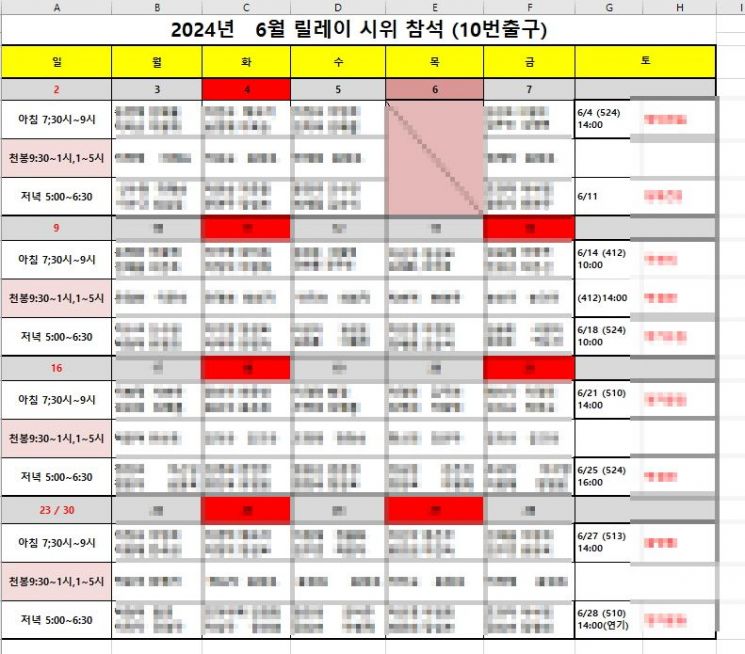 Schedule of Solo Protests, Court Attendances, and Tent Volunteer Work Shared by Victims of Ado International Fraud (Source=Korea Fraud Prevention National Association)
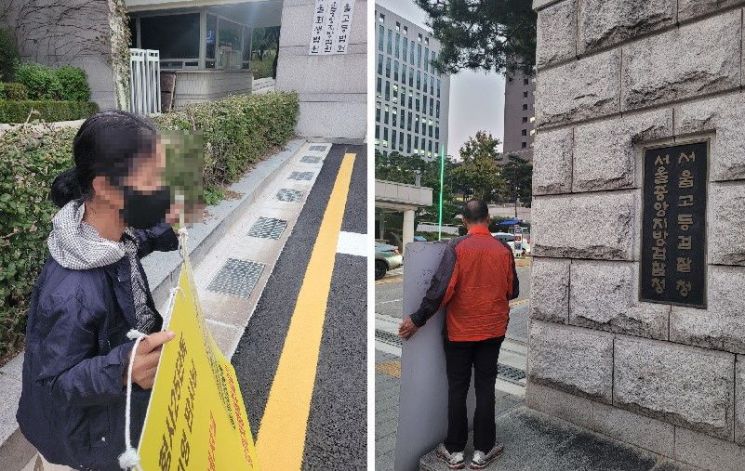 76-year-old Kang Mo and 75-year-old Lee Mo, victims of fraud by Ado International, are holding picket protests in front of the courthouse and the prosecutor's office, respectively. (Source=Korea Fraud Prevention National Association)
‘Faith,’ ‘Pain,’ ‘Crime,’ ‘Lies’ Repeated... Reflected Hopes for Judicial Retribution
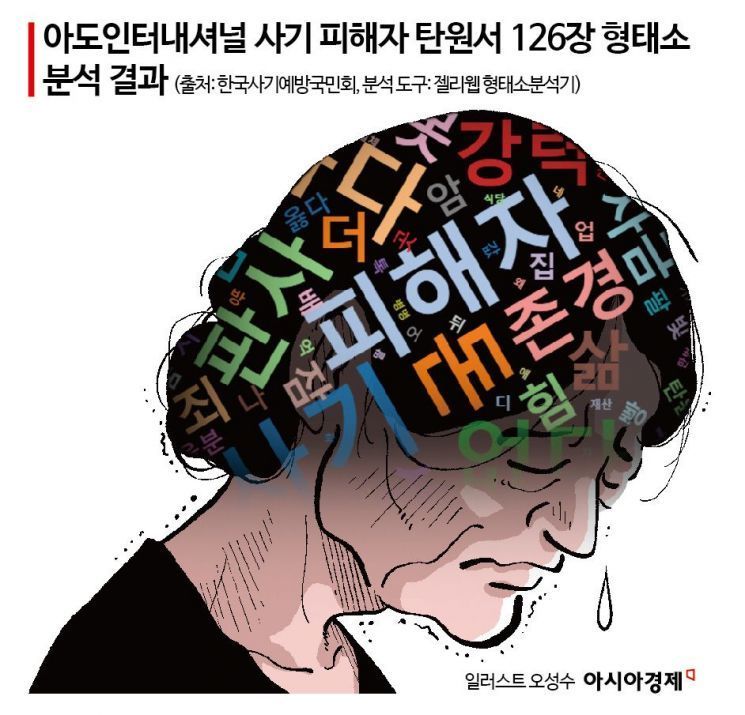
What drives elderly fraud victims to such anger and direct action? Asia Economy collected 126 petitions from Ado International coin scam victims and conducted a morpheme (the smallest unit of meaning in language) analysis. Lee Hosun, a geriatric psychology expert and professor at Soongsil Cyber University, participated as an advisor. The aim was to examine the frequency of words repeatedly used by elderly victims in their petitions to understand their social implications.
The analysis revealed that the linguistic puzzle hidden in the 126 petitions converged on keywords such as "faith," "pain," "crime," and "lies." Excluding nouns like "fraud" (261 times), "victim" (164 times), and "money" (142 times), the most frequently used word was "none" (108 times). In the petitions, "none" was used to express the absence of hope or resources, the lack of remorse from the perpetrators, and the absence of justice being served. Phrases like "no crime," "no punishment," "no money," "no way," "no one," and "no remorse" captured moments of despair. Words such as "life" (37 times), "pain" (37 times), "loan" (25 times), and "tears" (19 times) reflected the burdens of lives shattered by fraud. These sentiments were well illustrated in the petition of Mr. Kim (born in 1961): "I have worked hard all my life, but nowadays, as people live longer, I tried to find a way to support myself in old age and ended up being scammed."

Professor Lee interpreted the results of the morpheme analysis as revealing the unstable psychological state and depression of elderly victims. He explained that while financial ruin is the primary harm from fraud, the psychological depression that comes from recognizing and gradually facing asset loss pushes seniors' lives into crisis. He said, "Elderly victims experience both psychological failure and material bankruptcy due to fraud," and added, "Even when facing bankruptcy in old age, they tend not to share the investment process or results with family or children, choosing to bear the burden alone. Ultimately, this leads to thoughts of death, believing that this way, their failure will not be passed on to family and acquaintances."
Words like "trust" (23 times), "multi-level" (16 times), "acquaintance" (14 times), "lie" (13 times), and "victimized" (9 times) also appeared frequently, reflecting the nature of multi-level marketing scams, where many elderly victims were persuaded to invest by acquaintances. The subject of "trust" was sometimes "judge" or "law," but also "scammer" or "company." Choi Heeseon (pseudonym), who helped victims file complaints, said, "They targeted the victims' vulnerabilities, such as family circumstances, debt, and financial hardship, to induce investment." Ms. Juyoun was also introduced to Ado International by a friend she trusted. As her husband was unable to work outside due to a stroke, she became the breadwinner and invested 9.7 million won-money she borrowed-in Ado International in June last year. She found out it was a scam within a month. "I couldn't sleep out of anger after realizing I had been scammed," she said. She now makes a living folding towels collected from jjimjilbangs (Korean saunas) for a laundry service.
Between the lines of the petitions, one could also sense trust and hope in the judiciary's "retribution" and "rule of law." Frequently repeated nouns such as "respect" (42 times), "trial" (39 times), "punishment" (88 times), and "gratitude" (20 times) supported this. "Money" (142 times) and "debt" (36 times) represented both the reason for and the result of investment. Many victims, after suffering financial losses due to fraud, tried to recover their losses and ended up being deceived again.
Elderly Victims Scammed Multiple Times... Top Targets for Coin Recruiters
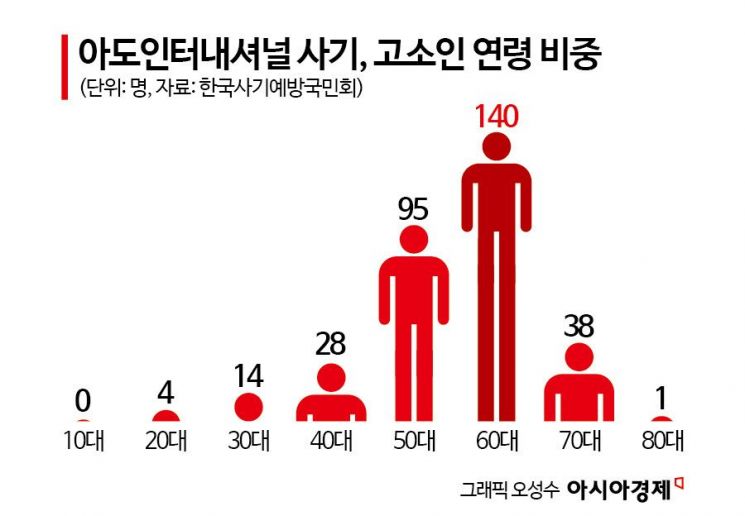
Kim Junghoon, a man in his 20s who became a whistleblower after working as a recruiter and is now a suspect, said that the number one target for recruitment was "elderly people who had already been scammed." Kim explained, "Because they have a strong desire to recover their principal and make up for losses, they are more easily lured by promises that this investment will offset previous losses. This is an exploitation of the hope these people are desperately trying to grasp." Many victims had been scammed multiple times. Kim Younghwa, a woman in her 70s living in Icheon, Gyeonggi Province, invested 27 million won in Ado International and lost it all. During this time, recruiter Heo Mo persuaded her to invest in another coin. She put in an additional 7 million won, which she also lost.
Why do elderly people continue to trust someone and keep investing? Whistleblower Kim pointed to shared experiences of community culture. Unlike the younger generation, seniors are from the era of the Saemaul Undong (New Village Movement) and have learned and experienced such movements. This is especially true for those who worked in agriculture. They have memories of building solidarity through community-based networks. Kim said, "For seniors, the sales pitch 'Please trust me just this once' is surprisingly effective. Older people tend to trust others more easily than younger people." The morpheme analysis showed that words representing community, such as "nation" and "future," appeared 20 times, while words like "request" (19 times), "meet" (13 times), and "Republic of Korea" (13 times) were also frequently used.
For low-income seniors, insufficient retirement funds lead to poor decisions. The word "retirement," which appeared 26 times in the petitions, illustrates why they are easily tempted. Oh Younghwan, Secretary-General of the Senior Financial Education Council, explained, "Seniors who must live to 100 years old feel anxious that their current retirement funds are not enough to support them, making them vulnerable to scams." Professor Lee added, "As people age, overall physical decline and diminished judgment occur. In such situations, repeated exposure to fraudulent multi-level marketing leads them to believe that external success stories can happen to them as well, ultimately resulting in them investing their retirement funds."
© The Asia Business Daily(www.asiae.co.kr). All rights reserved.
![Clutching a Stolen Dior Bag, Saying "I Hate Being Poor but Real"... The Grotesque Con of a "Human Knockoff" [Slate]](https://cwcontent.asiae.co.kr/asiaresize/183/2026021902243444107_1771435474.jpg)

















