Maximum 4m Long Shell Fill Layer Confirmed
Expected to Help Reveal the Reality of Gaya Royal Palace
Large-scale construction traces were discovered at the Bonghwang-dong site in Gimhae, presumed to be the royal palace site of Geumgwan Gaya.
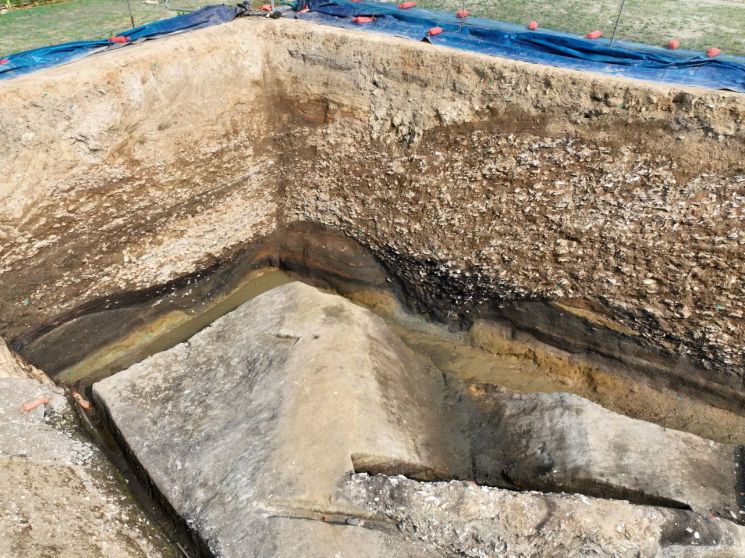
The National Gaya Cultural Heritage Research Institute reported on the 22nd that while investigating the eastern slope and flat land of Bonghwangdae Hill, they confirmed a shell mound layer indicating large-scale earthworks about 1,600 years ago. The shell mound layer is a layer built by compacting soil mixed with a large amount of seashells in a sloped, layered manner.
The discovered mound layer is up to 4 meters long. It was created by reclaiming the lowland northeast of Bonghwangdae Hill. An institute official said, “There was likely construction to expand the land in this area during the 5th century,” adding, “If it is considered to extend to the fortress walls of the nearby Bonghwang earthen fortress, the length is estimated to be over 100 meters.”
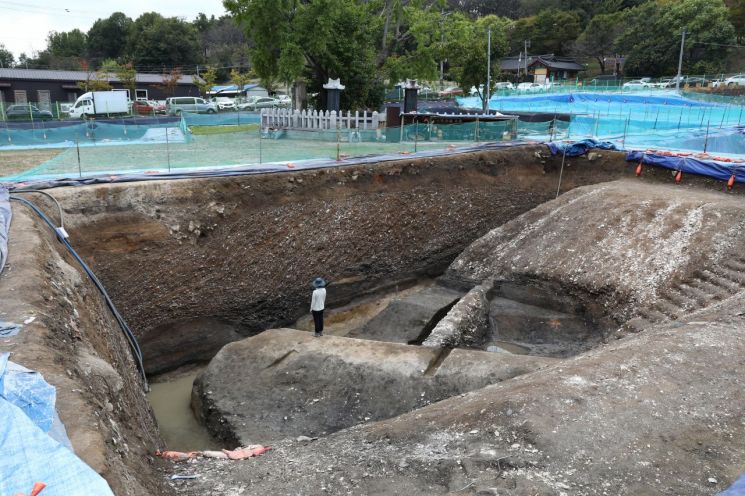
The method of compacting soil layer by layer around sloped land is mainly used to create wide land areas. Representative examples include the sites of Hwangnyongsa Temple in Gyeongju and Geumgangsa Temple in Buyeo, which are temple sites from the Three Kingdoms period. The Bonghwang-dong site predates these sites chronologically. It also differs in that seashells were mixed in.
The results of this investigation are expected to help clarify the reality of the Gaya royal city (the city with the royal palace) in the future. An institute official emphasized, “The heyday of Geumgwan Gaya is known to be the 4th century, but the fact that construction of this scale was carried out in the 5th century means that the ruling class’s power was solidified at that time.” He added, “Large-scale construction requires corresponding labor and resources,” and said, “This area can be considered one of the former royal cities of Geumgwan Gaya.”
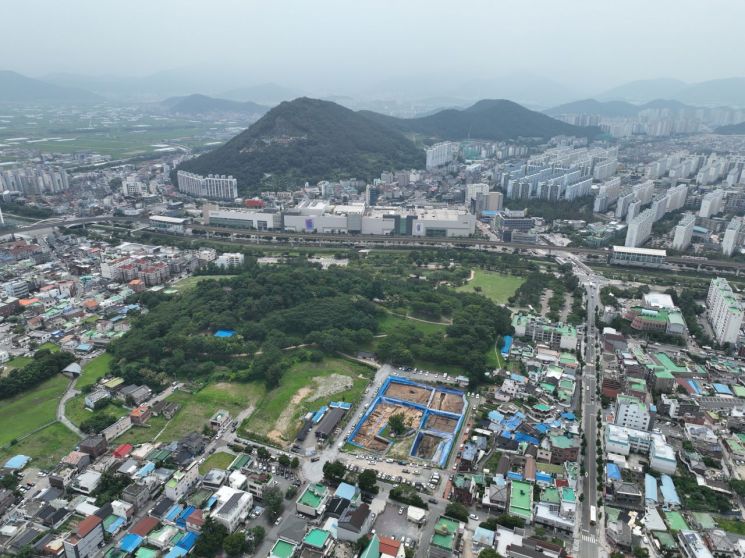
At the Bonghwang-dong site, previous excavations have confirmed traces from the Bronze Age to Geumgwan Gaya, including docking facilities for ships, ironworking sites where iron was produced and forged, and earthen fortresses. It is evaluated as a site indicating the lifestyle of southern Korea from the 1st to 4th centuries. Scholars also regard it as the site of the royal palace or royal city of Geumgwan Gaya.
© The Asia Business Daily(www.asiae.co.kr). All rights reserved.
![Clutching a Stolen Dior Bag, Saying "I Hate Being Poor but Real"... The Grotesque Con of a "Human Knockoff" [Slate]](https://cwcontent.asiae.co.kr/asiaresize/183/2026021902243444107_1771435474.jpg)

















