Water Quality Improvement in the 10km Section from Deokheungbo to Wolsanbo
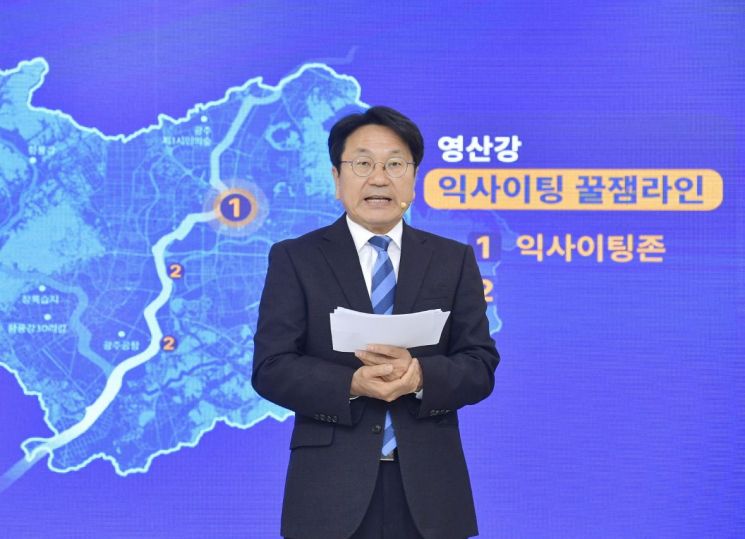 Mayor Kang Ki-jung of Gwangju City announcing the basic plan for the "Yeongsangang 100-ri Trail Y-Project" last October.
 [Photo provided by Gwangju City]
Gwangju City is expected to gain momentum in its ‘Yeongsan River Clean Water Utilization Project,’ which is being promoted to respond to the climate crisis and prepare for severe droughts.
According to Gwangju City on the 21st, the city is actively pursuing a plan to reuse Yeongsan River water by taking in river return flow water from the 10 km section between Deokheungbo in Seo-gu and Wolsanbo in Buk-gu to improve water quality, investing a total of 98.4 billion KRW by 2030 to establish a sound water circulation system for the Yeongsan River.
Since President Yoon Suk-yeol mentioned the importance of safe water supply measures to respond to climate change and promised support for the ‘Yeongsan River Water Reuse Plan’ at the Gwangju Public Livelihood Forum on the 5th of last month, the project is expected to accelerate.
President Yoon pledged national funding, stating, “We will do our best to ensure that the Yeongsan River can be properly utilized as a drinking water source for Gwangju citizens by improving water quality and securing water quantity.”
The Ministry of Environment also announced, “The Water Circulation Promotion Act, which can systematically support water-related disasters such as floods and droughts, is scheduled to be enforced at the end of this month,” and added, “We will actively consider designating water circulation promotion zones as proposed by Gwangju City to restore the Yeongsan River to a healthy natural ecosystem.”
In October last year, Gwangju City announced the ‘Yeongsan River 100-ri Trail Y-Project’ basic plan, aiming to improve water quality so that grade 2 clean water flows by 2030, and revealed the ‘Yeongsan River Clean Water Supply Plan’ to realize this goal.
To this end, the city has started the ‘Feasibility Study and Basic Plan Establishment Service for Building a Clean Water Circulation Supply System in the Yeongsan River Basin,’ investing 830 million KRW in service fees to devise optimal alternatives for improving water quality in the upper reaches of the Yeongsan River, securing water quantity, and obtaining alternative water resources.
Lee Seung-gyu, Head of the New Vitality Promotion Headquarters of Gwangju City, said, “Since the Yeongsan River is a national river, government support is crucial to establish a water circulation system,” and added, “We will strive to make the Yeongsan River a vibrant space and utilize it as a representative local tourist resource by continuously negotiating with the government following the Public Livelihood Forum to secure national support.”
© The Asia Business Daily(www.asiae.co.kr). All rights reserved.
![Clutching a Stolen Dior Bag, Saying "I Hate Being Poor but Real"... The Grotesque Con of a "Human Knockoff" [Slate]](https://cwcontent.asiae.co.kr/asiaresize/183/2026021902243444107_1771435474.jpg)















