OB raises prices of imported canned beer "Due to raw materials, logistics costs, and exchange rates"
Domestic products like Cass not considering price increase
HiteJinro and Lotte Chilsung "No plans for price increase"
Starting next month, the prices of imported beers handled by OB Beer, including Budweiser, Hoegaarden, and Stella, will increase by an average of 8%. As OB Beer, the industry leader, initiates the price hike, attention is focused on whether competitors will join the price increase trend.
Prices of Six Imported Beers Including Budweiser and Hoegaarden to Rise by an Average of 8% Next Month
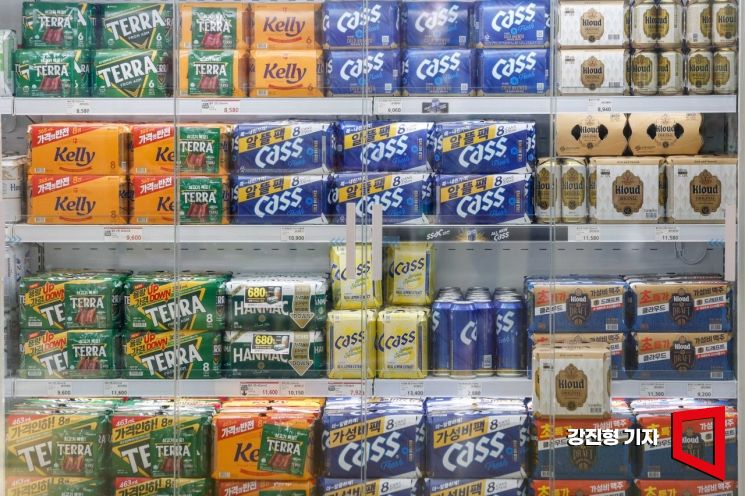 On the 11th, major beer products from OB Beer, such as Cass and Hanmac, were displayed at Yangjae Hanaro Mart in Seoul with an average factory shipment price increase of 6.9%. Photo by Jinhyung Kang aymsdream@
According to the industry on the 21st, OB Beer will raise the prices of six imported beers sold at convenience stores and large supermarkets: Budweiser, Hoegaarden, Stella, Suntory, Goose Island, and Elpa.
Specifically, the prices of Budweiser cans in 330ml, 500ml, and 740ml sizes, Budweiser Zero can 500ml, Hoegaarden cans 330ml and 500ml, Hoegaarden Ros?, Apple, and Zero cans 500ml, Stella cans 330ml, 500ml, and 740ml, Suntory can 500ml, Goose Island IPA and 312 cans 473ml, and Elpa can 500ml will be increased by an average of 8%.
Accordingly, the price of 500ml cans of Budweiser, Hoegaarden, Stella, Suntory, and Goose Island will rise by 400 KRW from 4,500 KRW to 4,900 KRW. The 330ml cans of Hoegaarden, Stella, and Budweiser will increase by 200 KRW from 3,500 KRW to 3,700 KRW. Budweiser and Stella 740ml cans will go up by 400 KRW from 5,000 KRW to 5,400 KRW.
However, although convenience stores were notified that the limited edition Cass can 740ml product, produced overseas, would also increase from 4,100 KRW to 4,500 KRW, OB Beer explained that there are no plans to raise the price. An OB Beer official said, "The increase is limited to imported products as part of a global policy at the headquarters level, and price increases for Cass products are not being considered."
Will Beer Price Increases Continue? Hite and Lotte Have No Plans to Raise Prices
As OB Beer, the industry leader, initiates price hikes, there is interest in whether competitors will follow suit with a time lag. However, Hite Jinro and Lotte Chilsung Beverage have stated that they are not considering price increases at this time. According to market research firm Nielsen Korea, OB Beer’s market share in the home-use beer market was 55.3% in the first half of this year, up 2.2 percentage points from the same period last year, maintaining its number one position.
This imported beer price increase also raises the likelihood of an increase in bundle discount prices for imported beers. Since 2014, the imported beer bundle discount started at "4 cans for 10,000 KRW," was raised to "4 cans for 11,000 KRW" in 2022, and increased once more to 12,000 KRW in July last year. However, some voices suggest that the actual perceived price increase by consumers may not be significant, as imported beers often have year-round discount events with discount rates reaching 40-50%. OB Beer also stated, "We will conduct various events such as bundle discounts when selling imported beers at convenience stores and supermarkets to reduce the perceived impact of the price increase."

This imported beer price hike is also interpreted as being related to the dual challenges of rapid diversification of imported alcoholic beverages in recent years and a consumption slump. According to Korea Customs Service export-import trade statistics, the import value of imported beers in Korea was $155.41 million (approximately 214 billion KRW) as of September this year, down 8.5% from $169.82 million (approximately 233.5 billion KRW) during the same period last year. The import volume also decreased by 8.3%, from 185,529 tons to 170,730 tons year-on-year.
As consumption of imported beers slowed, OB Beer’s performance also declined. According to the Financial Supervisory Service’s electronic disclosure system, OB Beer’s sales last year were 1.5458 trillion KRW, down 0.9% from 1.56 trillion KRW the previous year. Amid declining sales, operating profit also fell by 34.6% to 236.5 billion KRW from 361.8 billion KRW the previous year due to increased expenses such as selling, general and administrative expenses and logistics costs.
OB Beer explained that the company was affected by increased costs such as raw materials, increased marketing expenses including advertising compared to the previous year after the endemic transition, and worsened business conditions due to prolonged rainy seasons and summer heavy rains. In fact, OB Beer’s selling, general and administrative expenses and logistics costs rose 7.5% to 599.7 billion KRW from 557.9 billion KRW the previous year. Advertising expenses also increased by 13.3% to 124.6 billion KRW from 110 billion KRW the previous year.
Meanwhile, as the imported beer market growth stagnates and the company’s business performance shrinks, OB Beer, which had focused solely on beer, is recently seeking new growth engines. On the 11th of last month, OB Beer officially announced its decision to acquire Jeju Soju from Shinsegae L&B. Judging that it is difficult to sustain growth with beer as a single product category, the company is pursuing business diversification into soju, which is experiencing an export upswing.
Gu Ja-beom, Senior Vice President of OB Beer, said, "The acquisition of Jeju Soju is part of OB Beer’s long-term growth strategy and will open new possibilities. OB Beer is committed to providing the best beer experience to Korean consumers while focusing on expanding the export network of Cass through this acquisition."
© The Asia Business Daily(www.asiae.co.kr). All rights reserved.
![Clutching a Stolen Dior Bag, Saying "I Hate Being Poor but Real"... The Grotesque Con of a "Human Knockoff" [Slate]](https://cwcontent.asiae.co.kr/asiaresize/183/2026021902243444107_1771435474.jpg)
















