Two Additional Sites Including Beolmal and Seongnaehani Neighborhood Parks by Year-End
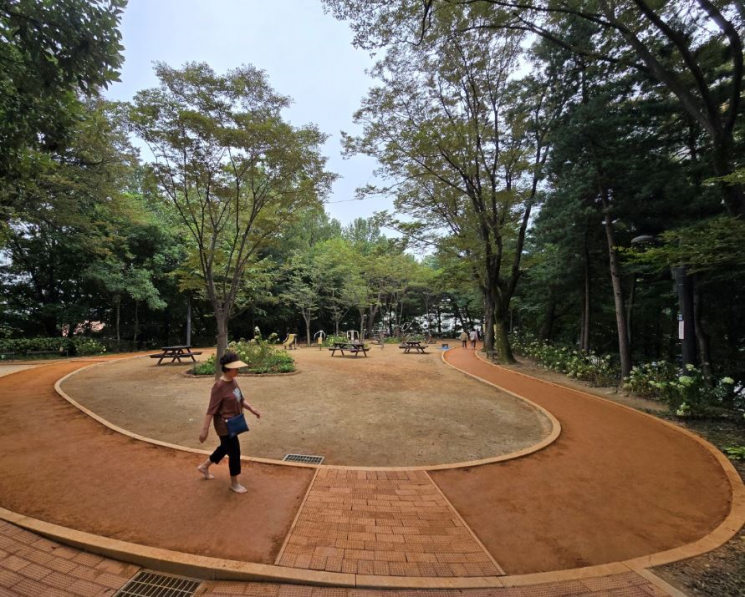 A resident is walking on the circular red clay path at Dure Neighborhood Park. Provided by Gangdong-gu.
Seoul Gangdong-gu (District Mayor Lee Suhee) announced on the 21st that, in response to the recent walking craze for health and the growing interest of residents in loess trails, loess trails have been created in a total of three locations, including Dure Neighborhood Park (Godeok-dong 497).
The district previously carried out the ‘Myeongil Park Maintenance and Renovation Project,’ during which some paved surfaces of the walking paths in the park were cleared and a loess trail (70m long, 1m wide) was created. However, as the number of visitors to the site gradually increased, safety issues arose and complaints grew, leading to an additional maintenance and renovation project planned in February. Major construction is currently underway with the goal of completion within this month.
The existing loess trail has been extended by an additional 85㎡ (85m long, 1m wide) to form a circular route. A foot washing station has been newly installed, and the walking paths are also being refurbished.
Myeongil Neighborhood Park (Sangil-dong 141) is the largest park in the district, covering approximately 420,000㎡. It is well-known as a place where local residents come to relax, and it is notable that the creation of the loess trail began as more people started walking barefoot there.
The green space along Dongnam-ro (Godeok-dong 306) is adjacent to Myeongil Neighborhood Park and is expected to see an increase in foot traffic with the upcoming extension and opening of Subway Line 9. However, since its establishment in 2006, the resting facilities such as benches and shelters, as well as the pavement, have deteriorated, making it a poor space for actual rest.
In December of last year, the district newly refurbished this area into a lush green space and created a 320㎡ (160m long, 2m wide) loess trail to provide a healing space within the city.
This area, located next to an apartment complex and adjacent to a road, was designed to improve the efficiency of maintaining the loess. Due to the risk of significant loess erosion during heavy summer rains, a dry-type construction method was adopted on a trial basis. Although the dry-type loess trail feels firmer and rougher with granules of sand compared to the wet-type, it is popular among residents who prefer stability and cleanliness.
The loess trail in Dure Neighborhood Park (Godeok-dong 497) was created earlier this year as part of the ‘Forest Barefoot Walking Path Creation Project’ in response to increasing demand for loess trails.
From February, a total of 216㎡ (120m long, 1.8m wide) of wet-type trail was constructed over six months, featuring a circular layout to maintain the flow of exercise. A foot washing station and shoe lockers were also installed for use after walking.
As part of the ‘Creating Walkable Paths in Parks Project,’ the district plans to additionally create loess trails of 232㎡ (116m long, 2m wide) and 178㎡ (148m long, 1.2m wide) at Beolmal Neighborhood Park (Gangil-dong 700) and Seongnae Honey Neighborhood Park (Seongnae-dong 533), respectively, by the end of this year.
District Mayor Lee Suhee stated, “Since creating loess trails allows residents to enjoy a healthy and relaxed daily life within the city, it is meaningful, and we will continue to do our best to improve the quality of life for residents.”
© The Asia Business Daily(www.asiae.co.kr). All rights reserved.
![Clutching a Stolen Dior Bag, Saying "I Hate Being Poor but Real"... The Grotesque Con of a "Human Knockoff" [Slate]](https://cwcontent.asiae.co.kr/asiaresize/183/2026021902243444107_1771435474.jpg)















