As the Bank of Korea cut the base interest rate for the first time in 38 months, deposit interest rates in the financial sector have begun to decline. While some financial companies have chosen to proactively lower deposit interest rates, banks are closely monitoring the situation amid the widening loan-deposit interest rate spread caused by tightened loan regulations and the increasing burden on borrowers.
According to the financial sector on the 18th, SBI Savings Bank lowered the interest rate on its so-called 'parking account,' a demand deposit account (Cider Demand Deposit Account), by 0.2 percentage points from 3.2% to 3.0% for balances up to 100 million KRW as of the 16th. This comes about two months after raising the parking account interest rate in early August.
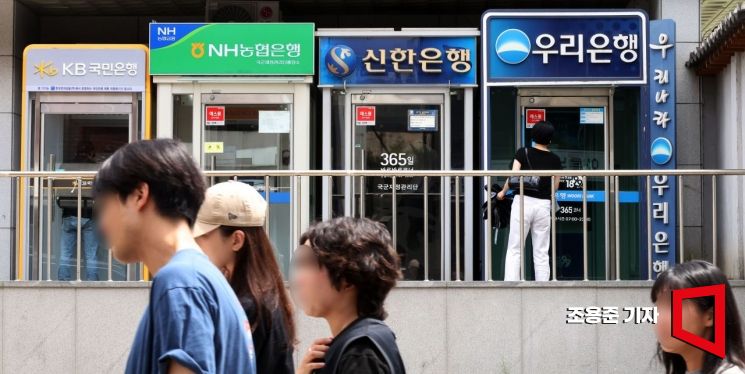 Since 2018 until June of this year, a total of 14,426 ATMs have been removed from banks over approximately six years. On the 24th, ATMs of commercial banks are installed on a street in Seoul. Banks are rapidly withdrawing ATMs, citing maintenance costs such as ATM management and heating and cooling expenses. Photo by Jo Yongjun jun21@
This interest rate cut is not limited to this savings bank alone. According to the Korea Federation of Savings Banks, the one-year fixed deposit interest rate in the savings bank sector as of the previous day was 3.69%, a slight decrease of 0.01% from 3.70% on the 10th, before the Bank of Korea's base rate cut. Although not prominent, a trend of lowering deposit interest rates is emerging among some institutions.
There have also been cases of deposit interest rate cuts in the banking sector. SC First Bank lowered the interest rates on its major deposit products by 0.1 percentage points the day before. For example, the interest rate for the bank’s flagship product, the 'e-Green Save Deposit,' when subscribed as a 12-month lump-sum payment, is 3.15% per annum, down 0.1 percentage points from the previous day.
The five major commercial banks (KB, Shinhan, Hana, Woori, NH Nonghyup) have not yet shown any significant movement. According to the Korea Federation of Banks, the one-year fixed deposit interest rates of these banks remain at a high level of 3.35% to 3.42% per annum. It appears they are taking a breather after lowering rates over the past few months in response to falling market interest rates.
The banking sector is closely watching the situation because the loan-deposit interest rate spread, which had been narrowing, has recently widened again. With the introduction of the second phase of the stress total debt service ratio (DSR) regulation next month, household loan demand has surged, prompting authorities and banks to suppress loan demand through various loan regulations, elimination of preferential interest rates, and increases in additional interest rates.
In fact, according to the Korea Federation of Banks, the household loan-deposit interest rate spread (excluding policy-based low-income financial products) of the five major banks widened by 0.14 percentage points to 0.57% in August from 0.43% the previous month. With the upper limit of mortgage loan interest rates at the five major banks rising to the mid-6% range, lowering deposit interest rates could further widen the loan-deposit interest rate spread. Public dissatisfaction, such as "deposit rates are falling faster than loan rates," is also causing hesitation in the banking sector.
However, maintaining deposit interest rates while borrowers’ burdens increase is another concern for banks. The Cost of Funds Index (COFIX), used as a benchmark for mortgage loan interest rates, actually rose by 0.04 percentage points to 3.40% as of September. COFIX reflects changes in the weighted average interest rates of funds raised by eight domestic banks, including interest rates on deposits, savings, and bank bonds actually handled by banks.
Authorities have also pointed out that the effects of interest rate cuts should be reflected in household loans. On the 11th, when the Bank of Korea decided to cut the base interest rate, Lee Bok-hyun, Governor of the Financial Supervisory Service, held a financial situation review meeting and stated, "We must closely monitor the trend of loan-deposit interest rates so that the effect of the base rate cut can be reflected even in existing household loans."
A representative of a commercial bank said, "If deposit interest rates are lowered, depositors may be dissatisfied, but on the other hand, borrowers benefit somewhat from the lower COFIX rate, which reduces their burden," adding, "We are carefully monitoring the direction of deposit interest rates while keeping various factors in mind."
© The Asia Business Daily(www.asiae.co.kr). All rights reserved.
![Clutching a Stolen Dior Bag, Saying "I Hate Being Poor but Real"... The Grotesque Con of a "Human Knockoff" [Slate]](https://cwcontent.asiae.co.kr/asiaresize/183/2026021902243444107_1771435474.jpg)















