"Under the stigma of 'Avoidance Departments,' 350 retirements expected by 2031
"In 3-4 years, it will be difficult for heart and lung cancer patients to undergo surgery""
By 2028, the number of newly certified cardiovascular thoracic surgery (thoracic surgery) specialists in South Korea is expected to be no more than 12, while the number of retiring thoracic surgeons during the same period is projected to reach 196. With more than 180 thoracic surgeons disappearing in just four years, concerns are rising that it will become increasingly difficult to receive heart or lung surgeries in the country.

According to the medical community on the 19th, following the mass resignation of residents due to prolonged conflicts between the government and medical professionals, a critical situation is worsening in thoracic surgery?a representative avoidance specialty and essential medical field?where the number of new specialists is being surpassed by retirees.
Thoracic surgeons perform surgeries on life-threatening conditions ranging from cardiovascular diseases such as heart valve, coronary artery, and aortic diseases to congenital heart defects, lung cancer, esophageal cancer, and respiratory-related intensive care. This specialty requires advanced surgical techniques and expertise that cannot be replaced by doctors from other departments.
According to a survey by the Korean Society for Thoracic and Cardiovascular Surgery, only six fourth-year residents are expected to qualify as new thoracic surgery specialists early next year. In 2026, only one specialist is expected to be certified. Including three in 2027 and two in 2028, the total number of new thoracic surgeons over the next four years will be just 12. Earlier this year, there were 107 thoracic surgery residents nationwide, but many resigned following the government's medical school expansion policy in February. This number assumes that residents do not drop out midway and continue their training.
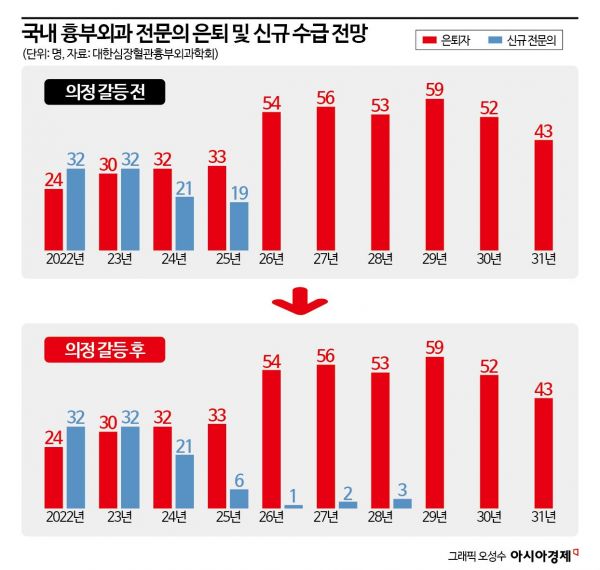
Meanwhile, the number of thoracic surgeons retiring upon reaching the mandatory retirement age of 65 is expected to be between 33 and 56 annually, totaling 196 over the period. Extending the period to 2031, three years later, the number of retirees will reach 350. As of 2020, there were over 1,300 licensed thoracic surgeons in South Korea, but only half of them worked at tertiary or general hospitals. This means that more than half of those will be further reduced.
Professor Jeong Ui-seok of the Department of Cardiovascular Thoracic Surgery at Gangbuk Samsung Hospital said, "Thoracic surgery is a specialty that is often avoided because of frequent emergency calls and the requirement for professors to be on duty. Even before, the number of applicants was very low, but the conflict between the government and medical professionals has now completely cut off the pipeline." He added, "For more than a decade, I have repeatedly said that measures are needed to address the shortage of thoracic surgeons, but the government still does not even properly know how many doctors capable of performing heart surgery are at which hospitals."
Thoracic surgery typically takes 6 to 7 hours and is performed by a team of at least 10 to 15 people, including the surgeon, surgical assistants (residents or dedicated surgical nurses), anesthesiologists, perfusionists, and nurses. Due to the high difficulty, the team must work in perfect coordination without losing focus even for a moment, making the role of specialists and the formation of dedicated teams crucial.
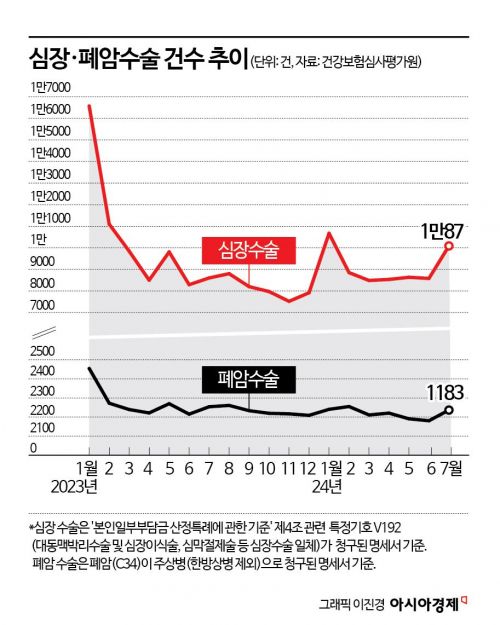
Accordingly, heart-related surgeries at tertiary and general hospitals temporarily decreased immediately after the mass resignation of residents but have since been maintained without significant change compared to the same period last year (a 5.3% decrease from February to July). Most heart diseases require immediate treatment (surgery) upon symptom detection, and hospitals explain that surgeries are being carried out forcibly by mobilizing dedicated nurses even in the absence of residents.
On the other hand, for lung cancer surgeries, which are also thoracic surgeries, many cases are first diagnosed through internal medicine and then transferred to tertiary hospitals in Seoul for surgery. As a result, the number of surgeries from February to July this year decreased by about 12.1% compared to the same period last year. Amid the medical gap, lung and heart transplant surgeries from brain-dead donors between February and August also decreased by 27.8% and 17.8%, respectively, compared to last year.
Professor Isaac of the Department of Cardiovascular Surgery at Severance Hospital said, "Due to the shortage of thoracic surgeons, only the most urgent surgeries can be performed, and as a result, intensive care units remain full. Patients who do not recover in secondary hospitals and whose conditions worsen are eventually transferred to tertiary hospitals. Professors are almost exhausted, and dedicated nurses cannot fully replace the roles of residents or fellows," he appealed.
Professor Jeong warned, "Doctors will continue to perform surgeries until they retire, but without revolutionary changes now, the future of thoracic surgery in just 3 to 4 years cannot be guaranteed. The future of patients, whether they can receive surgery immediately when needed, is disappearing."
© The Asia Business Daily(www.asiae.co.kr). All rights reserved.
![Clutching a Stolen Dior Bag, Saying "I Hate Being Poor but Real"... The Grotesque Con of a "Human Knockoff" [Slate]](https://cwcontent.asiae.co.kr/asiaresize/183/2026021902243444107_1771435474.jpg)

















