Ministry of Science and ICT Announces 4th Basic Radio Promotion Plan
New Fund Proposed to Foster Global Radio Companies
The government has announced a plan to secure 100 satellite networks by 2030 to timely supply future radio resources, which are key to digital innovation. It also plans to establish a fund to foster global radio companies.
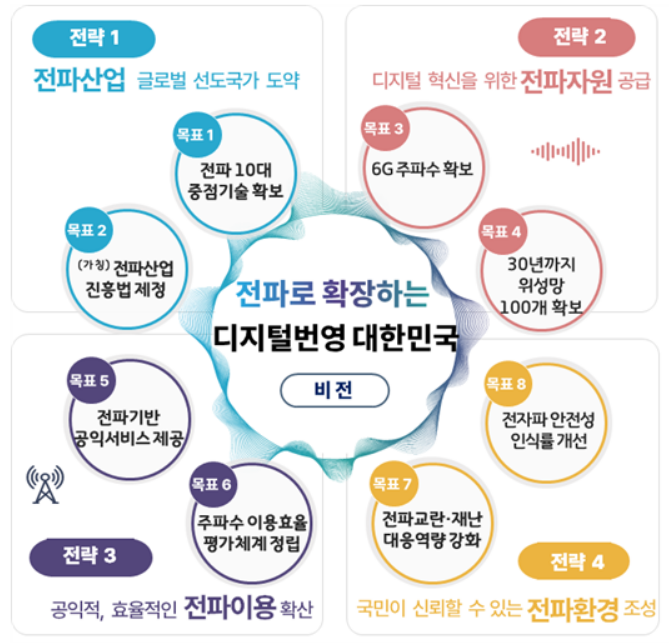
On the 16th, the Ministry of Science and ICT announced the "4th Basic Radio Promotion Plan," which centers on these contents. The ministry explained that current radio usage faces limitations such as poor connectivity in air, underwater, and underground environments, and difficulty passing through metal, and that the 4th plan includes measures to enable energy transmission beyond data transmission.
The government plans to secure 100 satellite networks by 2030 in preparation for future satellite radio demand. Satellite networks must be registered with the International Telecommunication Union (ITU), and currently, a total of 85 domestic satellite networks have been registered or are in the process of registration. Regarding low Earth orbit satellites, there are two domestic satellites to be developed through a preliminary feasibility study project in 2028. To increase the number of satellite networks, the government plans to improve usage and management systems, such as applying foreign satellite terminal permit presumptions. The permit presumption system allows sellers to use the authorization obtained from domestic authorities without individually obtaining radio certification.
The government will discover and secure 6G frequencies based on candidate bands adopted at the World Radiocommunication Conference (WRC-23). Currently, there are three 6G candidate bands: 4.4?4.8 GHz, 7.125?8.4 GHz, and 14.8?15.35 GHz. The government will decide whether to secure and promote these bands according to domestic usage conditions and trends and prepare frequency securing plans.

Regarding 5G frequencies, the government will consider additional supply not only for the 3.5 GHz adjacent band but also for low-band frequencies (700 MHz, 800 MHz, and 1.8 GHz bands). The utilization plan for the 28 GHz band, which was not supplied due to the cancellation of the 4th mobile communication network, is under discussion by a research group. Once the 4th mobile communication policy direction is decided, supply will be reviewed accordingly. Considering the cancellation of the 28 GHz band operator selection, the government plans to discuss introducing a financial capability verification procedure for applicants during frequency auctions. For 3G, LTE, and 5G frequencies nearing expiration, frequency reassignment and securing broadband frequencies will be pursued according to timing.
To dominate the global wireless market, the government will also strengthen core radio capabilities. To this end, it plans to consider establishing the K-Spectrum Fund (tentative name) as a resource for fostering global radio companies.
As digital public and public interest projects, five major digital wave projects will be promoted in the fields of ▲social safety ▲protection of the vulnerable ▲social integration ▲population change ▲climate response. A pilot project for frequency transfer and leasing will be implemented targeting I-eum 5G operators to improve transfer and leasing procedures. Additionally, the government will establish radio security by expanding and upgrading GPS monitoring systems, introducing an EMP response system based on post-restoration, and will also promote expanding training grounds and introducing systems to respond to illegal drones.
© The Asia Business Daily(www.asiae.co.kr). All rights reserved.
![Clutching a Stolen Dior Bag, Saying "I Hate Being Poor but Real"... The Grotesque Con of a "Human Knockoff" [Slate]](https://cwcontent.asiae.co.kr/asiaresize/183/2026021902243444107_1771435474.jpg)















