Bloomberg News Interview
Identifies Pennsylvania and Michigan as Key Battlegrounds
US Steel Opposes Sale to Nippon Steel
Antitrust Violation Google: "Other Fair Measures Instead of Breakup"
With the U.S. presidential election just three weeks away, former President Donald Trump, the Republican candidate, announced on the 15th (local time) that he would impose ultra-high tariffs to attract manufacturing plants back to the U.S. and create numerous jobs. He repeatedly indicated his intention to use tariffs as leverage, even using the phrase "threat of tariffs." He identified the battleground Rust Belt swing states of Pennsylvania and Michigan as the key decisive areas in the election and expressed confidence by saying, "We are doing well."
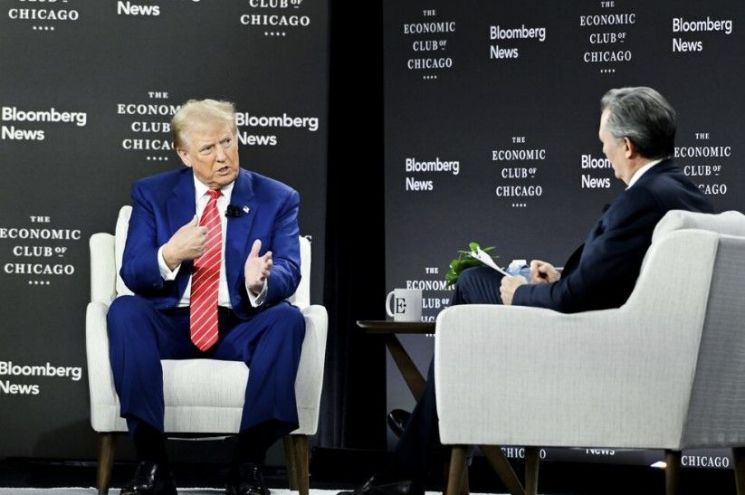
In an interview with Bloomberg News at the Chicago Economic Club that day, former President Trump said, "We will bring companies back to our country and increase jobs to a level never seen before," adding, "This is only possible through the threat of tariffs."
He claimed that the tariff hikes are "to protect the companies here in the U.S. and those that will come in." He continued, "Tariffs will be huge and have positive effects," emphasizing, "The higher the tariffs, the more likely companies will come to the U.S. to build factories, so they won't have to pay tariffs."
Regarding concerns that tariff increases could raise product prices and fuel inflation, thereby harming the U.S. economy, he countered that this could be offset by the creation of new domestic manufacturing jobs.
He also clearly stated his intention to use tariffs as a means to firmly maintain the U.S. dollar's status as the global reserve currency. Former President Trump pointed out that the dollar is being threatened by the yuan and other currencies, and if the dollar loses its current status, the U.S. would be downgraded to a third-world position. He reaffirmed his previous statement that tariffs would be imposed on countries that do not use the dollar as the settlement currency in trade.
With union votes in the Rust Belt swing states expected to be decisive in the election outcome, he reiterated his intention to block Japan Steel's acquisition of US Steel. Former President Trump emphasized that steel is related to important national security interests and said, "There are specific companies that we must have."
US Steel is located in Pittsburgh, Pennsylvania, a battleground state where both former President Trump and Democratic candidate Vice President Harris must win. Pennsylvania has the largest number of electoral votes among the seven key battleground states that will decide the presidential election, with 19 votes. Former President Trump also named Pennsylvania and Michigan as the main battlegrounds that will determine the election outcome. He said, "They (election experts) talk about Pennsylvania and I want to say it’s most of the decision. I think we are doing very well there. We also need to look at Michigan."
On illegal immigration, he reaffirmed a tough stance. Former President Trump said, "I want many people to come into our country, but I want them to come legally," and stated that if he returns to the White House, he will complete the construction of the southern border wall, implement large-scale deportations of illegal immigrants, and introduce measures to ban immigrants from Muslim countries.
Former President Trump referred to South Korea as a "Money Machine" and said that if he were in the White House, he would have made South Korea pay $10 billion annually (about 13.65 trillion won) for the cost of U.S. troops stationed there (defense cost-sharing). He also claimed that during his tenure, he demanded $5 billion annually from South Korea for defense cost-sharing, but South Korea was reluctant, so he first made them pay $2 billion and then planned to make them pay $5 billion the following year. He criticized his successor, President Joe Biden, for reversing the agreement, calling it "a shame."
The interview also included a question about whether he would dismiss Jerome Powell, chairman of the U.S. Federal Reserve, if he wins the election. Former President Trump has mentioned dismissing Chairman Powell several times before. While avoiding a direct answer in the interview, he expressed the view that the president should be able to express opinions on interest rates to the central bank chief. He said that while the president should not direct monetary policy, "a very smart and sensible president should at least be able to talk with him." He also criticized the Fed for initially missing the inflation response and for lowering interest rates by 0.5 percentage points in September to support Vice President Harris.
Regarding Google, which recently lost an antitrust lawsuit filed by the U.S. Department of Justice over the search market, he said measures should be taken to make the search engine fairer but expressed the view that there is no need to break up the company.
Regarding claims that he spoke several times with Russian President Vladimir Putin after leaving office, he said, "I won’t comment, but if I did, I would say it was a wise thing," adding, "Being friendly and building relationships with people is not a bad thing but a good thing."
Bob Woodward, the Watergate scandal investigative journalist, wrote in his new book "War," published on the 15th (local time), that former President Trump spoke with President Putin seven times after leaving office in 2021.
© The Asia Business Daily(www.asiae.co.kr). All rights reserved.
![Clutching a Stolen Dior Bag, Saying "I Hate Being Poor but Real"... The Grotesque Con of a "Human Knockoff" [Slate]](https://cwcontent.asiae.co.kr/asiaresize/183/2026021902243444107_1771435474.jpg)















