"Over 10% Market Share in Europe for China Is Difficult"
Considering Factory and Brand Withdrawal, Layoffs
Carlos Tavares, CEO of Stellantis, warned that delaying the transition to electric vehicles would result in higher costs for manufacturers. This statement directly contradicts recent calls from European automakers to ease the European Union (EU)'s carbon emission regulations.
At the Paris Motor Show on the 14th (local time), CEO Tavares told major foreign media, "Extending the transition period to electric vehicles is a big trap," adding, "When the transition period is extended, internal combustion engine (ICE) vehicles do not get replaced by electric vehicles. Instead, electric vehicles are added on top of ICE vehicles." This means that if the shift to electric vehicles is delayed, investments must be made in both ICE vehicles and electric vehicles, worsening the industry's profitability.
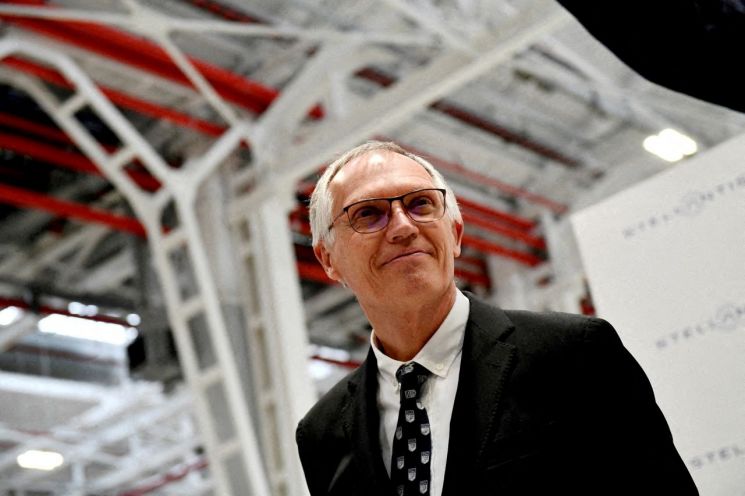
Stellantis is the world's fourth-largest automaker, owning brands such as Peugeot, Fiat, and Chrysler.
The EU will regulate the carbon emissions of new cars sold from next year to 93.6g per kilometer, a significant tightening from this year's 116g/km. In response, major manufacturers are urging the EU to relax these regulations.
Stellantis is experiencing a decline in performance due to increased inventory in the U.S. market and weak demand in key markets. CEO Tavares emphasized the need to focus on selling electric vehicles at lower prices to consumers in order to survive competition with low-cost Chinese competitors. He stated, "There are no limits to customer demands," and predicted that if Chinese companies achieve a 10% market share in Europe within the next few years, European car factories struggling with overproduction will face even greater difficulties.
In an interview with radio station RTL on the same day, CEO Tavares also mentioned that some factories might need to be closed or brands sold to maintain profitability amid the entry of Chinese companies into Europe. He did not rule out job cuts.
The EU is expected to implement a plan to raise tariffs on Chinese electric vehicles to as high as 45.3% starting at the end of this month. In response, Chinese companies such as BYD, Chery, and Xpeng are accelerating their market penetration by securing production bases within Europe.
On the same day, Stella Li, Vice President of BYD, the world's second-largest electric vehicle manufacturer, stated in an interview with foreign media that the company plans to produce almost all vehicles sold in Europe locally. Li said BYD has not yet decided whether to pass on the 17% tariff increase to consumers or absorb it themselves. However, she added that they do not expect to be able to sell cars priced below 30,000 euros in Europe.
© The Asia Business Daily(www.asiae.co.kr). All rights reserved.
![Clutching a Stolen Dior Bag, Saying "I Hate Being Poor but Real"... The Grotesque Con of a "Human Knockoff" [Slate]](https://cwcontent.asiae.co.kr/asiaresize/183/2026021902243444107_1771435474.jpg)















