Yoon Returns Today After 5-Night, 6-Day Southeast Asia Tour
Closely Strengthening Top-Level Partnership with ASEAN
Cooperation on Nuclear Power and Supply Chains with the Philippines and Singapore
Meets Japanese PM Ishiba to Share Views on North Korea and Russia Issues
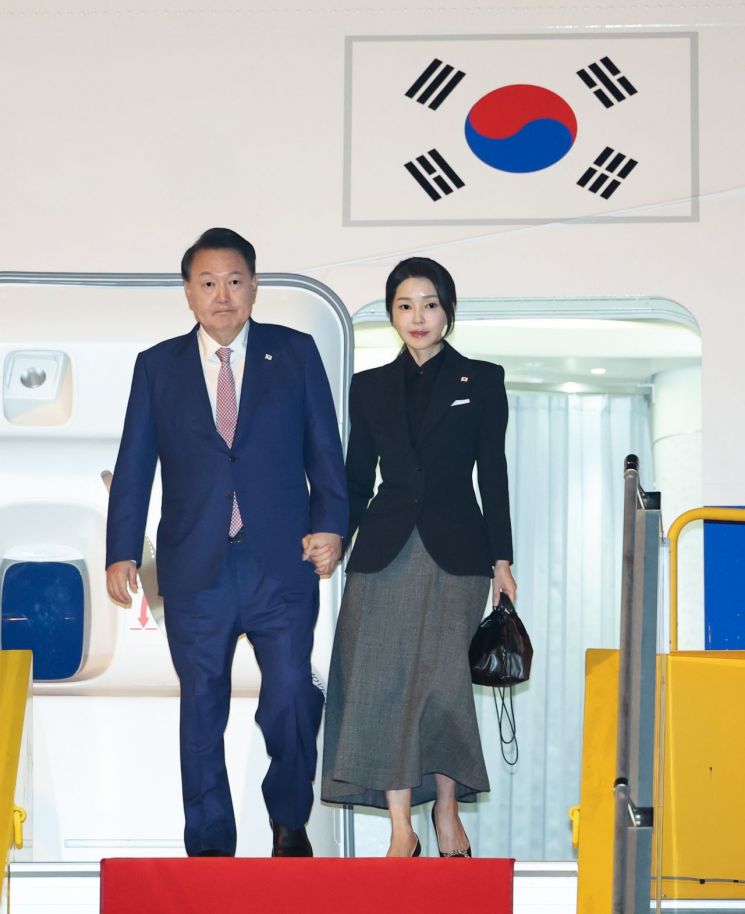 President Yoon Suk-yeol and First Lady Kim Keon-hee, attending the ASEAN Summit, arrived at Wattay International Airport in Vientiane, Laos, on the 9th (local time) and are disembarking from Air Force One, their exclusive aircraft.
 [Image source=Yonhap News]
President Yoon Suk-yeol significantly expanded South Korea's diplomatic horizons and economic territory through a 5-night, 6-day tour of the Philippines, Singapore, and Laos. He established the highest level of partnership in 35 years of diplomatic relations with ASEAN (Association of Southeast Asian Nations), which has a population of 685 million, and held the first Korea-Japan summit with Japanese Prime Minister Ishiba Shigeru, forming a consensus on security cooperation such as 'real-time sharing of alert information.' Notably, he also achieved results in promoting exports and investments by signing memorandums of understanding (MOUs) on cooperation in areas including nuclear power and supply chains with the Philippines and Singapore.
President Yoon will return home on the 11th after completing his tour of the three Southeast Asian countries. During this trip, which included attending the ASEAN summit held on the 10th (local time) in Vientiane, the capital of Laos, President Yoon focused on promoting 'all-round and comprehensive cooperation as partners for joint prosperity' with ASEAN. The establishment of a 'Comprehensive Strategic Partnership' after 14 years since the formation of a 'Strategic Partnership' reflects this focus. This signifies the formation of a long-term friendly relationship encompassing not only security and economy but also a sustainable future across comprehensive fields.
ASEAN is a huge market with a gross domestic product (GDP) of $3.81 trillion. Most member countries are developing nations with high growth potential, making them ideal partners for South Korea, which has a high degree of economic openness. The Korea-ASEAN joint statement declared that "by fully utilizing bilateral and multilateral mechanisms, trade and investment will be promoted and economic integration enhanced," raising expectations for increased trade and investment between companies in the future.
President Yoon also engaged in 'sales diplomacy' during his state visits to the Philippines and Singapore. With the Philippines, an agreement was reached for Korea Hydro & Nuclear Power to conduct a feasibility study to resume the Bataan nuclear power plant project, which was halted after the Chernobyl disaster in 1986. If the feasibility study is successfully completed, it could pave the way not only for the Bataan plant but also for securing orders in the Southeast Asian nuclear power market.
Additionally, with Singapore, a 'Supply Chain Partnership Agreement' was signed to jointly respond to supply chain disruptions, along with an MOU on cooperation in the liquefied natural gas (LNG) sector. Amid growing global uncertainties originating from the Middle East, Singapore, a global logistics and transportation hub and an LNG powerhouse, has been established as a stable supply chain partner. Close ties with Southeast Asian countries, which have cheap labor and abundant natural resources, are also expected to positively impact South Korea's economy by reducing its dependence on China, a known vulnerability.
During the tour, President Yoon expanded not only economic but also diplomatic and security horizons. In particular, during the first 40-minute meeting with Prime Minister Ishiba, they agreed to actively conduct 'shuttle diplomacy' (regular summits alternating between the two countries). They also agreed to closely operate a 'real-time alert information sharing system' in response to North Korea's missile threats. They shared concerns about North Korea's nuclear threats and illegal cyber activities and reached a consensus that Russia-North Korea military cooperation is illegal. However, sensitive issues often cited as limits to improving Korea-Japan relations, such as forced labor and Dokdo, were not discussed.
Upon returning home, President Yoon is expected to focus on resolving domestic political issues that have accumulated. During the tour, the burden on the ruling party increased as the controversy over First Lady Kim Geon-hee's alleged interference in candidate selection and the fallout surrounding Myung Tae-kyun expanded. The Democratic Party of Korea is even pushing for a permanent special prosecutor targeting the Kim-related risks, which have become a core controversy. After the by-elections on the 16th, President Yoon plans to have a private meeting with People Power Party leader Han Dong-hoon to discuss the Kim-related risks, medical school expansion, and the controversies involving Myung Tae-kyun and Kim Dae-nam.
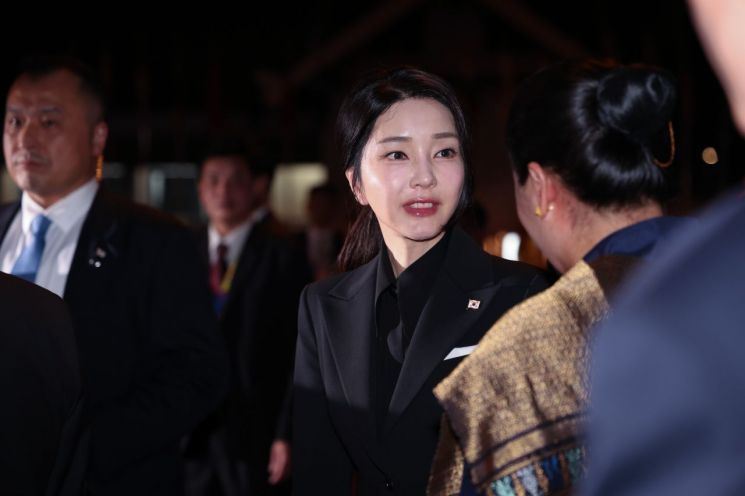 First Lady Kim Keon-hee, who accompanied President Yoon Suk-yeol to the ASEAN Summit, arrived at Wattay International Airport in Vientiane, Laos, on the 9th (local time) and is seen conversing with Laotian officials who came to welcome her. [Image source=Yonhap News]
© The Asia Business Daily(www.asiae.co.kr). All rights reserved.
![Clutching a Stolen Dior Bag, Saying "I Hate Being Poor but Real"... The Grotesque Con of a "Human Knockoff" [Slate]](https://cwcontent.asiae.co.kr/asiaresize/183/2026021902243444107_1771435474.jpg)
















