NVIDIA CEO Also Names Nuclear Power as Optimal Energy for Data Centers
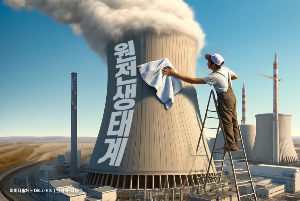
Expectations are rising that nuclear energy will enter a new golden age due to the AI technology boom led by big tech (large information technology companies).
On the 9th (local time), the British weekly magazine The Economist reported, "Microsoft (MS), Amazon, Google, and other big tech companies are competing to find enough clean energy to power the data centers supporting the AI boom," adding, "This is accelerating the nuclear revival."
Unlike wind and solar energy, nuclear energy has been noted as an energy source for data centers because it can supply clean energy 24 hours a day. Jensen Huang, CEO of Nvidia, also cited nuclear power as the most suitable clean energy for data centers in a Bloomberg interview on the 27th of last month.
However, since the US, Europe, and Japan have only recently shifted back to pro-nuclear policies, there are hardly any suitable reactors to meet the surging power demand driven by AI industry development. This means new nuclear power plants need to be built, which can take a long time and require enormous capital. The construction cost of Vogtle Unit 4 in Georgia, which began operation this year, exceeded $35 billion?more than twice the initial estimate?and its completion was delayed by seven years.
Big tech companies facing urgent power demand are turning to Small Modular Reactors (SMRs) as an alternative. SMRs have the advantage of significantly reducing construction time and costs compared to traditional nuclear plants because the modules are prefabricated in factories and then assembled.
Last month, software company Oracle announced plans for a large data center powered by three licensed SMRs. On the 3rd, Google also stated that it is considering SMRs to supply power to its data centers.
Currently, only China and Russia operate SMRs, but the US has more SMR construction plans than anywhere else in the world. For example, US power equipment manufacturers like GE Vernova have started developing SMR models. TerraPower, an SMR startup invested in by Bill Gates, the founder of MS, broke ground on its first factory in Wyoming last August.
Oklo, supported by Sam Altman, the "father of ChatGPT" and founder of OpenAI, plans to build multiple SMRs by 2030. Earlier this year, Oklo signed a contract to provide a 500 MW nuclear power plant to data center operator Equinix.
Last month, MS also launched a $30 billion AI-dedicated infrastructure fund in collaboration with BlackRock to invest in nuclear projects.
Many governments worldwide, which have been lukewarm toward nuclear power for decades, have also pledged support. At the UN Climate Week event held in New York State on the 22nd of last month, more than 20 countries reaffirmed their commitment to triple global nuclear power generation by 2050, a goal adopted at last year's UN Climate Change Conference of the Parties (COP28). Fourteen major banks also joined in pledging to finance new nuclear projects at the event.
Chris Womack, CEO of Southern Company, a power company based in Georgia, emphasized, "The government needs to provide cost overrun insurance (for nuclear energy development)" and "streamlining the lengthy approval process is also necessary."
© The Asia Business Daily(www.asiae.co.kr). All rights reserved.
![Clutching a Stolen Dior Bag, Saying "I Hate Being Poor but Real"... The Grotesque Con of a "Human Knockoff" [Slate]](https://cwcontent.asiae.co.kr/asiaresize/183/2026021902243444107_1771435474.jpg)















