Financial authorities are closely monitoring the recent signs of a slowdown in the growth of household debt, maintaining a high level of vigilance. While carefully observing whether additional measures are necessary, a new regulatory option called the 'Landlord Total Debt Service Ratio (DSR) Limit' is also being proposed.
According to the banking sector on the 10th, as of the end of last month, the outstanding balance of mortgage loans (including jeonse deposit loans) at the five major banks (KB Kookmin, Shinhan, Woori, Hana, and NH Nonghyup) was 574.5764 trillion won, an increase of 5.9148 trillion won compared to 568.6616 trillion won the previous month. This increase is less than 70% of the 8.9115 trillion won rise in mortgage loan balances seen in August alone. This appears to be the effect of the loan regulation stance that has spread throughout the financial sector since July. Additionally, the volume of apartment transactions in Seoul, which peaked in July, has been declining for two consecutive months.
The financial authorities plan to monitor whether mortgage loans and household loans remain stably below target ranges until mid-October. At a meeting with financial holding company chairpersons earlier this month, Financial Services Commission Chairman Kim Byung-hwan directly emphasized that additional measures would be boldly implemented if household debt increases. Currently, household loan levels are being managed through voluntary regulations by financial companies, but this indicates that the authorities are not letting their guard down. This is because the demand has not actually disappeared, only the loans have been restrained.
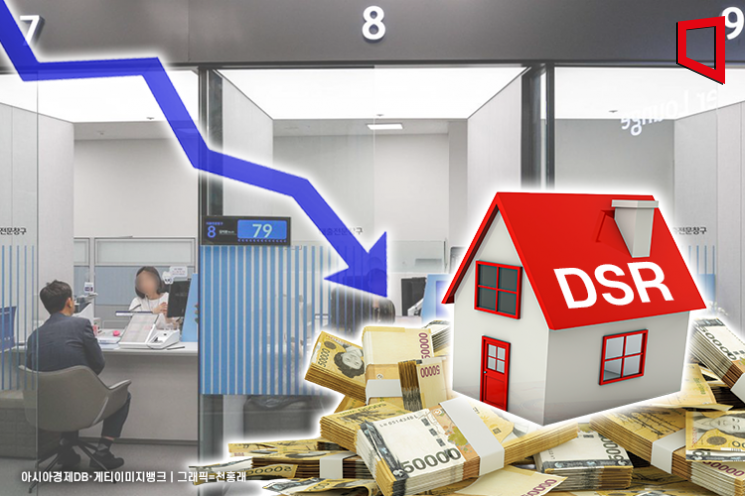
In response, various proposals regarding DSR regulations are emerging as additional measures. Earlier this year, financial authorities identified the expansion of DSR application as one of their key tasks. The Financial Supervisory Service stated it would gradually expand the scope of DSR application to establish credit screening focused on repayment ability, and the Financial Services Commission also announced it is considering expanding DSR application to include jeonse deposit loans and policy finance. Early implementation of the third phase stress DSR, currently postponed to the second half of next year, is also being discussed.
Recently, the Korea Institute of Finance released a report proposing a new DSR regulatory approach. Park Chun-sung, a research fellow at the Korea Institute of Finance, suggested in the "Discussion Report on DSR Regulation Measures Considering Jeonse Deposit Loans" that interest on jeonse deposit loans be directly reflected in the DSR for tenants, and that a form of stress DSR be introduced for landlords as well.
This proposal goes beyond the previously discussed inclusion of tenant jeonse loan interest in the DSR within the financial sector. According to this plan, the DSR regulatory level for landlords would be strengthened to maintain their borrowing capacity. This is a measure to prepare for situations where landlords cannot return deposits due to falling house prices, allowing them to use additional loans to repay deposits. Since it reflects the risk of jeonse price declines, it can be seen as a type of stress DSR.
Park explained, "Although the nominal borrower of the jeonse deposit loan is the tenant, considering where the funds go during the jeonse contract period, the actual borrower is the landlord, so the proposal is to reflect this in the landlord's DSR."
© The Asia Business Daily(www.asiae.co.kr). All rights reserved.
![Clutching a Stolen Dior Bag, Saying "I Hate Being Poor but Real"... The Grotesque Con of a "Human Knockoff" [Slate]](https://cwcontent.asiae.co.kr/asiaresize/183/2026021902243444107_1771435474.jpg)

















