Generation 1030 Obsessed with Saju "Relieving Anxiety"
7.7 Million Users on Top 6 Fortune Apps Over 6 Months
Experts Say "A Type of Consumer Good... Not a Negative Phenomenon"
On a weekday afternoon, I visited the Saju Cafe street in Gwangjin-gu, Seoul. Along the street, there were shops offering Saju and Tarot readings, filled with young people ranging from their teens to their 30s. In some of the more famous shops, which gained popularity through word of mouth online, people were even seen lining up and waiting.
At one Saju cafe that day, I met Kim (27), a job seeker, who said, "I've been preparing for employment for three years, but the results haven't been good, so feeling frustrated, I came here to get a Saju reading based on recommendations from acquaintances." She added, "During the 30-minute session, I shared my thoughts and listened to what kind of person I am, and I think I received some helpful advice."
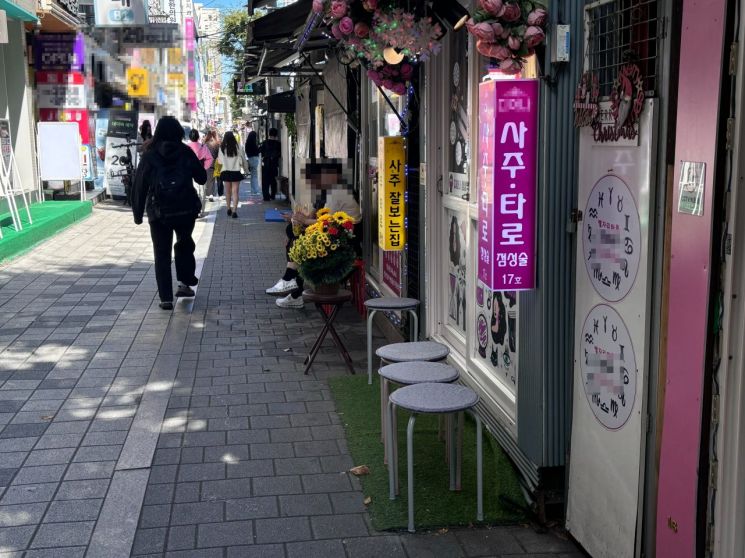
Recently, a culture of consulting fortune-telling methods such as Saju, shamanistic divination, Tarot, palm reading, and physiognomy has taken root, especially among the MZ generation (Millennials + Generation Z). Analysts say that young people rely on fortune-telling to soothe their anxious realities. The 1030 generation I met on the Saju Cafe street all agreed that they sought Saju readings to calm their anxious minds and find direction for their futures.
Office worker Lee (30) said, "I was unsure whether to stay at my current job or move, so I got a Saju reading twice, hoping it might help. I was told it would be better to make a move in the first half of next year rather than this year, so I’m preparing accordingly." University student Lim (24) said, "I’m about to graduate, and my mind is unsettled, so I’ve had Saju readings about four times this year, spending around 200,000 won. The main content is similar, but the interpretations differ, and I change the focus each time, such as employment luck or aptitude luck."
Because the demand is diverse?from university students to job seekers and office workers?some reputedly skilled shops have their reservations fully booked for a year. Lim (67), who has run a Saju house for 10 years, explained, "In recent years, women in their mid to late 20s have visited the most, and usually, young customers from their late teens to 30s come continuously. Since many live away from home, they seem to seek to relieve anxiety when trying to change their environment, such as employment, moving, or changing jobs." Kim (63), who has operated a fortune-telling house for 30 years, also said, "Although the number of visitors has decreased due to the tough economy, young people are definitely visiting more."
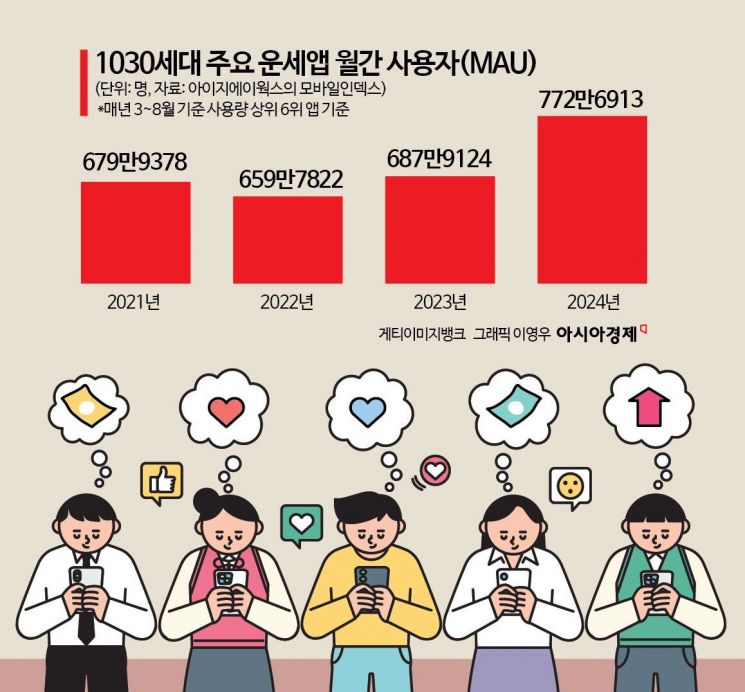
Many also consult Saju readings remotely, either by phone or online counseling without visiting the shops in person. In fact, the number of users of applications (apps) offering services like Saju interpretation or daily horoscopes is rapidly increasing. According to Mobile Index data from data company IGAWorks, the number of 1030 generation users of the top six fortune-telling apps in the past six months (March to August) reached 7,726,913, an increase of 920,000 compared to three years ago.
Beyond simply visiting for readings, more 1030 generation individuals are studying and learning fortune-telling themselves. Office worker Kim Kyung-min (25) said, "When I went for a Saju reading last February, I experienced relief from my worries, which sparked my interest and led me to start studying. I’ve read about 10 related books at the library and am also studying physiognomy while listening to my acquaintances’ concerns."
Experts analyze this phenomenon as the 1030 generation viewing Saju as a kind of medium to soothe real-life anxieties while also perceiving it as a consumer product. Professor Gu Jung-woo of the Sociology Department at Sungkyunkwan University said, "Basically, with anxiety about the future and the ability to see various fortunes, it is being consumed somewhat like a game. Since fortune-telling is still mostly practiced by social leaders or elite groups, there is no need to view the increasing visits by the MZ generation with prejudice."
Professor Lim Myung-ho of the Psychology Department at Dankook University added, "Since the COVID-19 pandemic, young people have repeatedly faced difficulties in employment and marriage, making it hard to achieve a sense of accomplishment, which leads them to rely on Saju or Tarot. Psychologically, it can have a positive effect by providing a direction to work harder through self-fulfilling prophecy." He continued, "Although fortune-telling is perceived as unscientific and wasteful, it clearly has psychological effects. Unless it is an excessive generalization, it can be used as a means to rely on."
© The Asia Business Daily(www.asiae.co.kr). All rights reserved.
![Clutching a Stolen Dior Bag, Saying "I Hate Being Poor but Real"... The Grotesque Con of a "Human Knockoff" [Slate]](https://cwcontent.asiae.co.kr/asiaresize/183/2026021902243444107_1771435474.jpg)
















