A technology capable of responding to the extinction threat of Korean nutmeg yew using microorganisms has been developed domestically.
On the 30th, the National Institute of Forest Science announced that it succeeded in developing a technology that reduces the mortality rate of young Korean nutmeg yew trees while enhancing their immunity using eco-friendly microorganisms, in collaboration with Professor An Young-sang's team at Chonnam National University.
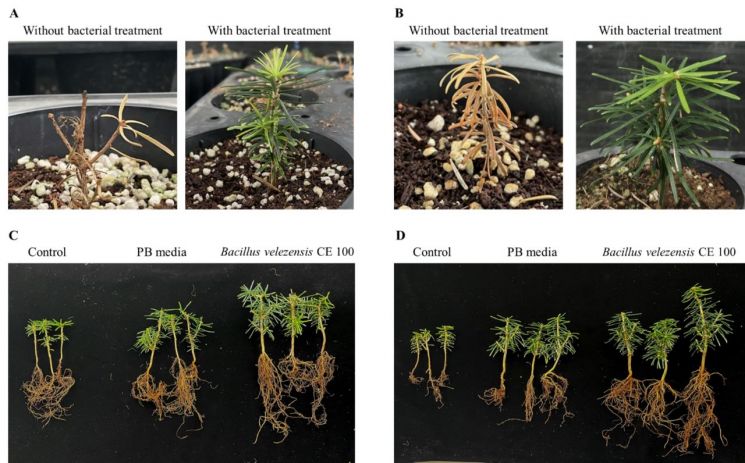 A technology to increase the survival and growth of young arborvitae trees through microbial treatment has been developed domestically. Photo by National Institute of Forest Science
Korean nutmeg yew is an endemic tree species in Korea that has recently been pushed to the brink of extinction due to climate change and other factors. Currently, only nine colonies remain, mainly in the southern central regions of the Korean Peninsula, including Hallasan, Jirisan, and Deogyusan.
The main cause of the decline of Korean nutmeg yew is the sharp decrease in the emergence rate of young trees, which indicates the sustainability of the forest. In fact, the emergence rate of young Korean nutmeg yew trees decreased by 43.5% from 2018 to 2020, highlighting the urgent need for propagation measures for the conservation and restoration of Korean nutmeg yew.
In response, the Forest Science Institute and Professor An's research team identified two fatal pathogens to Korean nutmeg yew through RNA analysis and inoculation of dead young trees, and conducted experiments treating Korean nutmeg yew seedlings inoculated with these pathogens with microorganisms.
As a result, compared to the control group treated with medium only, the survival rate of young Korean nutmeg yew trees increased by 1.4 to 1.8 times, and growth volume improved by 1.8 times.
The research paper containing these results was recognized for its academic value and published in the international scientific journal Biological Control.
Researcher Lim Hyo-in of the National Institute of Forest Science stated, “The development of technology to enhance Korean nutmeg yew immunity using microorganisms is a key research outcome necessary for producing young trees to rebuild Korean nutmeg yew forests,” adding, “The Forest Science Institute will strive to expand the application of this technology to other high-altitude conifers based on these research results.”
© The Asia Business Daily(www.asiae.co.kr). All rights reserved.
![Clutching a Stolen Dior Bag, Saying "I Hate Being Poor but Real"... The Grotesque Con of a "Human Knockoff" [Slate]](https://cwcontent.asiae.co.kr/asiaresize/183/2026021902243444107_1771435474.jpg)















