August Statistics Korea Industrial Activity Trends
Driving Increase in Semiconductor and Car Production
Industrial production in all sectors turned positive in August for the first time in four months. This was due to increased production in semiconductors and automobiles. Retail sales also rose to their highest level in 18 months, supported by the early arrival of the Chuseok holiday.
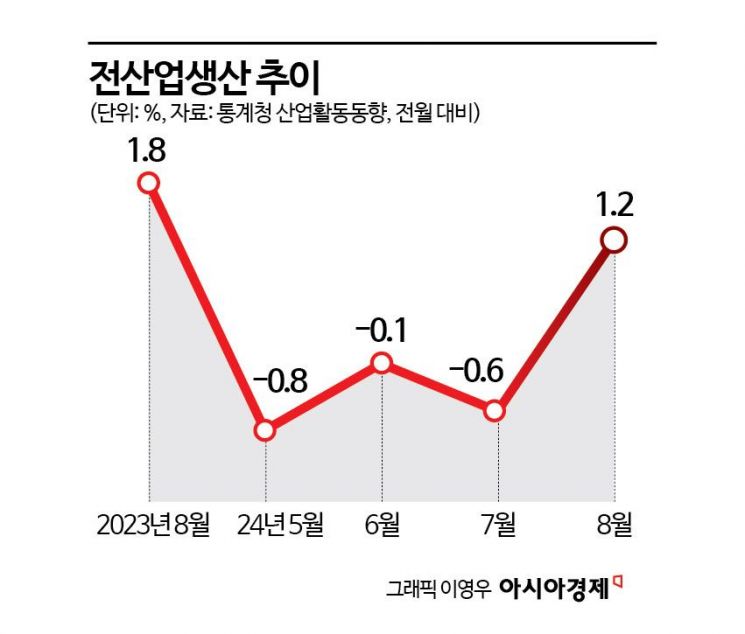
According to the 'August Industrial Activity Trends' released by Statistics Korea on the 30th, total industrial production last month increased by 1.2% compared to the previous month. After showing negative trends consecutively in May (-0.8%), June (-0.1%), and July (-0.6%), it shifted to an upward trend. This marks the first increase in total industrial production in four months.
Manufacturing, which accounts for the majority of the mining and manufacturing industry, led the production increase with a 4.1% rise compared to the previous month. This is the highest increase in 12 months since August last year when it rose by 5.4%. Although production decreased in areas such as telecommunications and broadcasting equipment (-7.1%), the significant increase in production of the two main pillars of manufacturing?automobiles (22.7%) and semiconductors (6.0%)?had a major impact. The Ministry of Economy and Finance explained that automobiles contributed about 1.9% and semiconductors about 1.2% to production.
The automobile sector reflected a base effect following a 14.4% drop in production in July due to parts suppliers' strikes and line maintenance work. Mi-sook Gong, Director of Economic Trend Statistics at Statistics Korea, explained, "In August, semiconductors were leading production, and automobiles also performed well, so manufacturing was in a very good condition."
In fact, manufacturing shipments increased by 5.7% compared to the previous month due to increased shipments of automobiles and petroleum refining. Specifically, domestic shipments of automobiles rose by 20.2%, and export shipments of semiconductors increased by 9.7%. The average operating rate of manufacturing rose by 3.2 percentage points from the previous month to 74.3%. Although inventories increased by 1.4% compared to the previous month, Statistics Korea assessed this as not negative since these inventories were waiting to be shipped.
Service sector production also increased by 0.2% compared to the previous month, marking three consecutive months of growth. This was due to increased vehicle usage during the vacation season and a significant rise in the number of foreign tourists entering the country. The number of foreign arrivals increased from 1,458,000 in July to 1,633,000 last month. Increased use of air conditioning also led to higher fuel consumption.
As a result, production decreased in information and communication (-4.3%) but increased in wholesale and retail trade (3.0%) and accommodation and food services (4.4%). Director Gong explained, "Although it was vacation season, lower-than-average rainfall led to increased production in accommodation and food services." Both restaurant and bar sectors saw growth in production.
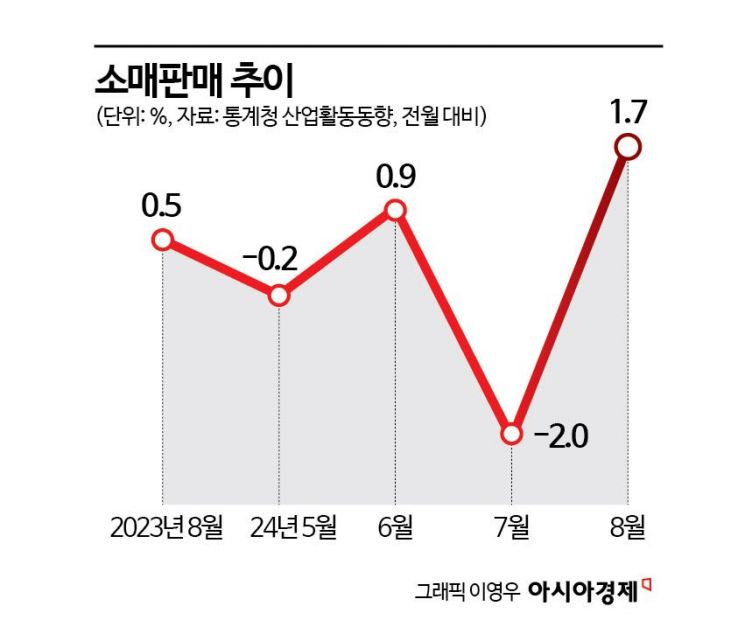
Retail sales, which indicate trends in goods consumption, also turned positive with a 1.7% increase. This is the highest growth rate in 18 months since February last year (4.0%). Retail sales had shown a decline in April (-0.6%) and May (-0.2%), turned positive in June (0.9%), but decreased again in July (-2.0%).
Sales decreased in semi-durable goods such as shoes and bags (-0.9%), but increased in non-durable goods like food and beverages (2.7%) and durable goods such as passenger cars (1.2%). Director Gong analyzed, "The early arrival of Chuseok led to increased food and beverage sales, and fewer rainy days in August combined with the vacation season boosted vehicle fuel production." Domestic passenger car sales also increased.
Facility investment decreased by 5.4% compared to the previous month. This was due to reduced investment in transportation equipment (-15.4%) and machinery such as semiconductor manufacturing equipment (-1.0%). Statistics Korea explained that a base effect was at play following a large increase in transportation equipment investment (50.5%) in July due to aircraft imports. A Ministry of Economy and Finance official said, "In July, two large aircraft and six medium-sized aircraft were imported, but only three were imported in August, which had a significant impact."
Construction performance decreased by 1.2% compared to the previous month, continuing a negative trend for four months, as civil engineering projects increased by 2.4% but building construction decreased by 2.4%. This was due to a decline in non-residential buildings such as factories. The heatwave appears to have slowed the progress of construction at semiconductor plants like Samsung Electronics.
The coincident index, which reflects the current economic trend, stood at 98.2, down 0.1 points from the previous month. It has recorded negative growth for six consecutive months since March this year. This is the first time since July-December 2018 that the coincident index has declined for six consecutive months. The leading index, which predicts future economic trends, also fell by 0.1 points to 100.6.
The coincident index declined due to decreases in construction performance and import volume, while the leading index fell due to decreases in factors such as the short- and long-term interest rate spread. Director Gong forecasted, "Looking at the overall trend, the leading index has been rising or stable since May last year, and the coincident index is expected to follow suit."
The government evaluated that total industry improved as special factors such as parts suppliers' strikes were resolved last month, leading to a sharp rebound in mining and manufacturing and three consecutive months of growth in the service sector. In particular, mining and manufacturing saw production increases across various industries, raising expectations for 12 consecutive months of export growth in September and continued recovery centered on exports and manufacturing. Regarding domestic demand, with retail sales rebounding amid improvements in the service sector, the government added that it will implement tailored policy measures reflecting the varying conditions across sectors.
© The Asia Business Daily(www.asiae.co.kr). All rights reserved.
![Clutching a Stolen Dior Bag, Saying "I Hate Being Poor but Real"... The Grotesque Con of a "Human Knockoff" [Slate]](https://cwcontent.asiae.co.kr/asiaresize/183/2026021902243444107_1771435474.jpg)

















