The Korean Intellectual Property Office (KIPO) announced on the 26th that it held the "Public-Private Cooperation Conference to Strengthen Countermeasures Against Counterfeit Goods" (hereinafter referred to as the Conference) at the JW Marriott Hotel in Seoul.
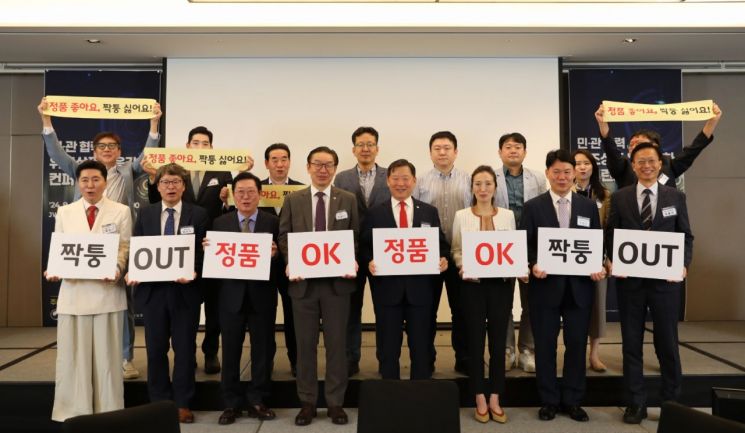 Kim Wanki, Commissioner of the Korean Intellectual Property Office (fourth from the left in the front row), is taking a commemorative photo with key attendees after attending the "Public-Private Cooperation Conference to Strengthen Response to Counterfeit Goods" at the JW Marriott Hotel in Seoul on the 26th. Photo by the Korean Intellectual Property Office
The Conference was organized to commemorate the 10th anniversary of the launch of the Council for the Prevention of Distribution of Counterfeit Goods (hereinafter the Council) and to mutually share strategies for responding to counterfeit goods. Currently, 96 member companies participate in the Council's activities.
About 150 stakeholders attended the event, including trademark owners who have suffered actual damage from counterfeit goods, private associations, major domestic online platforms such as Naver, Coupang, and 11st, as well as related public institutions.
The Conference was divided into two parts. The first part featured overseas direct purchase counterfeit goods, counterfeit goods seized by special judicial police, and a comparative exhibition corner where attendees could distinguish and experience genuine and counterfeit products. The second part was dedicated to sharing public-private countermeasures against counterfeit goods and discussing systems to strengthen responsibility for blocking counterfeit goods on online platforms.
In the second part, KIPO also introduced the "KIPO-Customs Collaboration System," which is being promoted to prevent the distribution of counterfeit goods through overseas direct purchases. Within this system, KIPO provides market monitoring results to the Korea Customs Service, which then plays a role in blocking the inflow of counterfeit goods into the country based on this information.
The panel discussion in the second part focused on improving systems to prevent the distribution of counterfeit goods online. Key topics included the "Notice & Takedown" system, which immediately removes items upon counterfeit goods reports, and the mandatory designation of domestic agents to strengthen the responsibility of overseas platform companies.
Kim Wanki, Commissioner of KIPO, stated, "As the popularity of K-brands increases in the global market, the damage caused by the distribution of counterfeit goods is also growing. To address these issues, KIPO will foster an environment where the public and private sectors can jointly respond and will actively cooperate with the National Assembly to protect the trademark value of K-brands."
Meanwhile, according to the Organisation for Economic Co-operation and Development (OECD), as of 2021, the global trade volume of counterfeit goods infringing on Korean companies' trademarks is estimated to reach a total of 11 trillion KRW annually.
© The Asia Business Daily(www.asiae.co.kr). All rights reserved.
![Clutching a Stolen Dior Bag, Saying "I Hate Being Poor but Real"... The Grotesque Con of a "Human Knockoff" [Slate]](https://cwcontent.asiae.co.kr/asiaresize/183/2026021902243444107_1771435474.jpg)















