Intense Competition to Secure Overseas Markets Amid Domestic Market Saturation
High Growth Potential Noted Due to Strong Demand for K-Food and Chicken
The chicken franchise 'Big 3 (BBQ, Kyochon, bhc)' is finding a breakthrough to improve profitability through overseas business expansion. As the domestic chicken market reaches saturation, they are actively targeting overseas markets where preference for K-food has increased.
According to the franchise industry on the 5th, Genesis BBQ Group signed a master franchise (MF) agreement last month with 'Jakarta Heritage Rasaharum,' a subsidiary of Indonesia's food company Gunung Sewu Group, and is making a full-scale entry into the Indonesian market.

Indonesia, the World's 4th Most Populous Country... Kyochon vs. BBQ Face-off
BBQ plans to rapidly expand its presence in the Indonesian market through collaboration with partners who have solid infrastructure and food business capabilities in the local market. In fact, Gunung Sewu Group’s subsidiary 'Sriyasewu Indonesia' owns a slaughterhouse with a daily capacity of 70,000 chickens, ensuring a stable supply of raw meat. BBQ intends to expand its franchise business by opening stores in major cities such as Jakarta, the capital and largest city, Bandung, Semarang, Surabaya, and Bali.
With BBQ entering Indonesia, it will face off against Kyochon Chicken on foreign soil. Kyochon Chicken entered Indonesia in 2014 and has steadily increased its number of stores, currently operating 12 locations. Kyochon Chicken emphasizes the unique brand identity of K-chicken with soy sauce, red, and honey chicken flavors, while also offering differentiated strategies by providing menus suited to local Indonesian food culture, such as 'butter rice.' Having opened stores mainly around Jakarta, Kyochon plans to expand its territory beyond the metropolitan area to non-metropolitan regions.
Indonesia, with a population of about 270 million, is the world's 4th most populous country and is growing into a key Southeast Asian market based on its huge domestic market. More than half of the population was born in the 1980s and 1990s, with an average age of only 27.9 years, making them sensitive to trends and having high consumption tendencies, which is seen as having great growth potential for the dining-out business. According to market research firm Euromonitor, Indonesia's 'limited-service restaurant' sales reached $2.5748 billion (about 3.43 trillion KRW) last year, growing at an average annual rate of 2.0% since 2019. Euromonitor expects the limited-service restaurant sector to continue growing at an average annual rate of 6.2% from this year through 2028.
The Indonesian dining market is broadly divided into 'full-service restaurants' and limited-service restaurants. Among limited-service restaurants last year, the largest sales sector was Asian food, accounting for 31.3% of the total. Chicken followed with 28.1%, and burgers recorded 24.6%. As the popularity of Asian food, chicken, and burgers continues to rise in the Indonesian dining market, various franchise companies are entering the market. Currently, 'McDonald's' and 'KFC' are competing for the top sales position in the limited-service restaurant sector, while in 2022, the American brand 'Popeyes' newly entered, and domestic companies are also joining one after another.
Indonesia is known for strict government regulations related to the dining franchise business, making registration procedures complicated. To register a local franchise, a business description must be registered first, followed by issuance of a 'Franchise Registration Certificate (STPW).' According to Indonesian government regulations, there are many prerequisite processes, including two years of financial reports, number of business locations, and franchisee lists. Due to this, most companies entering the market do so through MF contracts or joint venture establishments.
Previously, Kyochon Chicken entered the local market by signing an MF contract with the local Wahana Group, and BBQ also chose the MF method. MF is a method of contracting with a local company instead of direct entry, allowing the headquarters to spend less on investment costs while collecting trademark royalties. The decision-making burden regarding local laws, market trends, and commercial area analysis is also relatively low. A BBQ official said, "Managing the local market from headquarters in Korea involves many costs and time issues," and judged that local companies know the market well and can respond well to various situations with abundant infrastructure, deciding to enter through an MF contract.
K-Chicken Big 3 Compete to Expand Global Territories
The domestic chicken franchise industry is focusing all efforts on pioneering overseas markets. Among the Big 3, BBQ is the most aggressive in expanding overseas territories. BBQ currently operates over 700 stores in 57 countries worldwide, including the United States, Canada, Panama, Costa Rica, Taiwan, Japan, the Philippines, Malaysia, and Fiji. Based on its success know-how in the U.S., it is recently expanding its activities to Latin America and Southeast Asia, accelerating global expansion. BBQ recorded overseas corporate sales of 110 billion KRW last year, a 69% increase from 65 billion KRW the previous year.
BBQ, which entered overseas markets since 2003, directly operates its global headquarters in the U.S., its main market, while conducting business in other countries through the MF method. MF is a method of contracting with a local company instead of direct entry, allowing the headquarters to spend less on investment costs while collecting trademark royalties. The decision-making burden regarding local laws, market trends, and commercial area analysis is also relatively low. A BBQ official said, "Managing the local market from headquarters in Korea involves many costs and time issues," and added, "Except for the U.S., other countries are entered through MF contracts because local companies know the market well and can respond well to various situations with abundant infrastructure."
 The exterior of Kyochon Chicken's first store in Canada, which opened in Vancouver in July. [Photo by Kyochon F&B]
The overseas market is also considered a mid- to long-term growth task for Kyochon Chicken. Since 92.5% of the sales of Kyochon F&B, which handles Kyochon Chicken’s domestic and overseas franchise operations, come from domestic business, domestic store openings have practically stagnated. Kyochon Chicken is focusing on overseas business expansion with 'global' as a core keyword to achieve its vision of a second leap. It has entered the U.S. through direct operation and franchising, China through direct operation and MF, and Malaysia, Indonesia, the Middle East, Taiwan, and Canada through MF.
Currently, the number of overseas stores is in 8 countries, which is smaller in scale compared to BBQ’s 75 stores. However, KB Securities analyst Seong Hyun-dong evaluated, "Given the large difference in the number of stores compared to BBQ, the growth potential is actually higher."
Growth has somewhat stalled. Last year, global business sales were 17.812 billion KRW, a slight increase of about 1% from 17.568 billion KRW the previous year, and this year’s first half sales were 9.172 billion KRW, similar to last year’s 9.132 billion KRW.
To make up for this, Kyochon has accelerated expansion in the North American market by opening its first store in Vancouver, Canada, in the second half of the year. Last year, Kyochon Chicken’s U.S. subsidiary 'Kyochon USA' signed an MF contract with Mirae F&B Holdings, which operates various businesses such as dining, wholesale and retail, and real estate in Canada, announcing its entry into the Canadian market. In addition, Kyochon Chicken is preparing to expand its American business by renewing its first directly operated U.S. store and introducing cooking robots, and plans to develop new regions and countries in Southeast Asia.
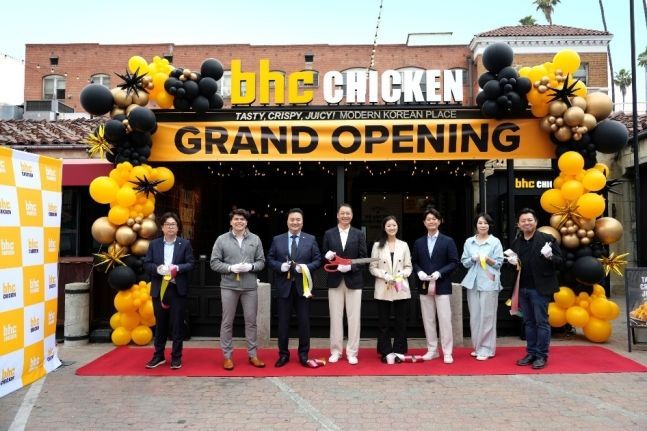 At the opening event of bhc Chicken's third U.S. store, 'Chapman Plaza Branch,' held last May, Song Hoseop, CEO of bhc (fourth from the left), and other officials are posing for a commemorative photo.
 [Photo by bhc]
bhc Chicken recorded the highest overall sales among the Big 3 chicken franchises last year, but its overseas sales scale is relatively small. However, since growth is clearly limited by the domestic market alone and overseas consumers’ interest in K-chicken is steadily increasing, bhc is actively pursuing overseas market expansion as a latecomer. In February last year, it opened its first North American directly operated store, 'LA Farmers Market,' in Los Angeles, California, launching its local business, and in May, it opened the 'San Diego Sorrento Valley' store, starting its franchise business. bhc currently operates stores in five countries including the U.S., Malaysia, Hong Kong, Singapore, and Thailand, and last year’s sales increased by 193% to 2.022 billion KRW from 691 million KRW the previous year.
© The Asia Business Daily(www.asiae.co.kr). All rights reserved.
![Clutching a Stolen Dior Bag, Saying "I Hate Being Poor but Real"... The Grotesque Con of a "Human Knockoff" [Slate]](https://cwcontent.asiae.co.kr/asiaresize/183/2026021902243444107_1771435474.jpg)

















