Service Launch on the 26th... 'Gangnam Pilot Operation Zone' Weekday Late-Night
Equipped with Near Full Autonomous Driving Environment and World-Class Operational Know-How
Free for First Rides... Conveniently Hail Like Regular Taxis via 'KakaoT App'
The nation's first late-night autonomous taxi will begin operating in the Gangnam-gu area. Operating hours are during late-night weekdays, and the taxi finds the shortest real-time route based on the passenger's requested departure and destination.
On the 25th, the Seoul Metropolitan Government announced that starting from the 26th, the country's first "late-night autonomous taxi" will begin operating in the autonomous vehicle pilot zone in Gangnam-gu.
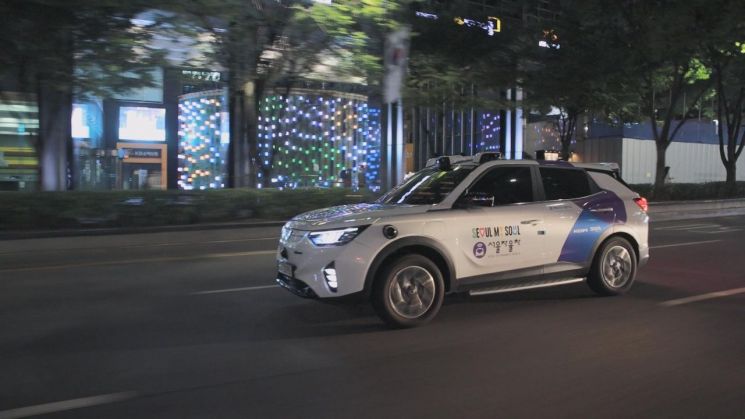
Seoul has been conducting world-class autonomous driving transportation projects such as demand-responsive services (Sangam), tourist shuttles (Cheonggyecheon), and autonomous route buses (late-night and Cheongwadae). By expanding the foundation to include taxis, which are demand-centered transportation, Seoul will showcase autonomous driving transportation services across a wide range of fields from public transportation to individual mobility.
Autonomous taxis do not have fixed routes and operate by finding the shortest real-time route according to passenger requests for departure and destination. Operating hours are from 11 PM to 5 AM on weekdays. The service will start in certain areas including Gangnam-gu and Seocho-gu, and based on future demand and service stabilization, it plans to expand to the entire Gangnam pilot zone by the first half of next year.
The service will initially operate on major east-west roads (Bongeunsa-ro, Teheran-ro, Dogok-ro, Nambusunhwan-ro, Gaepo-ro) and north-south roads (Gangnam-daero, Nonhyeon-ro, Eonju-ro, Samsung-ro, Yeongdong-daero) in parts of Yeoksam, Daechi, Dogok, and Samseong-dong in Gangnam-gu, and some areas of Seocho-dong in Seocho-gu. By the first half of next year, it will expand to cover the entire pilot zone including Nonhyeon, Sinsa, Apgujeong, and Daechi-dong.
The fare will be free until paid transportation is scheduled to begin in 2025. The fleet will start with three vehicles and will be increased to support convenient mobility for citizens. Additionally, continuous service expansion such as extending operating hours to daytime and increasing the number of vehicles will be considered comprehensively based on demand, taxi industry opinions, and vehicle supply conditions.
To use the service, passengers can call the taxi through the taxi-hailing app "KakaoT," just like a regular taxi. If already registered with "KakaoT," no additional procedures are required for immediate use. Manual operation will be used when necessary for safety. On roads with four or more lanes during the route, the taxi will operate autonomously, while on residential side streets and child protection zones, it will be manually operated to ensure the safety of passengers and pedestrians. In case of service suspension due to adverse weather conditions such as heavy rain or snow, or vehicle inspections, announcements will be made, so users should refer to them when using the service.
Meanwhile, on the 11th, Seoul selected three districts for the pilot operation of the "Mobility Assistance Autonomous Bus" to be operated in transportation-disadvantaged areas of autonomous districts, continuing to expand the project. In October, Seoul will launch the "Dawn Companion Autonomous Bus," a flagship policy of advanced transportation innovation tailored to citizens' needs, showcasing future transportation services for the public. Yoon Jong-jang, Director of the Seoul Transportation Office, stated, "With Seoul's full-scale project promotion and demonstration results, autonomous transportation is approaching the stage of becoming an established transportation service," and added, "We will do our best to create future transportation services for citizens, using the late-night autonomous taxi operation, the first case in the country, as a milestone."
© The Asia Business Daily(www.asiae.co.kr). All rights reserved.
![Clutching a Stolen Dior Bag, Saying "I Hate Being Poor but Real"... The Grotesque Con of a "Human Knockoff" [Slate]](https://cwcontent.asiae.co.kr/asiaresize/183/2026021902243444107_1771435474.jpg)















