The Israeli military has continued large-scale airstrikes targeting the Lebanese armed group Hezbollah for the second consecutive day. With approximately 560 casualties already reported, they are simultaneously conducting assassination operations targeting the military leadership, preparing for the possibility of a full-scale war. As the crisis originating in the Middle East intensifies, the United Nations Security Council (UNSC) convened an emergency meeting.
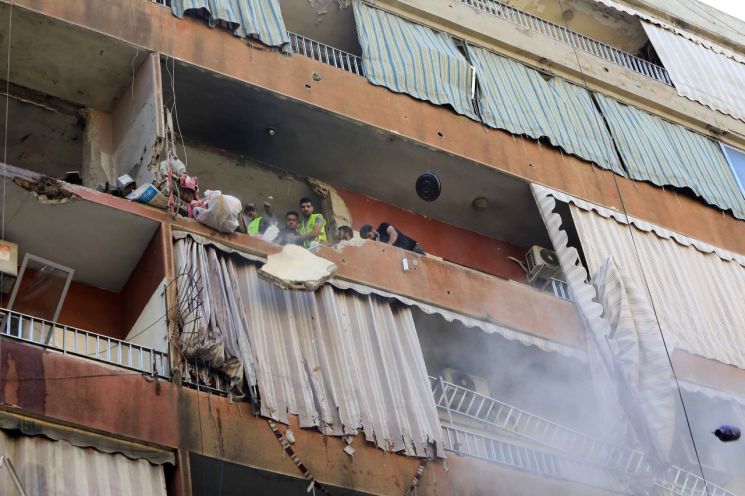
According to AP News and others, on the 24th (local time), the Israeli military announced that they killed Ibrahim Muhammad Qubaysi in a targeted airstrike in Beirut, the capital of Lebanon. Qubaysi was the commander of the missile and rocket unit responsible for launching missiles aimed at Israel. Born in 1962 in Jibdin, southern Lebanon, he was also the planner behind an attack in 2000 that kidnapped and killed three Israeli soldiers. Hezbollah confirmed Qubaysi's death shortly after, describing him as having "martyred."
Currently, the Israeli military is conducting the "Arrow of the North" operation, a broad airstrike campaign against Hezbollah military facilities, while simultaneously carrying out assassination operations targeting the military leadership. On the 20th, they killed Ibrahim Akil, commander of the special operations unit Radwan. According to materials distributed by the Israeli military on the 21st, six out of eight Hezbollah leaders under Hezbollah chief Hassan Nasrallah have been killed so far. These leadership assassinations are interpreted as efforts to sow confusion by destroying command structures and to weaken forces in preparation for the possibility of full-scale war.
The Lebanese Ministry of Health announced that six people were killed and 15 injured in Israeli airstrikes that day. The total death toll from relentless airstrikes in southern and eastern Lebanon over the past two days has reached at least 564. The Ministry did not distinguish between civilians and soldiers but reported that among the deceased were 54 children, 94 women, and 9 paramedics. The number of injured exceeded 1,800.
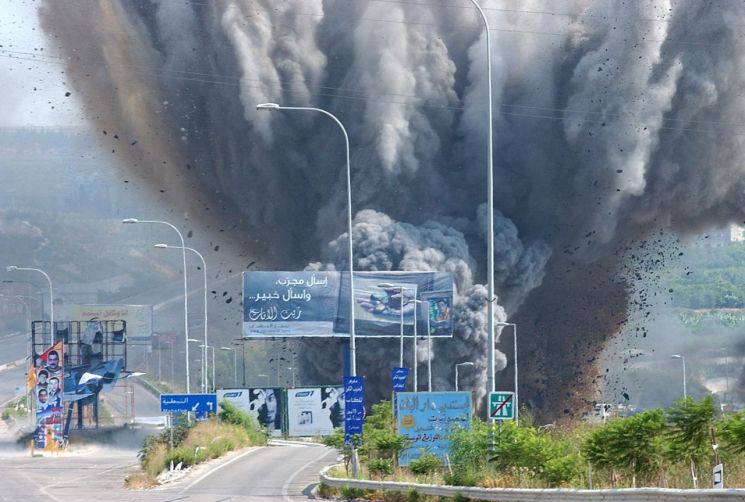
Israel, which has been at war for over 11 months since the surprise attack by the Palestinian armed group Hamas last year, has turned its attention to the northern front where Hezbollah is located and began airstrikes from the previous day. This is because Hezbollah has been attacking northern Israel almost daily since the outbreak of the Gaza Strip war, under the pretext of supporting Hamas. The Israeli military views this as an unacceptable violation of sovereignty.
Miri Aisin, a former senior Israeli intelligence officer, told The Washington Post (WP) that the approximately 1,500 targets Israel recently claimed to have struck were part of a detailed war scenario carefully planned over several years. WP reported, "Israel has been preparing for the next war with Hezbollah for nearly a decade, and a full-scale conflict seemed inevitable after October 7. Now that Hamas is weakened in Gaza, Israel is executing its combat plan against Hezbollah."
The Israeli military also confirmed that new attacks against Hezbollah are underway in the Bekaa Valley and southern Lebanon. Israeli Defense Minister Yoav Gallant told the military, "Today, Hezbollah is different from the organization we knew a week ago," adding, "We have prepared additional attacks." He indicated that Hezbollah's command, control, fighters, and combat capabilities have been hit, warning, "The moment to give orders may come, so we must be ready," hinting at the possibility of ground warfare.
However, Hezbollah has indicated that it will not cease supporting Hamas despite these large-scale airstrikes. Hezbollah responded by firing more than 300 rockets at eight Israeli targets that day. Among the targets was an explosives factory in Zikhron Ya'akov, located 60 km from the border. Axios also reported that Hezbollah recently requested Iran to launch attacks against Israel.
As tensions between Israel and Hezbollah edge toward full-scale war, the UN Security Council decided to hold an emergency meeting on the 25th. Slovenia, the UNSC president for September, urgently convened a formal meeting at 6 p.m. the following day to discuss the Lebanon issue. UN Secretary-General Ant?nio Guterres expressed concern over the escalating conflict during his opening speech at the UN General Assembly's general debate at the UN headquarters in New York, stating, "Lebanon is now on the edge of a cliff," and "The people of Lebanon, the people of Israel, and the entire world cannot bear for Lebanon to become another Gaza."
Meanwhile, Israeli Ambassador to the UN Danny Danon expressed openness to diplomatic solutions. During a brief press conference at the UN headquarters that afternoon, he said, "Even as we speak, important forces are trying to come up with ideas, and we are open to that," adding, "We do not want a ground invasion anywhere and prefer a diplomatic solution." Israeli Prime Minister Benjamin Netanyahu, originally scheduled to arrive in New York on the 25th to attend the UN General Assembly's general debate, will now arrive on the 26th, the day of his speech. CNN reported that Netanyahu is holding briefings for cabinet ministers and senior security officials on the Hezbollah airstrikes that day.
© The Asia Business Daily(www.asiae.co.kr). All rights reserved.
![Clutching a Stolen Dior Bag, Saying "I Hate Being Poor but Real"... The Grotesque Con of a "Human Knockoff" [Slate]](https://cwcontent.asiae.co.kr/asiaresize/183/2026021902243444107_1771435474.jpg)
















