Need for Sharing Excellent Administrative Cases of Local Public Institutions
Jeonnam Development Corporation Recognized for Effectiveness of 'Ten-Thousand-Won Rental Housing'
Attracts Attention by Driving Intensive Management Innovation and Investment Activation
# Jeonnam Development Corporation is introducing the '10,000 Won Rental Housing,' available for youth and newlyweds at a monthly rent of 10,000 won, to reduce housing burdens related to marriage, childbirth, and child-rearing. At the end of last year, related ordinances were enacted, and candidate sites were selected to supply 50 households each in four counties. Since July, a public contest for private operators has been underway, allowing employed youth to reside for up to 6 years and newlyweds up to 10 years if they have a second child.
After the government declared a 'national emergency on population,' public institutions nationwide have introduced various policies to overcome low birth rates and regional extinction. Policy directions addressing this national issue are being established, and effective policies are expanding, making the sharing of best practices necessary.
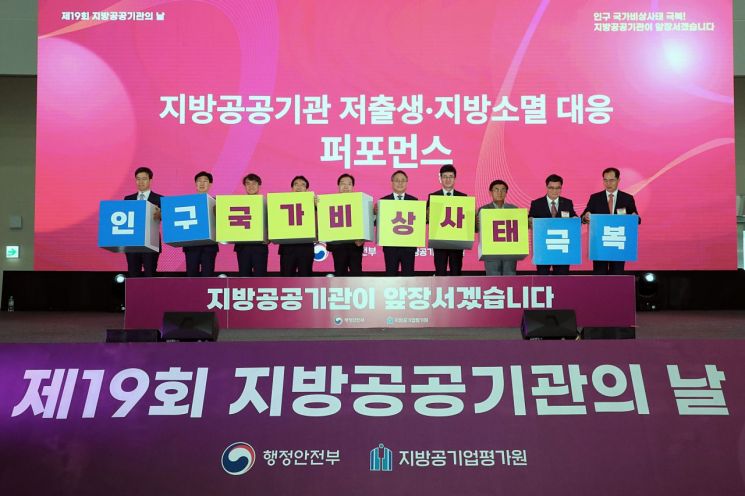 On the 23rd, the Ministry of the Interior and Safety held the "19th Local Public Institutions Day" commemorative event at the Daegu EXCO Convention Center, providing an opportunity for local public institution executives and employees to share policies aimed at overcoming low birth rates and regional extinction.
 [Photo by Ministry of the Interior and Safety]
At the '19th Local Public Institutions Day' commemorative event held on the 23rd at Daegu EXCO Convention Center, such cases were introduced nationwide, laying the foundation for policy expansion.
Besides Jeonnam Development Corporation's '10,000 Won Rental Housing,' Songpa Facilities Corporation's 'One-Stop Integrated Maternal Health Promotion Center' also attracted attention as an effort to respond to low birth rates and regional extinction. As Seoul's first public postpartum care center, it promotes not only maternal and infant health projects but also pregnancy and childbirth support programs. As of the end of last year, the number of users exceeded 500, with a satisfaction rate of 96%. Thanks to this, it became the first and only public postpartum care center nationwide to obtain KS certification.
Institutions leading management innovation and investment activation also stood out. Daegu Transportation Corporation has been undertaking intensive innovation since 2022, saving 35.7 billion won. Savings were achieved through service improvements, self-conducted precise inspections and performance evaluations of railway facilities, localization, reduction of station ticket vending machines, and improvements in Line 1 parts operations. Simultaneously, it earned 26.4 billion won through leasing mobile communication facilities, generating ancillary revenue close to 61 billion won.
Yongin Urban Corporation, which encompasses the semiconductor belt, was recognized as an institution that successfully activated investment. Representative projects include the 'Yongin Semiconductor Mega Cluster' project investing 3.7 trillion won in the Wonsam-myeon area of Cheoin-gu and the 'Public-Private Partnership Semiconductor Complex' project investing 280 billion won in the area. Both projects are public-private joint efforts, and Yongin Urban Corporation is also considering additional linked projects.
The government plans to actively share such excellent cases to proactively respond to the crisis of low birth rates and regional extinction. The large attendance of not only heads of institutions but also staff responsible for practical work at the recently concluded 'Local Public Institutions Day' commemorative event reflects this approach. Currently, they provide essential public services such as housing, education, and healthcare to local residents while addressing low birth rates and regional extinction through ▲expanding housing supply for youth, newlyweds, and multi-child families ▲strengthening care and medical services ▲supporting the use of cultural and sports facilities.
Accordingly, a total of 12 government awards were given to institutions and individuals who contributed to the development of local public institutions. The Daegu Public Facilities Management Corporation, which led structural reform of local public institutions; Gyeongnam Technopark Foundation, which realized industrial promotion policies in Gyeongnam; and Jeju Tourism Organization, which fostered and expanded Jeju's tourism industry through marketing investment, received presidential citations as institutional awards. Additionally, Jung Guk-young, CEO of Daejeon Urban Corporation, who promoted various projects for regional coexistence and development, received the National Medal, and Song Jae-cheol, head of Jeonbuk Development Corporation, who actively pursued major current projects through capital increase, received the presidential citation.
Han Soon-gi, Director of the Local Finance and Economy Office at the Ministry of the Interior and Safety, said, "We expect local public institutions to take the lead in solving low birth rate and regional extinction issues with policies tailored to regional characteristics, and that these pioneering efforts will spread throughout the private sector and local communities."
© The Asia Business Daily(www.asiae.co.kr). All rights reserved.
![Clutching a Stolen Dior Bag, Saying "I Hate Being Poor but Real"... The Grotesque Con of a "Human Knockoff" [Slate]](https://cwcontent.asiae.co.kr/asiaresize/183/2026021902243444107_1771435474.jpg)















