Construction Industry Jointly Pushes for Import of 780,000 Tons of Chinese Cement
Concerns Over 'Second Uyeosu Crisis' if Chinese Products Dominate Market
The construction industry is pushing for the import of Chinese-made cement for the first time in history. As a result, the cement industry is expected to be forced into low-price competition with China.
If Chinese cement dominates the domestic market in the future, there are concerns about the possibility of a 'second urea solution crisis' in the cement sector.
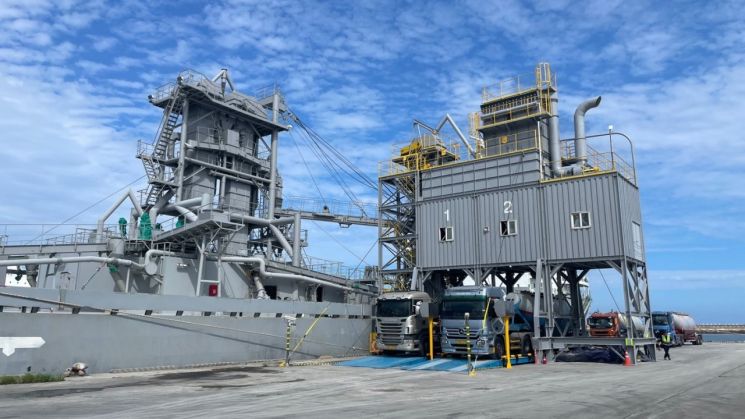 A cement carrier ship dedicated to transporting cement and the unloading site at the pier (unrelated to the article content).
 Photo by Asia Economy DB
According to the cement and construction industries on the 25th, the Korea Construction Materials Purchasing Council (KCMPC), a group of purchasing managers from major domestic construction companies, discussed specific plans for importing Chinese cement with Sun Industry Co., Ltd., a Chinese cement brokerage company, on the 6th. The exporting company is Shanshui Cement from Shandong Province, China, which has an annual production capacity of 3 million tons.
KCMPC and Sun Industry plan to build two cement storage silos at Pyeongtaek Port in Gyeonggi Province by next year and supply 780,000 tons of Chinese cement to construction sites starting in 2026. To this end, they will establish a Special Purpose Company (SPC) with a capital of 23.5 billion KRW, of which KCMPC members will contribute 13.5 billion KRW and Sun Industry will invest 10 billion KRW. The SPC’s shares will be held 51% by KCMPC and 49% by Sun Industry.
The Ministry of Land, Infrastructure and Transport (MOLIT) held a meeting with KCMPC and others at the end of last month regarding cement import and stockpiling plans. The industry expects that there was prior coordination with MOLIT since KCMPC had detailed discussions on cement imports following this meeting.
Regarding this, a MOLIT official said, "The government cannot interfere with private sector imports," adding, "The government is preparing measures to stabilize construction costs, but nothing has been finalized yet."
China accounts for half (about 2 billion tons) of the world’s annual cement production of approximately 4 billion tons. The quality of Chinese cement has improved to a level comparable to domestic and global standards. Apart from China, only India produces over 100 million tons annually (419 million tons). South Korea produces 51 million tons annually, the United States 99 million tons, and Japan 47 million tons.
The construction industry expects the domestic selling price of Chinese cement to be 95,400 KRW per ton, which includes the import cost of 93,400 KRW per ton (including logistics costs) plus a 2,000 KRW margin for the importer.
Domestic cement prices are considerably lower compared to major countries excluding China. According to the cement industry, as of last month, the price per ton of cement was 212,000 KRW in the United States, 167,000 KRW in Brazil, 149,000 KRW in Japan, 140,000 KRW in Malaysia, and 125,000 KRW in Taiwan. In most countries, the cement industry is focused on the domestic market due to high logistics costs and the nature of cement as a key national industry, resulting in limited profits from trade.
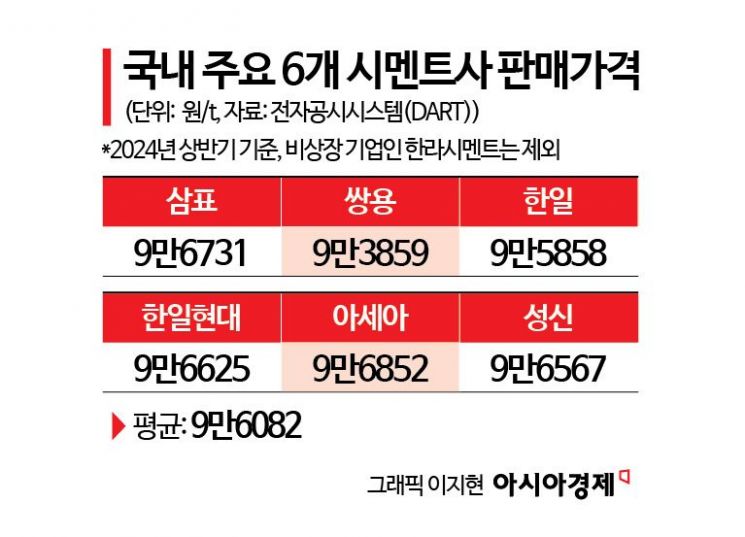
Although domestic cement prices were raised to 112,000 KRW per ton in November last year, the actual transaction prices on site are much lower. According to the Financial Supervisory Service’s electronic disclosure system, the average selling price of six major domestic cement companies is 96,082 KRW per ton, only 682 KRW less than the expected price of imported Chinese cement. Considering fluctuations in logistics costs, increased storage expenses, and potential carbon taxes under the future Carbon Border Adjustment Mechanism (CBAM), Chinese cement could even become more expensive than domestic cement.
Experts have expressed concerns about the possibility of a recurrence of the 'urea solution crisis' due to the push for importing Chinese cement. In 2021, a coal shortage in China led the Chinese government to control the production and export of urea, which is manufactured from coal, causing a global shortage. South Korea, which depended on China for 97% of its urea imports, suffered greatly. Similarly, if the Chinese government restricts cement exports, there are concerns about a shortage of domestic cement supply.
Professor Jinman Kim of the Department of Green Smart Architecture Engineering at Kongju National University said, "Domestic cement prices are still about two-thirds of those in major advanced countries and account for only about 0.2% of construction sale prices," adding, "We should not rely on China for cement supply."
© The Asia Business Daily(www.asiae.co.kr). All rights reserved.
![Clutching a Stolen Dior Bag, Saying "I Hate Being Poor but Real"... The Grotesque Con of a "Human Knockoff" [Slate]](https://cwcontent.asiae.co.kr/asiaresize/183/2026021902243444107_1771435474.jpg)
















