At the SNE Research KABC 2024 Seminar on the 24th
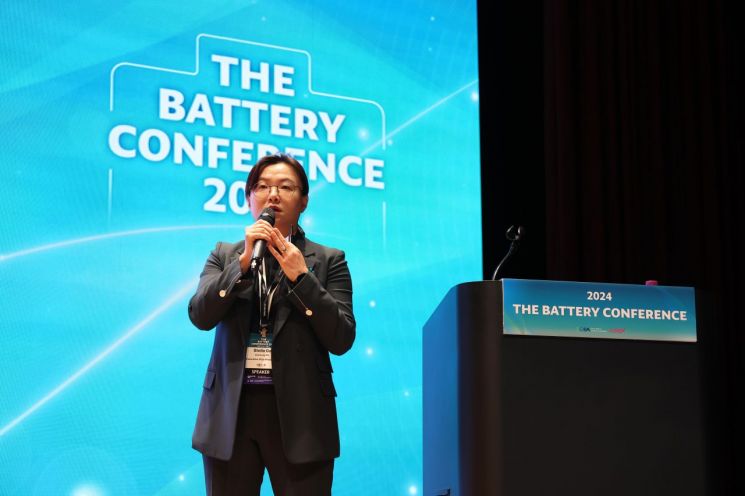 Ko Ju-young, Vice President, Head of Large and Medium-sized Commercialization Team at Samsung SDI [Image source=Yonhap News]
Ko Jooyoung, Vice President and Head of the Medium and Large Product Planning Team at Samsung SDI, emphasized that the development goals for electric vehicles and batteries should achieve driving ranges and charging speeds comparable to internal combustion engine (ICE) vehicles.
On the 24th, at the 'KABC 2024' seminar hosted by SNE Research, Vice President Ko stated, "The penetration rate of electric vehicles (the proportion of electric vehicles among new cars) is expected to be around 20% this year, and the industry anticipates this figure to exceed 50% by 2050. To reach such penetration rates, factors like driving range and charging time must become as convenient as those of internal combustion engine vehicles."
Currently, electric vehicles in the A and B segments (light and compact cars) have an average charging time of 31 minutes and a driving range of 220 km. The C segment, which is the compact mid-size class, charges for 37 minutes and drives 330 km, while the D segment (mid-size) charges for 26 minutes and drives 413 km. Regarding this, Vice President Ko said, "The current performance of electric vehicles (in terms of driving range and charging speed) shows a significant gap compared to internal combustion engines, which refuel in 5 minutes and drive 400 to 600 km," adding, "There is a need for electric vehicles to either outperform or become more affordable than internal combustion engines."
He also emphasized that for the all-solid-state batteries, which Samsung SDI is leading in development and mass production, to be widely used, a reduction in production costs is necessary. When asked about the expanding market share of LFP (Lithium Iron Phosphate) batteries and how Samsung SDI views price and market share competition after the commercialization of all-solid-state batteries, Vice President Ko responded, "Samsung SDI's all-solid-state batteries, scheduled for mass production in 2027, will initially target ultra-luxury vehicles, while LFP batteries are moving up from lower segments to higher segments with broader applicability." He added, "The competition will likely focus on how quickly all-solid-state batteries can secure price competitiveness and reduce costs. I believe that many (materials, parts, and equipment) companies entering the all-solid-state battery market quickly to lower prices will accelerate the 'penetration' and widespread use of these batteries."
© The Asia Business Daily(www.asiae.co.kr). All rights reserved.
![Clutching a Stolen Dior Bag, Saying "I Hate Being Poor but Real"... The Grotesque Con of a "Human Knockoff" [Slate]](https://cwcontent.asiae.co.kr/asiaresize/183/2026021902243444107_1771435474.jpg)















