55% of Economic Output Depends on Natural Capital
Annual Loss of $2.7 Trillion Feared by 2030
Approximately $45 Trillion Market Capitalization Exposed to Natural Capital Loss Risk
Samil PwC announced on the 23rd that it has published the ‘Nature Positive’ report.
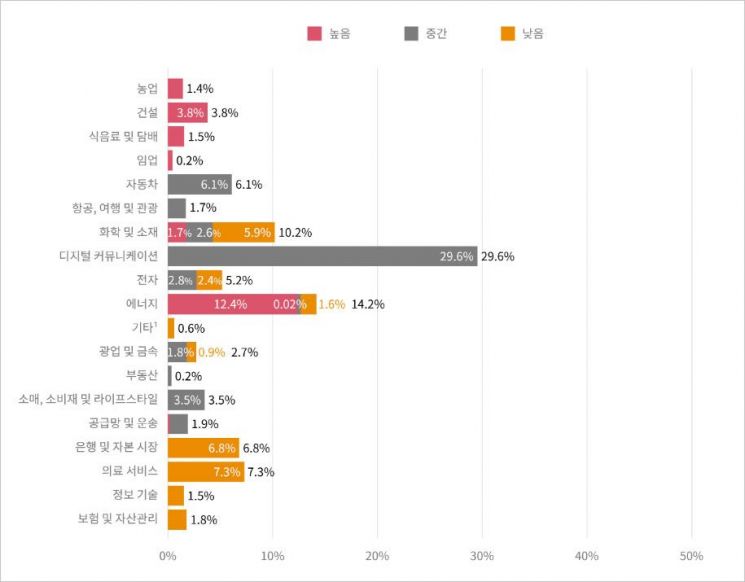
According to the report, as the loss of natural capital and the biodiversity crisis worsen, the industries most affected are agriculture, forestry, fisheries and aquaculture, food and tobacco, and construction, in that order. Emphasizing the importance of global natural capital, it analyzed that the Korea Exchange is ranked 9th among 19 major global stock exchanges in terms of high exposure to natural capital loss risk.
This report explains the basic concepts of natural capital and biodiversity, and covers the global status and impacts on capital markets. According to the survey, more than 55% of economic output depends on natural capital, which translates to an economic value of $58 trillion (approximately 78,000 trillion KRW). If the Earth fails to address natural capital loss and biodiversity issues, it is projected that an annual loss of $2.7 trillion (approximately 3,600 trillion KRW) will occur by 2030.
In particular, companies belonging to industries with high dependence on natural capital are more likely to be exposed to financial risks caused by natural capital loss. The report stated that agriculture, forestry, fisheries and aquaculture, food and tobacco, and construction industries are most dependent on natural capital, with the economic value of these industries totaling $13 trillion (approximately 17,500 trillion KRW).
Furthermore, the report mentioned that natural capital loss also affects global capital markets, emphasizing that about $45 trillion (approximately 63,000 trillion KRW) of market capitalization is exposed to the risk of natural capital loss. In the case of the Korea Exchange, industries with medium or high dependence on natural capital among listed companies account for 71% of the total market capitalization, raising concerns.
Samil PwC proposed three approaches for companies to manage risks related to natural capital and biodiversity. First, identify the company’s dependence on natural capital and recognize risks and opportunities. Second, establish a natural capital data management system to fulfill related disclosure obligations. Third, set scientific targets and explore business opportunities.
Steven Kang, Sustainability Platform Leader at Samil PwC, emphasized, “The natural capital and biodiversity crisis will have broad direct and indirect impacts on businesses and markets,” adding, “Companies must proactively respond to these crises and seek nature-friendly solutions to create new value.”
© The Asia Business Daily(www.asiae.co.kr). All rights reserved.
![Clutching a Stolen Dior Bag, Saying "I Hate Being Poor but Real"... The Grotesque Con of a "Human Knockoff" [Slate]](https://cwcontent.asiae.co.kr/asiaresize/183/2026021902243444107_1771435474.jpg)















