"Even if Only One Medical Association Steps Forward, the Consultative Body Will Operate"
40% Return to Medical Field
The Presidential Office stated on the 19th regarding the ruling and opposition parties, medical community, and government consultation body, which is facing difficulties due to the medical community's refusal to participate, that "the medical community should not postpone problem-solving by setting preconditions such as changes in the government's attitude, but rather come to the dialogue table first, put their heads together, and discuss solutions as a duty to the people."
In particular, since the medical community consists of various groups such as residents, private practitioners, employed doctors, and medical students, the office expressed its position that if even one medical organization participates in the dialogue, the ruling and opposition parties, medical community, and government consultation body will be promptly activated.
Jang Sang-yoon, Senior Secretary for Social Affairs at the Presidential Office, held a briefing at the Yongsan Presidential Office in the afternoon and said, "I once again request that you do not ignore the cries of patients, which are the reason for doctors' existence, and come to the dialogue table."
Senior Secretary Jang emphasized, "The government's consistent position that the door to dialogue is open remains unchanged," and added, "Patients are the people you doctors must protect."
He also reaffirmed that the government's existing position on medical school quotas remains unchanged. Senior Secretary Jang said, "Adjusting medical school quotas for the 2025 academic year, during which university admissions such as rolling admissions are underway, is realistically impossible." He continued, "The government holds a flexible stance on quotas from the 2026 academic year onward," and explained, "If the medical community presents a reasonable plan based on scientific evidence, the government once again emphasizes its position to engage in discussions with an open mind."
"No emergency chaos, collapse, or paralysis during Chuseok holiday"
The Presidential Office evaluated that, contrary to initial concerns, there was no major confusion regarding emergency medical situations during this year's Chuseok holiday. Senior Secretary Jang said, "During the five-day holiday until the day before, although there were difficulties and inconveniences for the public in emergency medical sites, it ended without major accidents compared to what was feared," adding, "I believe that 'chaos,' 'collapse,' and 'paralysis' did not occur."
Senior Secretary Jang cited the dedication and hard work of medical staff who stayed on site, the mature civic consciousness of the public, medical institutions that were open more during the holiday, and the efforts of local governments nationwide that operated emergency systems as reasons for this outcome.
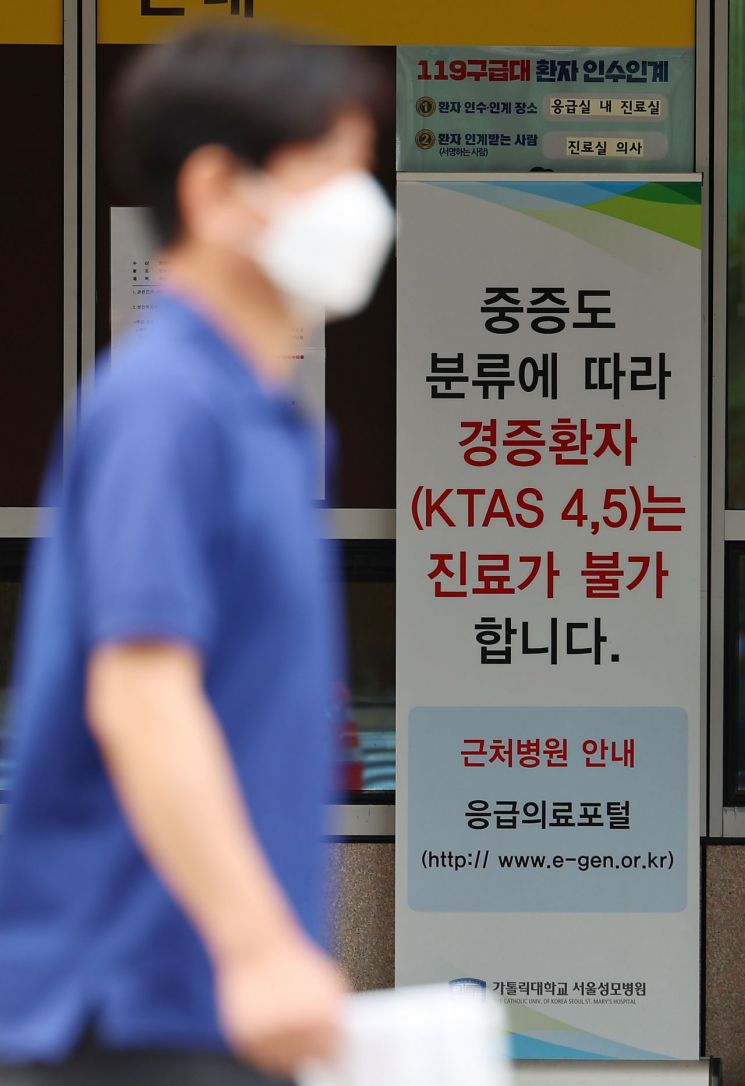 On the morning of the 19th, a notice indicating that mild patients cannot be treated was placed in front of the emergency medical center of a large hospital in downtown Seoul. [Image source=Yonhap News]
The number of medical institutions open during this Chuseok holiday averaged 8,743 per day, which was 812 more than the initially expected 7,931. Senior Secretary Jang explained, "This is nearly double compared to last year's Chuseok and 2.4 times more than this year's Lunar New Year," and added, "The change in emergency room usage during this Chuseok holiday can also be understood as an opportunity for the existing medical usage system to improve." He further stated, "Since there is still a week left in the emergency countermeasure period for this Chuseok holiday, the government will maintain vigilance and work with local governments to ensure thorough response until the end."
"40% of all residents have returned to medical sites"
Senior Secretary Jang also stated, "Among the total 10,000 residents, about 1,000, or 10%, are currently working, and about 8,900 residents have resigned," adding, "Of these, about 2,900, or 33%, have newly been employed at other medical institutions and are working as doctors." He said, "In other words, 40% of all residents have already returned to medical sites," and explained, "This indicates that residents have not given up on being doctors, but if the training environment and medical system properly change, they want to return and continue their training."
Senior Secretary Jang diagnosed that recent cases reported in the media, such as the finger amputation patient in Gwangju, the pregnant woman in Cheongju, Chungbuk, and the stab wound patient in Daejeon, were results stemming from a shortage of essential medical personnel. He explained, "These cases all involve areas lacking essential medical personnel such as microsurgery, emergency childbirth and neonatal admission, and trauma," adding, "In other words, these are cases where emergency medicine specialists cannot handle the treatment in the emergency room, and specialists responsible for external and follow-up treatment are absolutely necessary."
Senior Secretary Jang lamented, "The medical community has long complained about the shortage of specialists and the burden of medical accidents in fields affected by low birth rates, such as severe emergency care and pediatric delivery," and added, "Even when astronomical salaries are offered at local medical centers, no doctors apply, and it has become so commonplace that it no longer even makes the news."
He continued, "The recruitment rate for essential medical residents is also at a very serious level," stating, "In thoracic surgery, the average recruitment rate over the past 10 years has not reached 50%, and in pediatrics, the average recruitment rate over the past three years has not reached 50%." "Since the 2000s, specialist fields have become more subdivided, increasing medical expertise but narrowing the scope of practice. Although the number of doctors should increase, this has not happened due to the freeze on medical school quotas," he explained. "In addition to the shortage of doctors, structural problems such as an unfair compensation system with low income relative to difficulty in essential medical fields and the burden of medical accident liability have not been resolved."
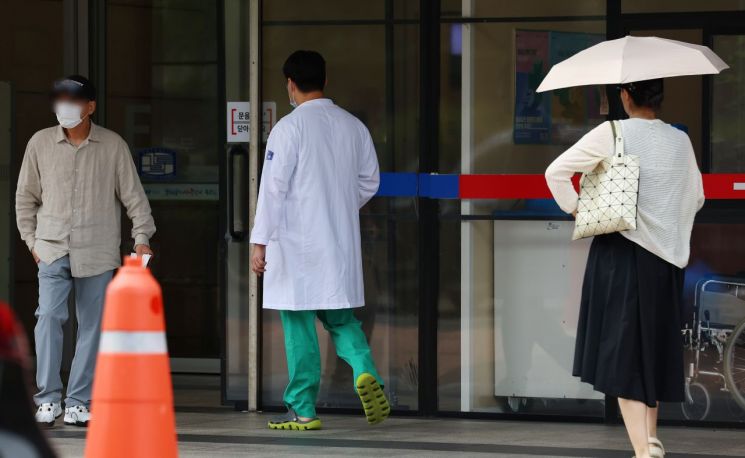 On the morning of the 19th, medical staff and citizens are passing in front of the emergency medical center of a large hospital in downtown Seoul.
 [Image source=Yonhap News]
Presidential Office: 'Moon Care' accelerated medical overuse
In particular, the Presidential Office viewed the health insurance coverage expansion policy 'Moon Care,' initiated by the Moon Jae-in administration in 2017, as one of the factors that worsened the situation. Senior Secretary Jang said, "Moon Care made large non-reimbursable items such as selective treatment fees and upper-level hospital room charges reimbursable, increasing apparent coverage, but the execution amount of health insurance skyrocketed, increasing the burden on the public," and criticized, "Rather than fair compensation for essential medical care, it accelerated medical overuse and intensified the concentration of patients and doctors in the metropolitan area."
He added, "If unnecessary non-reimbursable treatments and medical shopping are not minimized and health insurance finances are not reformed to focus on essential medical care, it will become difficult to sustain," emphasizing, "This is why our government started medical reform despite difficulties such as doctors' collective actions, and why reform cannot be postponed to next year or the year after."
Regarding the upcoming dinner meeting on the 24th where President Yoon Seok-yeol will meet with Han Dong-hoon, leader of the People Power Party, and other party leaders in Yongsan to discuss medical reform and other issues, a Presidential Office official said, "In forming the consultation body of ruling and opposition parties, medical community, and government, it is a reality that persuading and bringing the medical community to the dialogue table is very difficult." The official added, "Nevertheless, the ruling party and government share the same intention to promptly activate the consultation body by asking even one medical organization about their willingness and explaining the purpose."
When asked about plans to induce the medical community's participation in the ruling and opposition parties, medical community, and government consultation body, the official said, "We are cooperating with the party to make efforts so that they can come to the dialogue table quickly," adding, "That is the plan and the alternative."
© The Asia Business Daily(www.asiae.co.kr). All rights reserved.
![Clutching a Stolen Dior Bag, Saying "I Hate Being Poor but Real"... The Grotesque Con of a "Human Knockoff" [Slate]](https://cwcontent.asiae.co.kr/asiaresize/183/2026021902243444107_1771435474.jpg)
















