Pension Funds "Climate Information Essential... Scope 3 Also Needed"
Companies "Securing Scope 3 Data Is Difficult"
Vice Chairman "Disclosure Needed Before Climate Financial Support"
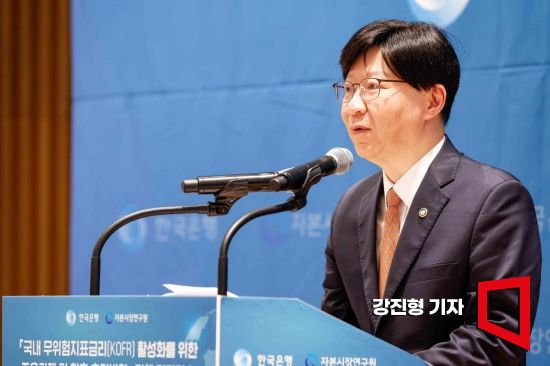 Kim So-young, Vice Chairman of the Financial Services Commission, stated on the 19th regarding the introduction of Scope 3 greenhouse gas emissions disclosure, "We will conduct a more thorough review to determine if there are areas to enhance corporate acceptability without hindering the achievement of policy goals." Photo by Kang Jin-hyung aymsdream@
Kim So-young, Vice Chairman of the Financial Services Commission, stated on the 19th regarding the introduction of Scope 3 greenhouse gas emissions disclosure, "We will conduct a more thorough review to see if there are areas to enhance corporate acceptability without hindering the achievement of policy goals."
On the same afternoon, Vice Chairman Kim held a 'Sustainability Disclosure Standards Corporate Meeting' at the Korea Chamber of Commerce and Industry, meeting with nine major companies including Samsung Electronics and Hyundai Motor Company. She said, "To resolve corporate confusion and support the preparation of disclosure reports, we will also strengthen the provision of guidelines and training for practitioners."
Vice Chairman Kim referred to the 'Expansion Plan for Financial Support to Address the Climate Crisis' announced by the Financial Services Commission in March, adding, "For climate-related financial support to be smoothly executed, it is necessary to link a transparent and reliable disclosure system."
This meeting was arranged to listen to corporate opinions after the public consultation period for the 'Draft Sustainability Disclosure Standards' released in April had ended. Attendees included major companies such as Samsung Electronics, Hyundai Motor Company, SK, POSCO, Naver, KT&G, Amorepacific, Korea Shipbuilding & Offshore Engineering, and E-Mart, as well as four major economic organizations.
Earlier, over a four-month period until August, the Financial Services Commission received feedback from 29 domestic investors including the National Pension Service, domestic pension funds, asset management companies, and securities firms, as well as 17 overseas investors such as the Norwegian Government Pension Fund and the Netherlands APG. Vice Chairman Kim evaluated this by saying, "It signifies that global investors' interest and expectations in our capital market have increased."
Institutional investors argued that "climate disclosure is essential, and since other sustainability matters are equally important to investors, a related schedule should be presented." They also emphasized, "While understanding the difficulty in measuring and safeguarding Scope 3 information, investors need Scope 3 data to understand the risks companies face." Furthermore, they positively assessed the adoption of the International Sustainability Standards Board (ISSB) standards, stating it would provide consistent and comparable sustainability-related information to the global capital market.
Conversely, companies agreed on the priority need for climate disclosure but expressed concerns regarding Scope 3 disclosures. In fact, as a result of collecting opinions from 111 companies, 96 out of 106 companies (91%) that submitted opinions agreed on the necessity of climate-related disclosure. However, they raised points such as "It is difficult to secure reliable climate-related information for overseas subsidiaries within the scope of disclosure," "There is no globally unified standard for Scope 3 greenhouse gas emissions disclosure, and some major countries do not require Scope 3 disclosures, so a grace period is necessary," and "While agreeing on the usefulness of disclosure for policy purposes, there are concerns about increased disclosure burdens."
Companies attending the meeting generally agreed on prioritizing climate disclosure and emphasized that disclosure standards should be decided quickly to resolve uncertainties. They also noted the need for clear guidelines and best practice cases. However, regarding Scope 3 greenhouse gas emissions disclosure, they pointed out that obtaining accurate data is difficult and that excessive costs and efforts are required for emission calculations, thus a grace period is necessary. They also suggested that criteria allowing companies to exclude certain entities from the reporting scope based on their judgment should be established. Economic organizations also acknowledged the need for climate disclosure but expressed opinions that voluntary disclosure should start first or more specific standards should be provided to allow companies sufficient preparation time.
The Financial Services Commission plans to review the results of the public consultation on the draft sustainability disclosure standards, discuss with related ministries, and coordinate stakeholder opinions.
© The Asia Business Daily(www.asiae.co.kr). All rights reserved.
![Clutching a Stolen Dior Bag, Saying "I Hate Being Poor but Real"... The Grotesque Con of a "Human Knockoff" [Slate]](https://cwcontent.asiae.co.kr/asiaresize/183/2026021902243444107_1771435474.jpg)















