US 'Big Cut' in Interest Rates After 4.5 Years, Increasing Possibility of Domestic Rate Cuts
August Seoul Apartment Transactions at 61% Compared to Previous Month
Experts Emphasize Potential Decline in Transaction Volume and Price Growth
Due to Anticipated Rate Cut Effects and Loan Regulations Impact
Amid a decline in housing transaction volumes due to recent government loan regulations, there is a growing outlook that the US interest rate cut could deepen the market's wait-and-see stance. With the US implementing a 'big cut' for the first time in 4 years and 6 months, narrowing the interest rate gap between Korea and the US to a maximum of 1.5 percentage points, the possibility of an interest rate cut in Korea has increased. However, experts commonly agree that the government's tightening of loan regulations will have a greater impact on the market than expectations for interest rate cuts and liquidity expansion.
US Big Cut's Impact on Domestic Real Estate 'Limited'
Domestic real estate experts forecast on the 19th that even if US interest rates are cut, the impact on the domestic real estate market will be limited. The US Federal Reserve (Fed) announced on the 18th (local time) at the Federal Open Market Committee (FOMC) meeting that it would lower the benchmark interest rate by 0.5 percentage points.
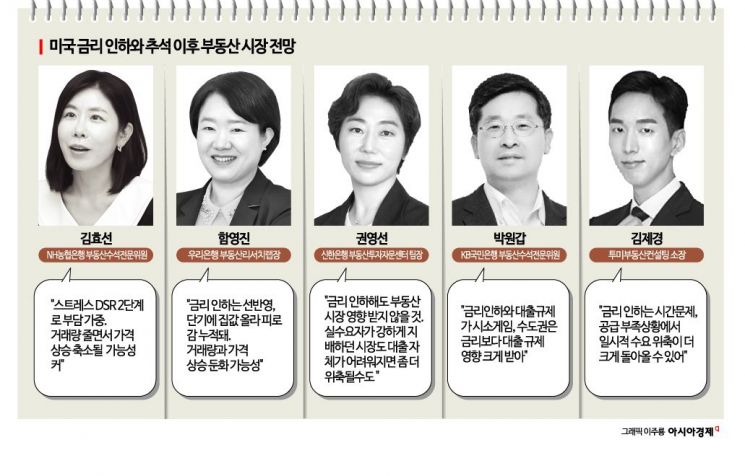
Kim Hyoseon, Senior Real Estate Specialist at NH Nonghyup Bank, said, "With the implementation of the second phase of the stress Debt Service Ratio (DSR) and the burden of rising real estate prices, coupled with loan regulations reducing transaction volumes, the price increase is likely to be limited. Areas on the outskirts of Seoul such as Nowon, Dobong, and Gangbuk are heavily affected by loan regulations, so unless loan interest rates are sharply lowered, the loanable amount will not differ much from before. The market is expected to maintain a wait-and-see atmosphere until the end of the year," she analyzed.
Since the end of last month, commercial banks have started tightening household loans, and the volume of apartment transactions in Seoul continues to decline. As of the 18th of last month, the number of apartment transactions in Seoul was 5,457, which is about 61% compared to the previous month (8,835). Although the Consumer Sentiment Index for the metropolitan housing market rose by 1.0 point to 120.4 compared to the previous month, maintaining an upward trend, the increase was smaller than the previous month's 4.9 points.
Ham Youngjin, Head of the Real Estate Research Lab at Woori Bank, said, "There is a possibility that Korea will cut its benchmark interest rate in October or November, but as the government has started managing the total volume of household loans, it has become difficult for multi-homeowners or gap investors to obtain jeonse loans." He added, "As seen with the implementation of the second phase of the stress DSR, loans will become more stringent." He continued, "Due to the pre-reflection of the interest rate cut trend, stricter loans, and accumulated fatigue from short-term housing price increases, housing transactions and price increases are likely to slow down. Even if transaction volumes recover slightly during the moving season, the upward trend will not be aggressive."
Since the expectation of an interest rate cut in the second half of this year was dominant, there seems to be no impact until the household loan policy direction changes significantly. Kwon Youngseon, Team Leader of the Real Estate Investment Advisory Center at Shinhan Bank, said, "Currently, the government's guideline is not to increase loans, and it will take more time to see how the US interest rate cut will be received in Korea and what guidelines will be presented."
Conflicting Outlooks for Next Year
Regarding the situation after next year, Team Leader Kwon analyzed, "The willingness to buy remains high, so despite rising loan interest rates, the strong desire to borrow has driven up real estate prices. However, if the DSR is further strengthened next year, borrowing itself may become difficult, potentially causing the market to contract somewhat." He added, "The current upward trend will likely continue, but it will be sluggish, hovering around a plateau."
Park Wongap, Real Estate Specialist at KB Kookmin Bank, said, "Interest rate cuts are expected to have more impact on non-Gangnam areas than Gangnam. The financial authorities applied higher stress DSR rates to metropolitan area mortgage loans in the second phase implemented in September. The metropolitan apartment market is heavily influenced by financial variables and relatively more affected by loan regulations." He explained, "Even if US interest rates are cut, the impact is likely to be greater on apartments in the outskirts of Seoul, Gyeonggi, Incheon, and other provinces."
On the other hand, Kim Jegyeong, Director of Toomi Real Estate Consulting, said, "Although buying sentiment is subdued due to loan regulations and immediate movement is difficult, a domestic interest rate cut is ultimately a matter of time." He explained, "Expectations and anxieties coexist, but if interest rates drop significantly, prices may rise from next year, and temporary demand contraction could later return as a bigger boomerang."
Experts advise selective approaches if actual buyers are considering purchases. Kim Hyoseon said, "Nationally, the market is stabilizing downward, and only some areas in Seoul have risen significantly, so there is no need to rush into purchases." However, she added, "The Nodobang area (Nowon, Dobong, Gangbuk) remains a buyer's market, and in other areas, buyers can enter when prices are deemed acceptable." Park Wongap said, "Even when buying apartments in popular Seoul areas, it is better to selectively approach properties with price merits."
Kim Jegyeong advised, "Although transactions were difficult in July and August, the market has now entered a breathing phase, which could be a buying opportunity. Within Seoul, areas like Mayongseong (Mapo, Yongsan, Seongdong) may offer opportunities with relatively new buildings, and areas such as Seodaemun, Dongdaemun, and Dongjak districts should be explored focusing on new constructions. It is also good to pay attention to places where prices have yet to recover by about 200 to 300 million KRW compared to previous peaks."
© The Asia Business Daily(www.asiae.co.kr). All rights reserved.
![Clutching a Stolen Dior Bag, Saying "I Hate Being Poor but Real"... The Grotesque Con of a "Human Knockoff" [Slate]](https://cwcontent.asiae.co.kr/asiaresize/183/2026021902243444107_1771435474.jpg)















