Measures Targeting China... Similar Export Control Countries Exempt from Permits
Permit Required for Exports to Korea but Impact Considered Limited
The U.S. government announced new export control measures on key advanced technologies such as quantum computing and next-generation semiconductors. In this process, a system was established allowing advanced technologies to be exported to countries with export control systems equivalent to those of the U.S. without U.S. government approval. However, South Korea was not included in this list.
On the 5th (local time), the U.S. Department of Commerce’s Bureau of Industry and Security (BIS) announced an "Interim Final Rule (IFR)" designating core new technologies such as quantum computing and advanced semiconductor manufacturing as export control targets.
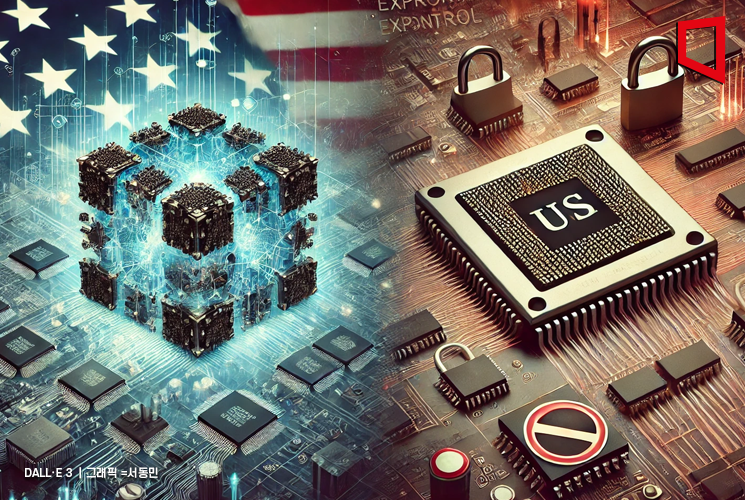
The controlled quantum computing technologies include quantum computers and related equipment, parts, materials, software, and technologies for developing and maintaining quantum computers. Tools and machinery essential for producing advanced semiconductor devices, gate-all-around (GAA) technology capable of producing or developing high-performance computer semiconductors used in supercomputers, and 3D printing technology capable of producing metal parts are also controlled.
Alan Estevez, U.S. Deputy Secretary of Commerce, stated, "Our national export controls are more effective when they keep pace with rapidly evolving technologies and cooperate with allies," adding, "Adjusting our control over quantum and other advanced technologies makes it more difficult for adversaries to develop and use these technologies."
This appears to be a strategy to preemptively block China from gaining technological hegemony in advanced technology fields together with allied countries. The U.S. has previously controlled exports of advanced semiconductors to China and has been considering additional measures.
BIS stated, "As core technologies for military use continue to emerge and develop, the need to regulate the movement of such items to prevent their use against national security or foreign policy interests is increasing."
BIS also announced that some countries have already introduced similar advanced technology export control systems, and established an 'Export Control Implementation Country (IEC)' exemption that allows exports of controlled items to these countries without U.S. government approval. On this day, a list of countries exempt from export licenses for 24 controlled items was released. For example, exports of 3D printing equipment to Italy, the United Kingdom, and the United States do not require approval. However, South Korea was not included in the list.
There are concerns that South Korean companies may face disadvantages compared to companies in IEC-exempt countries due to South Korea’s exclusion from the IEC exemption. However, it is also analyzed that the impact on South Korean companies will be limited, as the U.S. has reportedly set a policy to approve export license applications from South Korea.
BIS stipulated that for exports related to the controlled items in groups A:1, A:5, and A:6, the "presumption of approval" principle applies. South Korea belongs to groups A:1 and A:5, meaning that if it applies for export licenses to the U.S. government, they will be granted.
To be included in the IEC exemption countries, South Korea must also introduce export controls at a level similar to that of the U.S. The U.S. government has urged allies including South Korea to participate in export controls targeting China and Russia. South Korea is reorganizing its export control system, but it is known that the decision on whether to participate in semiconductor equipment export controls, which the U.S. emphasizes, is still under review.
Meanwhile, BIS applies the "presumption of denial" principle to countries included in D:1 or D:5, meaning that applications will not be approved; China is among these countries.
© The Asia Business Daily(www.asiae.co.kr). All rights reserved.
![Clutching a Stolen Dior Bag, Saying "I Hate Being Poor but Real"... The Grotesque Con of a "Human Knockoff" [Slate]](https://cwcontent.asiae.co.kr/asiaresize/183/2026021902243444107_1771435474.jpg)















