Space Cheong, 100-Day Launch Commemorative Press Conference
Completion of Space Transport System... Disclosure of Satellite Development Ecosystem and Space Exploration Plans
Yoon Young-bin, Administrator of the Korea Aerospace Agency, expressed his ambition to reduce the cost of launching satellites into low Earth orbit to around $1,000 per kilogram. He plans to confidently compete with SpaceX, which currently dominates the related market.
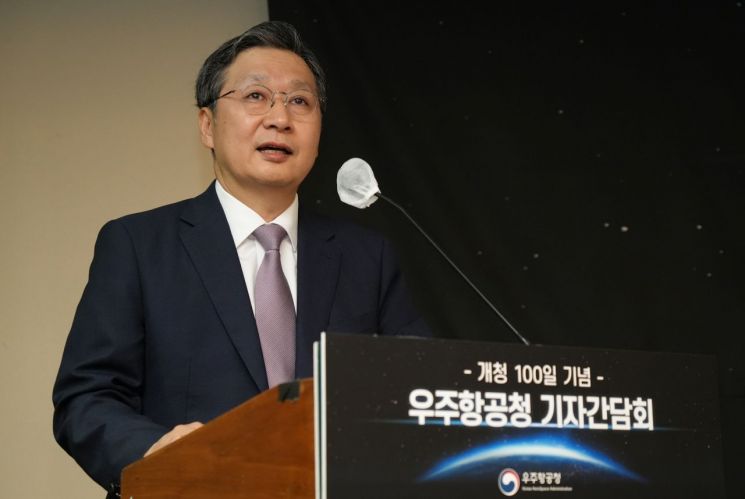 Yoon Young-bin, Administrator of the Space Aviation Agency, is speaking at a press conference commemorating the 100th day since the agency's opening on the 5th. Photo by Space Aviation Agency
At a press conference commemorating the 100th day since the establishment of the Korea Aerospace Agency held on the 5th at the Koreana Hotel in Seoul, Administrator Yoon stated, "The Korea Aerospace Agency aims to lower the transportation cost to low Earth orbit from the current $2,000 per kilogram to below $1,000 per kilogram."
Administrator Yoon also announced plans to achieve such low-cost space cargo transportation, build a space highway, develop orbital transport vehicles and re-entry spacecraft, and begin purchasing public satellite launch services starting in 2027. This is the so-called completion of the space transportation system.
He emphasized, "Currently, SpaceX charges between $2,000 and $2,500 per kilogram," and predicted, "If we achieve transportation costs to low Earth orbit below $1,000 per kilogram, it will lay the foundation for the growth of the space economy." Administrator Yoon stressed that developing reusable launch vehicles like SpaceX can achieve these costs.
The $1,000 per kilogram target set by the Korea Aerospace Agency is about 1/20th of the $24,000 per kilogram cost of Nuri, which was independently developed by Korea.
Development of orbital transport vehicles and re-entry spacecraft will also be pursued. After preliminary research and development in 2026, the goal is to complete a transportation system in the 2030s that freely travels between Earth and space, and between space and space. If this plan proceeds as intended, Korea will secure spacecraft similar to the Space Shuttle and Crew Dragon.
To secure satellite launch demand, the government will also begin purchasing public satellite launch services directly starting in 2027.
To foster the satellite development ecosystem, plans include developing full-scale 10cm resolution support synthetic aperture radar antennas, domestic production of electric thrusters for satellite constellation flight, and world-class Earth observation payloads.
Although excluded from next year’s budget, there is also a goal to launch an L4 exploration probe in 2025 based on international cooperation to establish the world’s first solar wind L4 space observatory.
The Korea Aerospace Agency plans to actively promote lunar exploration, where budget investment is concentrated. The lunar lander launch is scheduled for 2032, and the goal is to develop this as a sustainable and long-term plan rather than a one-time project.
For lunar base construction, necessary core missions will be pursued in connection with international cooperation, with gradual preparations to extend to Mars exploration. However, Administrator Yoon explained that specific plans for the "Space Gwanggaeto Plan," which aims to land on Mars by 2045, have not yet been concretely established.
Administrator Yoon also stated that he will visit the United States later this month to meet with NASA Administrator Bill Nelson to strengthen strategic partnerships and enhance international cooperation.
On this day, Administrator Yoon appeared to refute criticisms about the lack of specialized personnel at the Korea Aerospace Agency, explaining that among about 150 members, 16% hold doctoral degrees and 34% hold master's degrees, while in the mission headquarters, the proportions are much higher at 43% doctoral and 35% master's degrees.
Administrator Yoon said, "Since its opening, the Korea Aerospace Agency has worked as hard as a venture company," and added, "We will lead national development and regional innovation in the new space era."
© The Asia Business Daily(www.asiae.co.kr). All rights reserved.
![Clutching a Stolen Dior Bag, Saying "I Hate Being Poor but Real"... The Grotesque Con of a "Human Knockoff" [Slate]](https://cwcontent.asiae.co.kr/asiaresize/183/2026021902243444107_1771435474.jpg)















