4 Trillion Won Loss Due to Invasive Species
Compensation of 590 Won per 1kg Caught Proposed
In Thailand, the rapid increase of the invasive fish species 'Blackchin Tilapia' is causing headaches for authorities. Especially as this species, known for its strong reproductive ability, spreads quickly, the Thai government has determined that economic losses amounting to hundreds of billions of won have occurred.
On the 4th (local time), foreign media such as BBC and the Bangkok Post reported that Blackchin Tilapia is rapidly spreading through waterways across Thailand. According to the reports, it has been found in 19 out of 76 provinces in Thailand so far, and experts have begun research to identify the causes of the spread of this invasive species.
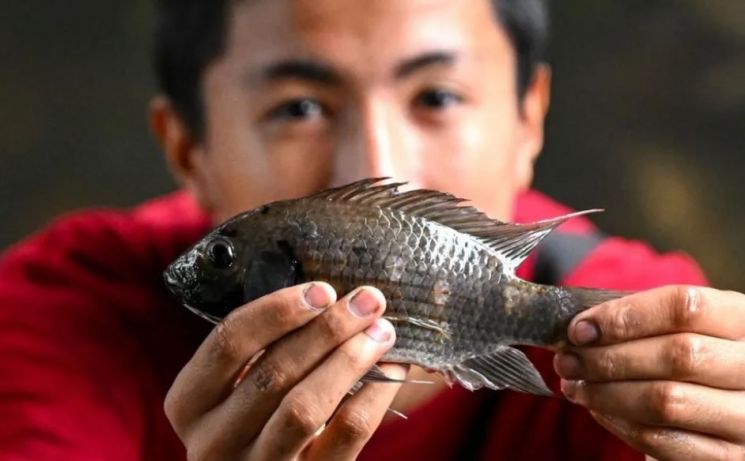
Tilapia is a freshwater fish native to Africa that adapts well even to dirty water, living in freshwater of grades 3 to 4. Blackchin Tilapia is a type of tilapia, with a lot of lean meat making it suitable for consumption, but it disrupts ecosystems by feeding on small fish, shrimp, and snail larvae. Its excellent reproductive ability is also a problem. Blackchin Tilapia females can lay up to 500 eggs at one time.
Natacha Bunchaiinsawat, Vice Chairman of the 'Blackchin Tilapia Countermeasure Committee' in the Thai Parliament, told the BBC, "We need to closely monitor this phenomenon," adding, "Otherwise, we will pass on this environment to the next generation." He emphasized, "We will not hand over a devastated ecosystem to the next generation." Representative Natacha estimated that the economic loss caused by Blackchin Tilapia to the Thai economy is at least 10 billion baht (approximately 396.4 billion won).
Ultimately, the Thai government declared a 'war against Blackchin Tilapia.' They also decided to operate a reward system that provides 15 baht (about 588 won) compensation for every 1 kg of the fish caught. Additionally, to control the population, genetically modified Blackchin Tilapia that cannot reproduce will be released into rivers around the end of this year.
However, it is uncertain whether the population can be controlled despite these efforts. Dr. Non Panitbong, a Thai ichthyologist and freshwater ecosystem expert, pointed out, "The problem with invasive species is that once they establish themselves in nature, it is very difficult to eradicate them."
© The Asia Business Daily(www.asiae.co.kr). All rights reserved.
![Clutching a Stolen Dior Bag, Saying "I Hate Being Poor but Real"... The Grotesque Con of a "Human Knockoff" [Slate]](https://cwcontent.asiae.co.kr/asiaresize/183/2026021902243444107_1771435474.jpg)
















