South Korea's Q2 Economic Growth Rate at -0.2%
Among the Lower Ranks of OECD Countries
Strong Exports but Significant Domestic Demand Concerns
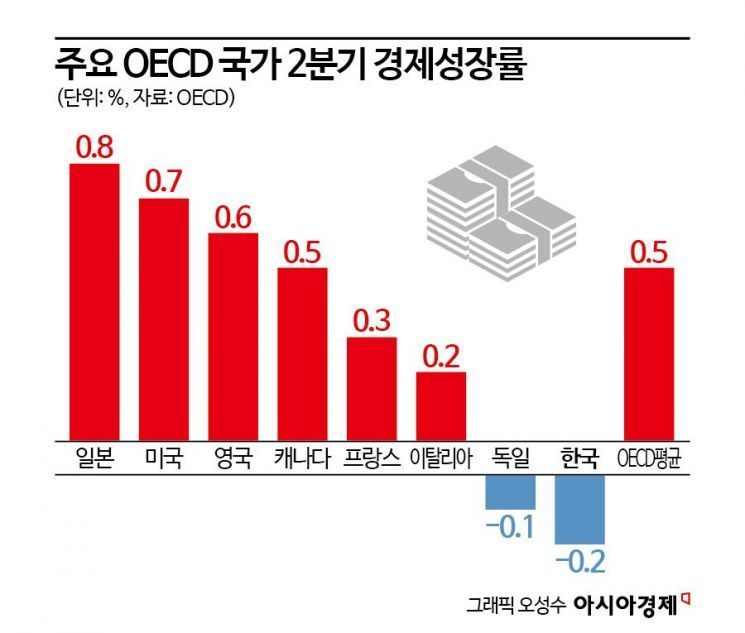
In the second quarter, South Korea's economy contracted, causing its economic growth rate ranking within the Organisation for Economic Co-operation and Development (OECD) to drop significantly. Although exports continued to improve, the sluggish domestic demand is expected to slow the pace of economic recovery more than anticipated.
According to OECD statistics released on the 30th, South Korea's second-quarter economic growth rate was -0.2% quarter-on-quarter, ranking 30th among the 33 OECD member countries that reported statistics. Only Latvia (-1.1%), Sweden (-0.8%), and Chile (-0.6%) had lower growth rates than South Korea in the second quarter.
By country, Poland had the highest growth rate at 1.5%, followed by Norway at 1.4%, Ireland and Costa Rica at 1.2%, and the Netherlands at 1.0%, placing them in the top ranks.
Among the G7 advanced economies, Japan recorded the highest growth at 0.8%, followed by the United States at 0.7%, the United Kingdom at 0.6%, Canada at 0.5%, France at 0.3%, Italy at 0.2%, and Germany at -0.1%. The overall OECD average was 0.5%.
South Korea's second-quarter economic growth rate was worse than market expectations. While exports continued to improve, weak domestic demand, including private consumption and investment, had a negative impact. Private consumption in the second quarter fell by 0.2% compared to the previous quarter, and facility investment dropped by 2.1%.
However, the Bank of Korea explained that the second-quarter economic slowdown was a temporary effect due to the base effect from the first quarter, when South Korea's economic growth rate was 1.3%, significantly exceeding expectations. In fact, among OECD countries, only Israel, T?rkiye, and Chile had higher economic growth rates than South Korea in the first quarter.
The Bank of Korea forecasts that the South Korean economy will grow by 0.5% in the third quarter, recovering from the contraction in the previous quarter. The expected economic growth rate for this year was revised downward by 0.1 percentage points from 2.5% to 2.4%.
Exports are also expected to continue improving in the third quarter, but domestic demand is projected to recover slowly. In particular, concerns have been raised that the recent rise in housing prices, which has significantly increased household debt, could constrain the recovery of private consumption. At the end of the second quarter, the household credit balance reached a record high of 1,896.2 trillion won, surging by 13.8 trillion won from the first quarter. Excessive household debt growth negatively affects consumption.
In fact, according to the 'July Industrial Activity Trends' released by Statistics Korea on the same day, the total industrial production index decreased by 0.4% from the previous month. The decline was largely due to a 3.6% drop in manufacturing production and a 1.9% decrease in retail sales. The Korea Development Institute (KDI) also assessed in its August economic outlook that "domestic demand remains weak, limiting economic improvement."
© The Asia Business Daily(www.asiae.co.kr). All rights reserved.
![Clutching a Stolen Dior Bag, Saying "I Hate Being Poor but Real"... The Grotesque Con of a "Human Knockoff" [Slate]](https://cwcontent.asiae.co.kr/asiaresize/183/2026021902243444107_1771435474.jpg)















